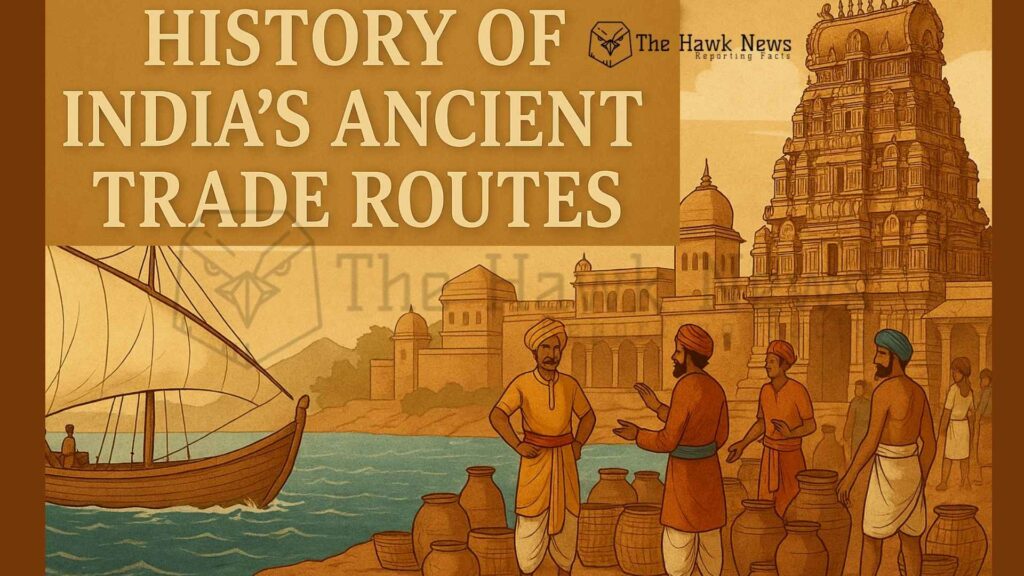
When we think of India’s glorious past, images of majestic palaces, intricate temples, and epic battles often come to mind. Yet, one of the most profound forces shaping India’s history—the extensive network of ancient trade routes connecting its kingdoms to the wider world—often remains overlooked.
These trade routes, particularly those across the Indian Ocean, were not just commercial lifelines but conduits of culture, religion, technology, and diplomacy. They elevated empires like the Vijayanagar and the Chola Dynasty into global players long before the European colonial era.
The Indian Ocean: The Superhighway of the Ancient World
Unlike land-based Silk Routes, which connected China to the Mediterranean, India’s Indian Ocean trade network offered vast, navigable maritime routes linking the subcontinent to East Africa, the Middle East, Southeast Asia, and beyond. Ancient Indian sailors mastered monsoon winds, allowing predictable seasonal voyages.
Ports like Muziris on the Malabar Coast, Calicut, and later Surat were bustling cosmopolitan hubs where merchants, scholars, and travelers converged.
These maritime corridors were essential for trading spices, textiles, gemstones, ivory, and precious metals. Indian pepper, cardamom, and cinnamon became luxury commodities abroad, while Indian cotton textiles and silk were coveted in regions as distant as the Roman Empire, Egypt, and Arabia.
In return, Indian ports received gold, silver, horses, and luxury goods that enriched local economies and supported monumental architectural projects.
Vijayanagara Empire: A Hub of Economic and Cultural Exchange
The Vijayanagara Empire (1336–1646 CE), based in southern India, exemplifies the synergy between trade and cultural grandeur.
The empire’s rulers strategically promoted commerce, creating thriving urban centers that combined economic might with artistic brilliance. Hampi, the empire’s capital, became a hub where traders from Persia, Arabia, and Southeast Asia met local merchants, exchanging goods, ideas, and technologies.
Vijayanagara’s wealth was not merely material. Trade revenue funded the construction of temples, fortifications, and reservoirs, reflecting a sophisticated understanding of urban planning and architecture.
These commercial interactions also facilitated cultural diffusion: South Indian temple architecture influenced Southeast Asian styles, while Hindu and Buddhist ideas traveled alongside merchandise. The empire’s administration, with its taxation and revenue systems, demonstrates how trade underpinned political stability and statecraft.
Chola Dynasty: Maritime Supremacy
Long before the Vijayanagara Empire, the Chola Dynasty (9th–13th century CE) dominated maritime trade across the Indian Ocean. Chola rulers deployed naval fleets to protect trade routes and establish diplomatic relations with distant kingdoms.
Their influence reached Sri Lanka, the Maldives, and even parts of Southeast Asia, including the Indonesian archipelago.
Chola trade was pivotal in spreading Indian culture abroad. Temples built in Southeast Asia echo South Indian architectural styles; Sanskrit inscriptions and Hindu-Buddhist practices spread along trade corridors.
These exchanges underscore the dual nature of commerce in India’s history: it was both an economic engine and a cultural bridge connecting continents.
Economic Significance of Trade Routes
Ancient Indian trade routes fueled the economy in multiple ways. They created wealth for local rulers, offered employment for artisans and laborers, and established India as a critical node in a vast global network.
The exchange of goods also encouraged technological and industrial innovations—textile weaving, shipbuilding, metallurgy, and navigation all advanced in response to trade demands.
Port cities often functioned as melting pots of culture, where merchants from diverse backgrounds mingled with locals.
Archaeological discoveries at sites like Pattanam (believed to be Muziris) reveal Roman amphorae, coins from various kingdoms, and a range of exotic goods, highlighting India’s interconnectedness with the ancient world.
Cultural and Religious Exchange
Trade was not merely about wealth; it was a channel for cultural and religious diffusion. Indian religions, particularly Hinduism and Buddhism, traveled to Southeast Asia along trade routes. Temples, scripts, languages, and art forms followed merchants to foreign lands.
Conversely, Indian ports absorbed influences from Persian, Arab, and East African traders, creating multicultural societies that were vibrant, tolerant, and innovative.
Modern Perspectives and Rediscovery
Recent archaeological research and maritime studies have brought renewed attention to these forgotten trade routes. Excavations in Kerala, Tamil Nadu, and along the eastern coast have uncovered remnants of ancient ports, coins, and trade artifacts, offering tangible proof of India’s maritime prowess.
Historians argue that understanding these networks helps contextualize India’s enduring global influence and its role in early globalization.
Moreover, modern India is increasingly recognizing its maritime heritage. Cultural festivals, heritage tourism in places like Hampi and Muziris, and research projects mapping ancient trade routes are helping revive interest in this history.
Contemporary parallels are clear: India’s participation in global trade today mirrors, in spirit, the ancient networks that once made it a central hub of commerce, culture, and innovation.
Lessons from the Past
India’s ancient trade routes offer enduring lessons. They remind us that connectivity—economic, cultural, and intellectual—has always been a driver of progress. They highlight the importance of adaptability, innovation, and openness in sustaining empires and economies.
The routes also demonstrate that commerce and culture are inseparable; thriving economies encourage art, religion, literature, and technology.
In a world increasingly focused on globalization, revisiting these maritime networks is not merely an academic exercise. It underscores India’s long-standing role as a bridge between continents, a center of trade, and a crucible of cultural exchange.
Understanding this history enriches our appreciation of India’s place in the world and inspires efforts to preserve and promote its ancient heritage.
Conclusion
The story of India’s ancient trade routes is one of ambition, ingenuity, and far-reaching influence. From the bustling ports of the Malabar Coast to the grandeur of the Vijayanagara Empire and the naval supremacy of the Cholas, these networks were the lifeblood of India’s economy and culture.
They shaped cities, inspired architecture, spread religions, and connected India to the broader world in ways that resonate even today.
Rediscovering and celebrating this legacy is crucial—not just to honor the past, but to understand how trade, culture, and connectivity have continually propelled India forward.
As modern scholars and tourists explore ancient ports and empires, the once-forgotten maritime highways of India remind us of a time when the subcontinent was not just a land of kingdoms but the beating heart of a connected, globalized ancient world.