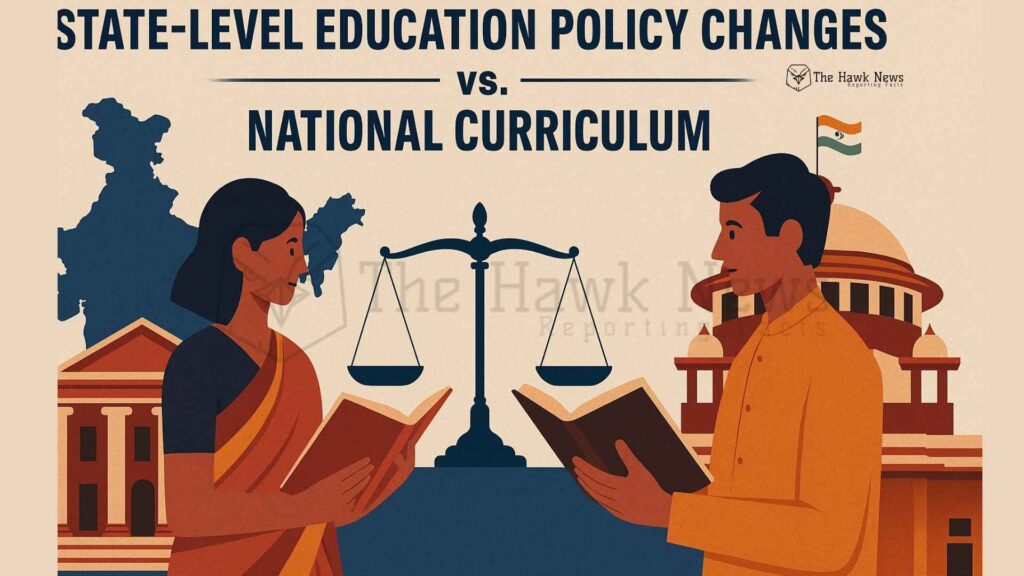
Education in India has never been merely about classrooms and syllabi—it has always been deeply political. At the heart of the current debate is a clash between state-level autonomy in shaping education policies and the central government’s push for uniformity through the National Education Policy (NEP 2020).
Nowhere is this tension clearer than in Tamil Nadu, where the state’s two-language policy directly conflicts with the NEP’s three-language framework. The tussle reflects broader issues of federalism, cultural identity, and governance, with implications that stretch far beyond education into the realms of politics and society.
The Federal Structure and Education
India’s Constitution places education on the Concurrent List, which means both the central and state governments can make laws on it. While the central government can set broad national frameworks, states retain the power to adapt or reject aspects that don’t align with local priorities. This unique arrangement has created space for diversity, but it has also fueled conflicts whenever the center attempts standardization.
Historically, language has been a flashpoint. From the anti-Hindi agitations in Tamil Nadu during the 1960s to today’s debates over curriculum and medium of instruction, education has been as much about identity and politics as about learning. Tamil Nadu, in particular, has consistently rejected any attempt to impose Hindi, preferring its two-language formula (Tamil and English) over the three-language model promoted by the center.
The NEP’s Push for Standardization
The National Education Policy 2020 was hailed as a landmark reform, promising flexibility, holistic learning, and a global outlook. However, one of its most controversial aspects remains the three-language policy, which recommends students learn two Indian languages plus English. The center has argued this will promote multilingualism, cultural exchange, and national unity.
Yet, in practice, this policy has run into stiff resistance. Tamil Nadu’s leaders—across party lines—have opposed it, framing it as a threat to the state’s linguistic identity. The ruling DMK government has reiterated its commitment to the two-language policy, emphasizing that Tamil and English are sufficient for both cultural preservation and global competitiveness. Other southern states like Kerala and Andhra Pradesh have echoed similar concerns, though with less intensity.
Tamil Nadu’s Defiance: A Case Study
In September 2024, Tamil Nadu once again formally rejected the NEP. Chief Minister M.K. Stalin declared that the state would pursue its own State Education Policy, crafted to reflect Tamil Nadu’s unique social and linguistic context. The move has political weight—resonating strongly with voters who view language as an integral part of their identity.
The conflict is not just about language but also about control. By asserting its own education policy, Tamil Nadu is making a broader political statement: that states must retain autonomy in deciding how children are taught. For a state that has long prided itself on social justice-driven education policies—like midday meals and reservations—this is also about safeguarding its progressive legacy.
Other States Push Back Too
Tamil Nadu is not alone. States like West Bengal, Kerala, and Telangana have raised concerns about NEP implementation. While some objections are about language, others focus on structural and financial challenges. For instance, NEP calls for a 5+3+3+4 model of schooling, which requires significant infrastructural upgrades. Many states argue that the center has not committed enough resources to support such changes.
Additionally, some states worry that a uniform curriculum could erode regional histories, cultures, and languages, replacing them with a homogenized narrative. Educationists in West Bengal have particularly criticized the lack of emphasis on regional literature and culture in centrally designed frameworks.
The Political Divide
What makes this debate more heated is its political undertone. For opposition-led states, resisting the NEP is not just about education—it is also about challenging the BJP-led central government’s perceived overreach. Education becomes an electoral issue, symbolizing the larger struggle between regional autonomy and central authority.
The BJP, on the other hand, frames the NEP as a modernizing reform that will elevate India’s education system globally. Party leaders argue that a common framework ensures national cohesion and equal opportunity, particularly for students in competitive exams and global job markets.
Thus, the education debate is also a proxy battleground for politics: a struggle over who gets to shape the future of India’s youth.
Implementation Challenges
Beyond politics, the clash creates practical challenges. Schools often find themselves caught between competing mandates. Should they follow state orders or align with central directives, especially when preparing students for national exams like JEE, NEET, or UPSC?
Teacher training, funding, and infrastructure add further complexity. Implementing NEP reforms requires massive investment—from upgrading early childhood education centers to revamping curricula and assessment methods. Many states argue they cannot implement these changes without substantial central funding, which has not been forthcoming at the promised scale.
The result is a patchwork education system, where students’ experiences and opportunities differ widely depending on their state.
Recent Flashpoints
Several recent developments highlight the intensity of the debate:
- Tamil Nadu (2024): The state government announced it would draft its own State Education Policy, firmly rejecting NEP’s language mandates.
- Kerala (2023–24): Education officials criticized NEP for ignoring state-specific curricula and focusing too heavily on central control.
- National Exams: States continue to question whether uniform testing systems disadvantage students taught under different frameworks.
These flashpoints underscore the fact that education is no longer a quiet policy domain—it is now a frontline political issue.
Expert Perspectives
Education experts are divided. Some argue that a uniform curriculum is necessary to ensure students across India have equal opportunities, especially in an increasingly competitive global environment. Others caution that over-centralization risks alienating states and undermining India’s rich cultural diversity.
Dr. Anita Rampal, a noted educationist, has pointed out that while NEP emphasizes holistic learning, its top-down approach risks ignoring ground realities. Meanwhile, political analysts note that states’ resistance is not merely symbolic—it reflects a genuine push to preserve local identities in the face of centralization.
Wider Implications
The stakes go beyond classrooms. The outcome of this tug-of-war will influence:
- Student mobility: Will students moving between states face hurdles due to differing policies?
- National competitiveness: Can India compete globally without a standardized system?
- Federal balance: Does the NEP strengthen or weaken India’s federal structure?
If unresolved, the conflict could lead to further fragmentation in the education system, with long-term consequences for equity and quality.
The Road Ahead
A possible middle ground may lie in adopting a flexible federal model—where the center sets broad national goals, but states retain the freedom to adapt implementation based on local needs. Collaboration, rather than confrontation, could allow India to balance its diversity with the need for standardization.
For now, however, the battle lines remain firmly drawn. Tamil Nadu’s rejection of the NEP has reignited the language wars of the past, reminding India that education is not just about knowledge—it is about identity, power, and politics.
Conclusion
The debate over education policy in India reveals a deeper truth: that education is inseparable from politics. Whether it is Tamil Nadu defending its two-language policy or the center pushing for NEP, the struggle is fundamentally about who controls the narrative of India’s future.
As India marches toward becoming a global economic and knowledge powerhouse, the question remains: Will education unite or divide? The answer may well shape not only the classrooms of tomorrow but also the very fabric of Indian democracy.