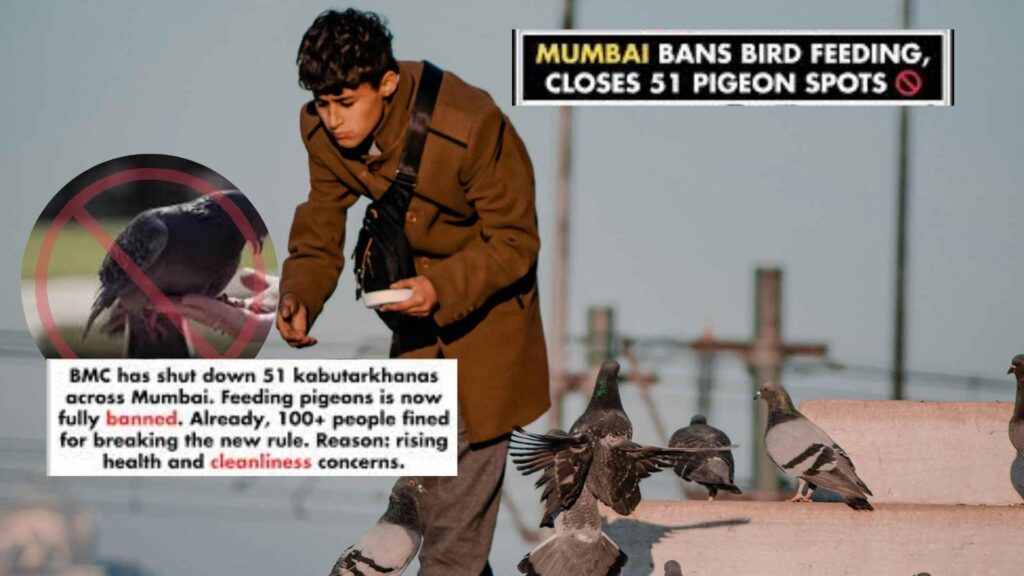
Mumbai is a city of contradictions—where skyscrapers rise above centuries-old shrines, and modern policies often brush against traditions deeply rooted in faith.
The recent Bombay High Court ruling that pigeon feeding constitutes a “public health hazard” has stirred one of the city’s fiercest debates in years, pitting civic order and science against spiritual devotion.
A Tradition That Feeds More Than Birds
For generations, Mumbai’s “Kabutarkhanas”—dedicated pigeon-feeding enclosures—have been woven into the city’s cultural fabric. For many Hindus, feeding pigeons is considered a sacred act, believed to bring merit and ward off misfortune. The practice also finds resonance in Islamic and Jain traditions, where feeding animals is an extension of compassion and service.
At busy crossroads in Dadar, Byculla, and Mohammed Ali Road, thousands of pigeons swoop down daily as devotees scatter grains. For the feeders, this ritual is as much about faith as it is about community. “Feeding pigeons is part of who we are,” said a resident protester outside one Kabutarkhana. “It is our way of showing kindness to God’s creatures.”
The Court Steps In
But what devotees see as an act of compassion, doctors and civic officials increasingly view as a public menace. Acting on years of complaints, the Bombay High Court in July 2025 ruled pigeon feeding to be a “public nuisance and a health hazard”, directing authorities to strictly regulate the practice.
The court cited mounting evidence linking pigeon droppings and feathers to respiratory illnesses such as hypersensitivity pneumonitis, fungal infections, and asthma. “No citizen’s faith can come at the cost of another citizen’s right to health,” the bench observed, calling on the Brihanmumbai Municipal Corporation (BMC) to enforce the order by penalizing violators.
The result was swift: police filed FIRs against individuals feeding pigeons in defiance of the ban, while civic squads began dismantling unauthorized Kabutarkhanas.
Faith Meets Resistance
The backlash was immediate. Hundreds of citizens, many of them elderly devotees, staged protests across South Mumbai, calling the ban “an attack on religion.” Religious groups argued that the court’s directive disregarded centuries of tradition. Some even likened it to policing prayer itself.
“Pigeons have lived with us in harmony for centuries. Why is the government suddenly calling them dangerous?” asked one protestor in Dadar, holding a placard reading “Faith, Not Fines.”
Adding to the chorus, several political leaders waded into the controversy, accusing the state of bowing to “hyper-scientific elitism” while ignoring grassroots beliefs. The protests gained momentum on social media, where hashtags like #SaveKabutarkhana and #FaithNotFines trended for days.
The Science Behind the Ban
Medical experts, however, insist the court’s stance is based on solid science. Studies have shown that pigeon droppings harbor pathogens such as Histoplasma and Cryptococcus, fungi that can cause serious lung infections. Feathers and dried droppings, when airborne, have been linked to bird fancier’s lung, a hypersensitivity disorder that leaves patients struggling to breathe.
“Many of our patients with chronic respiratory problems live near Kabutarkhanas,” said Dr. Rajeshwari Prabhu, a pulmonologist at Mumbai’s KEM Hospital. “They are not imagining the problem—it is real, measurable, and preventable.”
A recent Maharashtra government-appointed panel has now been tasked with conducting a comprehensive study on the health impacts of pigeon-related exposure.
Governance on the Edge
Caught between faith and health, the BMC has struggled to enforce the ban without sparking further unrest. Officials argue that uncontrolled pigeon populations pose not only health risks but also urban challenges—corroded buildings, blocked drains, and increased cleaning costs.
Yet, the optics of dragging away elderly devotees feeding pigeons have backfired. Critics accuse the state of lacking sensitivity and failing to engage communities in dialogue before rolling out harsh penalties.
Global Lessons in Bird Control
Mumbai is not alone in its pigeon dilemma. Venice famously banned pigeon feeding in St. Mark’s Square in 2008 after centuries of tradition, citing damage to monuments and health concerns. Barcelona enforces fines for feeding pigeons outside regulated zones. London deploys hawks to keep Trafalgar Square’s population under control.
These cities, experts argue, offer valuable lessons: control need not mean cruelty. Instead, structured feeding zones, sterilization programs, and community awareness can gradually shift public behavior without igniting cultural wars.
Searching for Middle Ground
Even some devotees acknowledge the risks but insist the solution should be dialogue, not bans. Suggestions have emerged for creating designated, medically safe pigeon-feeding areas away from dense residential zones. Others call for educational campaigns that explain the health risks while respecting faith.
Animal rights activists, meanwhile, stress that pigeons themselves are not at fault. “It’s about balance,” said an activist with People for Animals. “We must respect human health while also respecting the birds.”
What This Reveals About Modern India
At its core, the pigeon-feeding controversy is not just about birds—it is about how India’s cities navigate the tension between tradition and modernity. As urban centers grapple with public health challenges, civic bodies will increasingly be forced to confront practices that were once unquestioned.
In Mumbai, a city that thrives on both devotion and pragmatism, the road ahead lies in compromise: honoring faith while embracing science. The High Court’s intervention may have lit the fuse, but how the city resolves the conflict could set a precedent for India’s urban future.