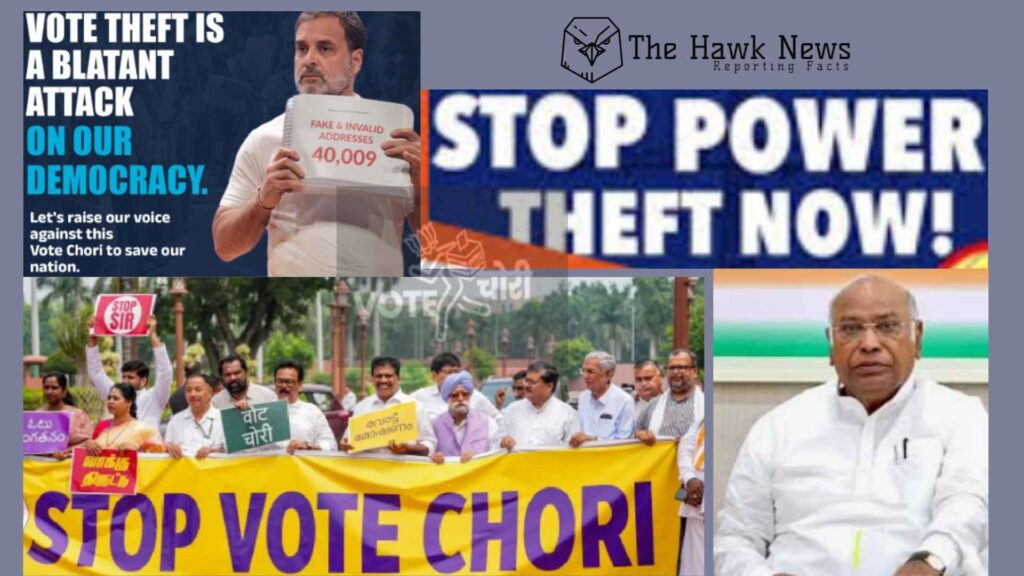
The corridors of Indian politics are buzzing again with a sharp phrase that has already set the tone for Parliament’s monsoon session. Mallikarjun Kharge, the Leader of Opposition in the Rajya Sabha and Congress President, has accused the BJP government of committing “satta chori”—power theft.
The remark comes in response to the Union government’s newly tabled “remove ministers” bills, which propose mechanisms for recalling or disqualifying ministers based on parliamentary votes or performance-based reviews.
At first glance, the proposals might seem like a technical tweak in governance. But scratch the surface, and a larger political storm brews: What does this mean for federalism? Are democratic institutions being strengthened, or strategically re-engineered for political dominance?
The “Remove Ministers” Bills: A Break from Tradition?
The bills, introduced in the Lok Sabha earlier this week, outline provisions to allow a parliamentary majority—or, in some cases, the Prime Minister’s recommendation—to formally recall sitting Union ministers. Supporters argue this could improve accountability, streamline governance, and ensure ministers remain effective.
Critics, however, view it as a radical reimagining of cabinet stability. By giving more structured mechanisms for dismissing ministers outside the Prime Minister’s direct prerogative, the Opposition fears this could become a tool to reshuffle power aggressively and weaken political opponents even within the ruling coalition.
“This is not about accountability—it’s about centralization,” a senior Opposition MP told The Hawk News. “The government is weaponizing procedure to cement control.”
Kharge’s Charge: From “Vote Chori” to “Satta Chori”
Kharge’s phrase “satta chori” is not accidental. It builds on the Congress’s earlier narrative of “vote chori” (vote theft), used repeatedly since 2019 to allege electoral manipulation, EVM tampering, and misuse of investigative agencies to destabilize Opposition-led state governments.
By linking the two, Kharge is signaling that the BJP is not merely contesting elections aggressively—it is reshaping the very rules of governance to retain and consolidate power.
“This government first stole votes, now it wants to steal institutions,” Kharge thundered in the Rajya Sabha. “These bills are a dagger at the heart of parliamentary democracy.”
BJP’s Defense: “A Step Toward Accountable Governance”
For its part, the BJP has defended the bills as a progressive reform. Party spokespersons argue that India’s governance must evolve with the times, and ministers who fail in performance or lose parliamentary trust should not remain in office merely out of convention.
“This is about empowering Parliament, not weakening it,” said a BJP strategist. “Kharge is clinging to outdated traditions. The people deserve a government where accountability is built into the system, not where ministers hide behind seniority or political shielding.”
In closed-door conversations, BJP insiders also highlight that similar recall provisions exist in local governments in states like Madhya Pradesh and Chhattisgarh. The central government, they argue, is only scaling up a mechanism already tested at grassroots levels.
A Constitutional and Federal Question
Beyond the immediate politics, constitutional scholars warn that such bills touch upon the delicate balance of power between the executive and legislature.
“The Indian parliamentary system, inherited from Westminster, vests dismissal of ministers squarely in the Prime Minister’s prerogative,” notes Dr. Sunil Arora, a constitutional expert at Delhi University. “Altering this equation risks creating parallel centers of power—or worse, eroding collective cabinet responsibility.”
Moreover, the Opposition fears the implications for federalism. If such mechanisms expand from Union ministries to state cabinets, it could tilt power further toward the Centre, allowing ruling coalitions to exert disproportionate pressure on regional leaders.
Historical Echoes: Lessons from the Past
India’s democracy has seen similar flashpoints before. During the Emergency (1975–77), constitutional structures were bent to consolidate authority. Later, the anti-defection law of 1985 sought to curb political instability but has since been criticized for curbing free legislative debate.
“In India, every major institutional reform has had unintended consequences,” says Prof. Madhavi Joshi, a political historian. “The recall of ministers sounds democratic on paper, but in practice, it could be used to enforce party discipline with an iron hand.”
The Political Chessboard: What’s at Stake in 2025
The timing of these bills is also politically loaded. With several state elections due later this year and the BJP eyeing a third consecutive Lok Sabha term in 2029, the narrative of “power theft vs. accountability” could shape voter perceptions.
For the Opposition, Kharge’s framing of “satta chori” is an attempt to reclaim lost ground, especially as regional allies grow wary of aligning too closely with the Congress. For the BJP, the bills offer a way to project reformist zeal—positioning itself as the party of modernization against what it calls the Opposition’s “status quo mentality.”
But in the process, India’s democratic fabric is once again under stress—caught between the competing pulls of efficiency and representation, centralization and federalism, majority power and minority rights.
A Global Perspective: Are Democracies Redesigning Institutions?
India is not alone in rethinking political accountability. In recent years, the UK has debated reforms around ministerial accountability, while the US continues to wrestle with executive overreach. Globally, democracies are experimenting with institutional redesigns to adapt to polarization and voter dissatisfaction.
Yet, as analysts caution, such redesigns must not come at the cost of undermining trust. “Democracy is not only about outcomes, but also about the processes,” says Prof. Joshi. “When rules are rewritten mid-game, the suspicion of manipulation always lingers.”
Conclusion: A New Battleground for Indian Democracy
Mallikarjun Kharge’s phrase “satta chori” has already entered the lexicon of Indian politics. Whether it becomes a rallying cry for a resurgent Opposition or fades into the echo chamber of Parliament remains to be seen.
But the larger battle is clear: India is entering a phase where democratic institutions themselves are the battlefield. From electoral reforms to parliamentary procedures, from federal equations to cabinet responsibilities, the fight is not only over who governs—but how governance itself is defined.
As the monsoon session unfolds, one thing is certain: the charge of “power theft” will shape headlines, political strategies, and perhaps even the contours of India’s democracy for years to come.