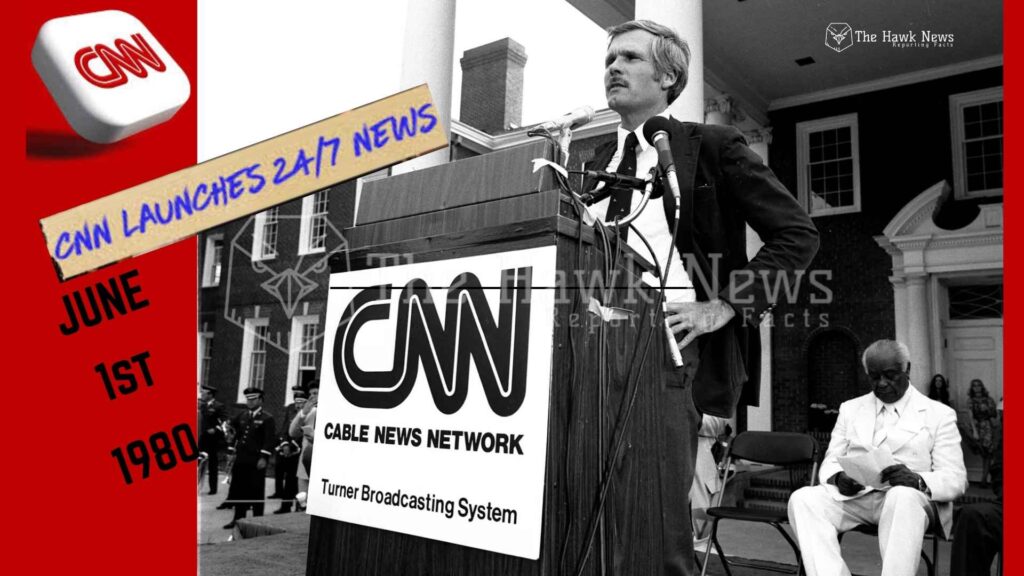
The world changed quietly on June 1, 1980.
In a modest Atlanta newsroom, two anchors — David Walker and Lois Hart — appeared on television screens across America.
Their words were simple:
“Good evening, I’m David Walker.”
“And I’m Lois Hart. Here’s the news.”
Few realized that those opening lines marked a revolution. That night, CNN — the Cable News Network — went live, promising something the world had never seen before: news, all day, every day.
It was the birth of the 24-hour news era, a turning point that would forever alter how humanity receives, reacts to, and remembers the truth.
A Vision Born in the South
The mind behind it all was Robert Edward “Ted” Turner III — a man as bold as the idea he carried.
At a time when the big three networks — ABC, NBC, and CBS — ruled American living rooms with fixed news hours, Turner envisioned a channel that never went dark.
His mission wasn’t just commercial. It was democratic.
He once said, “We won’t just cover history — we’ll catch it as it happens.”
Critics laughed. Rival executives called him “Turner the Burner.”
Who would watch news at 3 a.m.?
But Turner wasn’t listening to the laughter — he was listening to the future.
He sensed that a world growing faster each decade needed a voice that matched its speed.
And so, from a humble building in Atlanta, with a crew of only 300 and a fraction of a major network’s budget, CNN took its first breath.
Changing the Clock of Truth
Before CNN, news had a rhythm.
You read the morning paper, tuned in at six for the evening bulletin, and perhaps caught a nightly wrap-up before bed.
Information was scheduled.
CNN broke the clock.
Suddenly, the world’s heartbeat pulsed through a 24-hour cycle.
Breaking news became truly breaking.
Disasters, elections, wars, and triumphs were no longer stories that waited — they were events unfolding before your eyes.
Satellite technology made it possible, but conviction made it happen.
Ted Turner and his team believed that truth should have no timetable.
The Doubters and the Dreamers
In its early years, CNN stumbled more than once.
Technical glitches, modest viewership, and financial strain made skeptics smirk.
Yet Turner pressed on, guided by the same faith that fuels all pioneers — the belief that if something serves the public good, time will serve it back.
The turning point came in 1991, during the Gulf War.
While traditional networks struggled to get footage, CNN had reporters Bernard Shaw, Peter Arnett, and John Holliman broadcasting live from Baghdad as bombs fell.
For the first time, the world saw war in real time — the flashes, the fear, the silence between explosions.
That night, CNN wasn’t just reporting the story. It became the story.
From then on, “as seen on CNN” became shorthand for immediacy, authenticity, and impact.
The Human Engine Behind the Screens
The 24-hour model demanded more than cameras and cables — it demanded people who never slept.
Producers, correspondents, camera operators — all driven by the same mantra: “Be first, but be right.”
For them, journalism was no longer a shift. It was a calling.
Days blurred into nights, deadlines into lifelines.
Yet amid the fatigue, there was purpose.
“In the race against time, integrity must be the compass.”
That unspoken rule defined CNN’s DNA.
They were building not just a network, but a new ethic — that the public has the right to know, and to know now.
A Global Awakening
CNN’s rise triggered a domino effect across the world.
Soon, the BBC expanded its global service; Al Jazeera, Sky News, and Fox News followed.
What began as a single channel in Atlanta became the model for real-time global communication.
Diplomats watched CNN before issuing statements.
Presidents monitored it during crises.
Ordinary citizens in faraway lands found themselves witnessing the same moments simultaneously.
The planet had become smaller — a shared living room linked by light and satellite.
The Double-Edged Lens
But every revolution bears its shadows.
The constant hunger for “now” sometimes blurred the lines between urgency and understanding.
Speed became a virtue; reflection, a luxury.
As one editor famously said,
“In chasing the moment, we must not lose the meaning.”
The 24-hour model reshaped attention itself — news was everywhere, but focus was fleeting.
The challenge shifted from finding truth to filtering noise.
Yet, even in its imperfections, CNN’s creation expanded freedom — proving that access to information, however messy, is still the heartbeat of democracy.
Moments That Defined a Medium
From the fall of the Berlin Wall to the 9/11 attacks, from natural disasters to presidential elections, CNN became both witness and companion.
It wasn’t just a network anymore — it was part of the collective memory of modern civilization.
During crises, it became comfort.
During triumphs, celebration.
And during uncertainty, the glowing red “LIVE” light became a beacon of trust — reminding us that someone, somewhere, was watching on our behalf.
The Spirit of Innovation
Ted Turner once remarked,
“All my life, people have said I wasn’t serious about anything. The truth is, I was just serious about everything that mattered.”
What mattered to him was connection — the idea that humanity is better when informed.
CNN was born not out of profit, but out of possibility.
It democratized journalism, made global issues local, and turned viewers into participants of history.
It also made the journalist not just a reporter, but a witness on behalf of the world.
The Legacy That Never Signs Off
Today, as you read this, somewhere a red light blinks in a studio: ON AIR.
A reporter checks their mic. A producer whispers a countdown.
And once again, the world stays awake.
June 1, 1980 didn’t just birth a network — it birthed a new consciousness.
CNN taught humanity that information is not bound by clocks or continents.
It taught us that truth can travel at the speed of light, but must still carry the weight of integrity.
As one might say,
“The sun never sets on the news now — and that’s both a privilege and a responsibility.”
So here’s to the dreamers who dared to keep the lights on,
to the storytellers who turned silence into signal,
and to the watchers who understood that in a world always moving, being informed is being alive.