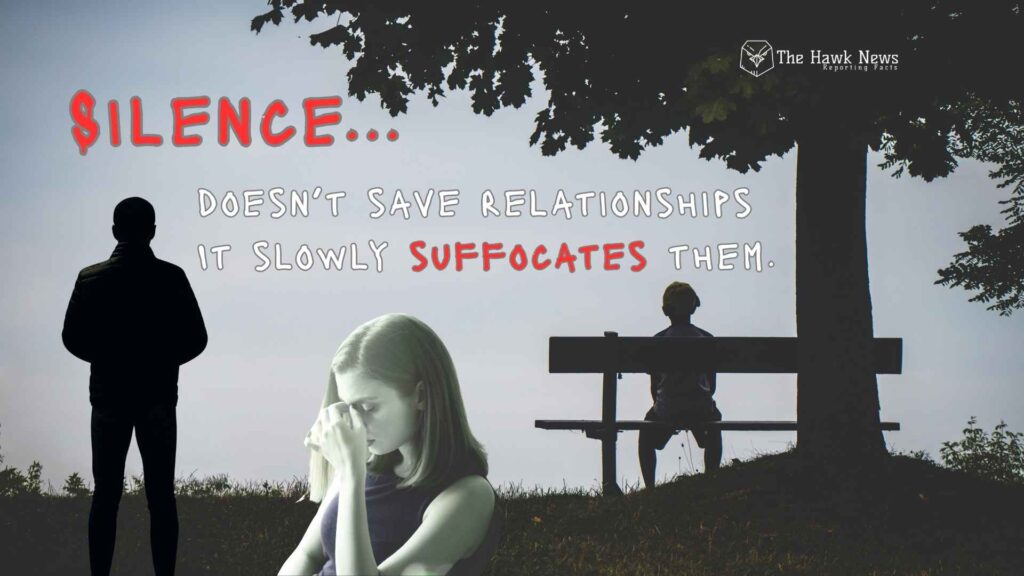
We talk so much about smart teams, innovative groups, and workplaces built on bold ideas — but we rarely admit the truth that sits inside our homes:
Families fail the same way teams do — when everyone agrees too quickly.
In companies, early agreement kills creativity.
In families, it kills honesty.
The pattern is identical:
- People stay quiet to keep the peace.
- Disagreement is treated as disrespect.
- Questions feel like rebellion, not concern.
- And soon, the “smart” group becomes the blindest one.
The result?
Overconfidence grows. Problems stay hidden.
And love becomes quiet — not because it’s weak, but because it’s scared.
A Different Vantage Point for This Generation
Our generation grew up being told:
“Don’t talk back.”
“Don’t question elders.”
“Don’t complicate things.”
What this actually trained many families to do was:
- avoid conflict,
- hide emotions,
- agree for the sake of peace,
- and mistake silence for respect.
But silence is not respect.
Silence is fear pretending to be peace.
And here’s the truth most homes don’t want to hear:
The healthiest families are not the quiet ones.
They are the ones where everyone feels safe to disagree.**
Not rudely.
Not violently.
But truthfully.
Because disagreement is not destruction.
It is contribution.
Why This Matters Now More Than Ever
This generation is more expressive, more self-aware, more emotional, and more informed — but also more misunderstood.
A lot of young people don’t feel unheard because they lack clarity…
They feel unheard because their families lack space.
Space for:
- “I feel hurt.”
- “I think differently.”
- “What you said affected me.”
- “I don’t want to follow the old way.”
- “Can we talk about this openly?”
In many homes, communication feels like a landmine. One wrong sentence, one different opinion, and peace breaks like glass.
But here’s the modern vantage point:
Families must move from emotional dictatorship to emotional democracy.
Not every voice is right.
But every voice must be heard.
When a family doesn’t allow challenge, it doesn’t become harmonious — it becomes fragile.
When children don’t speak, it doesn’t mean they agree — it means they’re scared.
When everyone nods, it doesn’t mean they understand — it means they’re exhausted.
And when problems are not discussed, they don’t disappear — they come back sharper.
The New Definition of a Strong Family
A strong family isn’t the one that avoids conflict.
It’s the one that survives conflict with clarity and love.
A strong home is where:
- opinions don’t threaten relationships,
- differences don’t feel like disrespect,
- silence doesn’t hide pain,
- and discussions don’t become battles.
In this new era, the most loving families will be the ones that encourage:
“Think aloud.
Feel aloud.
Disagree aloud.
Because your voice has value here.”
If Teams Need Dissent, Families Need It Even More
At work, dissent protects ideas.
But at home, dissent protects hearts.
A family that listens becomes a family that lasts.
A home that allows questions becomes a home that grows.
And a generation that is allowed to speak becomes a generation that heals.
Because the truth is simple:
Smart groups become blind without dissent.
Families become broken without it.
Let love be loud.
Let honesty be welcomed.
Let challenge be seen as care.
And let every voice in the home matter — even the smallest one.