A Red Moon Over Two Cities
On the night of September 7, millions of Indians looked skyward as the long-anticipated Blood Moon rose. In Delhi, it appeared a deep brick red, almost as if the Moon had been dipped in rust.
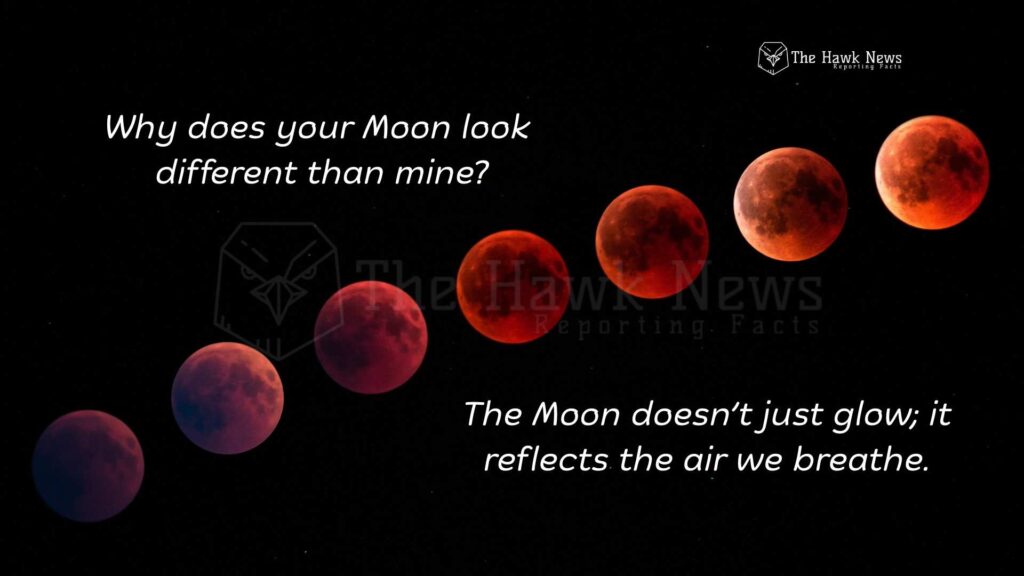
Yet in Bengaluru, the same celestial body glowed softer, a coppery orange. Social media buzzed with side-by-side photos: Why does your Moon look different than mine?
The answer, scientists explain, lies not in the Moon itself but in the air we breathe. The Blood Moon, created during a lunar eclipse when Earth’s shadow covers the Moon, is colored by the atmosphere.
Dust, pollution, wildfire smoke, and aerosols bend sunlight differently across regions. In short: the Moon becomes a natural mirror of the air above us.
This is where science meets spectacle — and where entertainment, business, and environment collide.
When Pollution Paints the Sky
During a lunar eclipse, the Earth blocks direct sunlight from hitting the Moon. But some light sneaks around the edges of our planet, filtered through the atmosphere. Blue light scatters out. Red and orange slip through, giving the Moon its eerie glow.
Here’s the twist: the exact shade of red depends on what’s floating in the air at that moment. Clean skies might give you a soft orange Moon. Dust or pollution makes it brick red. Add wildfire smoke or volcanic ash, and the Moon can turn a frightening crimson, even brown.
In essence, the Moon becomes a live report card of air quality. On September 7, Delhi’s heavy haze made its Moon darker and bloodier than Bengaluru’s. The atmosphere literally painted the sky differently for each viewer.
It’s haunting, but also oddly democratic: we all see the same Moon, but not the same color.
A Cosmic Spectacle Meets Instagram
For the younger crowd, especially Gen Z and Gen Alpha, the Blood Moon is more than science — it’s content. Instagram, TikTok, and X (formerly Twitter) overflowed with eclipse reels and timelapse videos. Hashtags like #BloodMoon2025 trended, filled with dramatic edits, filters, and captions like “Mars or Moon?”
In the entertainment world, celestial events are mini-festivals. Cafés hosted “Blood Moon parties” on rooftops. Astrology accounts gained followers by posting eclipse “energy updates.” Even wellness influencers tied in meditation sessions to “soak in the red glow.”
This digital-age fascination transforms an ancient fear (eclipses once signaled omens) into a shared social joy. The Moon is no longer just a silent witness in the sky; it’s a viral star.
The Business of Awe
But awe has an economy. Behind the beautiful pictures lies a thriving market.
- Tourism: Hill stations like Leh and Coorg reported a spike in bookings from eclipse-watchers seeking clear skies. Globally, eclipse tourism generates millions, with travelers flying across continents to chase totality.
- Tech and Gadgets: Telescopes, phone tripods, and eclipse glasses sold out on Amazon India weeks before the event. Even smartphone companies leaned in — one brand promoted its “Night Mode” with Blood Moon shots.
- Urban Rooftop Culture: In cities, rooftop cafés and bars offered “Blood Moon view passes” with cocktails, a commercial twist on what is, in essence, free.
- Corporate Branding: Sustainability-focused companies quietly tied the red Moon to climate messaging: “The darker the Moon, the dirtier our air.”
Like every spectacle — from cricket finals to solar eclipses — the Blood Moon feeds industries hungry for attention and revenue.
Data in the Sky: A Citizen Science Opportunity
Yet beyond the parties and hashtags lies an intriguing scientific possibility. The variation in Moon hues could be harnessed as a low-cost, crowd-sourced air-quality tool.
Imagine this: citizens across India submit photos of the Moon with location data. Scientists analyze the color spectrum against official air-quality index (AQI) readings. Over time, patterns emerge — giving us a new way to visualize pollution’s impact on the skies.
Some universities are already experimenting with eclipse imagery as a proxy for aerosol levels. Pairing NASA’s satellite data with citizen smartphone shots could one day make the Blood Moon a global atmospheric monitor.
This transforms an aesthetic experience into actionable science — a fusion of entertainment, participation, and environmental awareness.
Rituals, Rewritten
Historically, eclipses were feared. Ancient Indian texts considered them inauspicious; some people fasted, others stayed indoors. Today, those rituals are rewritten. Instead of fear, there’s fascination. Families gather on terraces. Photographers huddle with lenses. Students host watch parties on campuses.
The Blood Moon has shifted from omen to occasion — a chance to pause, look up, and remember we share one sky. The contrast is striking: what once symbolized cosmic chaos now doubles as a family outing, a classroom in the sky, or an Instagram highlight reel.
Can the Moon Shame Us Into Cleaner Air?
Here lies the paradox. We marvel at the red Moon’s beauty — but its very redness may be a warning. The darker and bloodier the eclipse, the more our atmosphere is choked with particles.
Unlike graphs or AQI numbers, the Blood Moon offers a visceral, visual truth. It’s hard to ignore when the heavens themselves wear pollution as paint. Just as glaciers shrinking became a symbol of climate change, perhaps the Blood Moon can become a subtle reminder of the air we leave behind.
The Moon doesn’t lie. Its color tells us about ourselves.
What Lies Ahead
As humanity sets its sights on the Moon again — with India’s Chandrayaan program, NASA’s Artemis missions, and private companies planning lunar bases — the Blood Moon takes on added layers of meaning. It is both a backdrop for space ambition and a mirror of Earth’s fragility.
By 2025, we may have lunar habitats on the horizon. Yet here on Earth, the Moon continues to hold up a mirror: are we willing to clean the skies so that its glow remains copper, not crimson?
Closing Thought
The Blood Moon of September 7 reminded us that beauty and warning often come together. As we clicked pictures and shared reels, we were also unknowingly recording the fingerprints of pollution.
The next time you see a blood-red Moon, pause. You may be gazing at more than an eclipse. You may be staring at the breath of your own city, painted across the heavens.