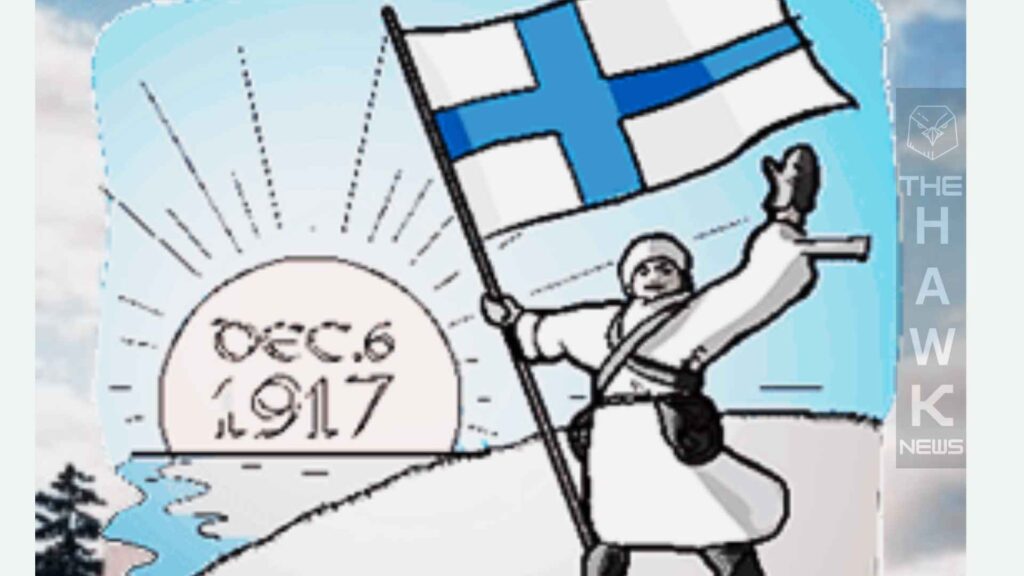
Nations love to tell tidy stories. Stories where freedom arrives on a peaceful morning, the ink dries on a declaration, and the sun obligingly rises on a new dawn.
But history rarely plays along. More often, nations are born the way stars are born — through collapse, pressure and flame.
Finland’s independence on December 6, 1917 is one such story. Not a gentle unfurling of blue-and-white flags, but a turbulent birth inside the tectonic fractures of the Russian Empire.
The world remembers the date. Few remember the firestorm that followed.
This is not the postcard version of Finland’s freedom.
This is the real version.
THE GRAND DUCHY: A NATION IN WAITING
For more than a century before 1917, Finland existed in a strange political twilight.
- From the 1100s to 1809, it lived under Swedish rule.
- After 1809, it became an autonomous Grand Duchy under Russia.
Autonomous didn’t mean free. But it did mean Finland carried a quiet, growing sense of self — its own language revival, its own literature, its own legal traditions. The roots of independence were already deep.
By the late 1800s, Russia began its “Russification” policies: tightening control, limiting the Finnish language, and dissolving autonomy. Instead of weakening Finnish identity, it sharpened it like a chisel.
A national consciousness hardened. A long fuse was quietly burning.
THE YEAR EVERYTHING COLLAPSED
The year 1917 was chaos stitched into calendar form.
Russia endured two revolutions in one year:
- The February Revolution toppled Tsar Nicholas II.
- The October Revolution brought the Bolsheviks to power.
The empire was crumbling. Armies were deserting. The center could no longer hold.
When the Tsar abdicated in March, Finland’s constitutional anchor snapped. The Grand Duchy existed because the Tsar existed. With him gone, Finland was suddenly standing on a cliff-edge of legal uncertainty.
The Finnish Parliament, Eduskunta, sensed the opening and moved decisively:
They attempted to take full legislative power for themselves.
But the Russian Provisional Government rejected the move.
Finland waited, watching Russia unravel.
When Lenin and the Bolsheviks took power in November, the moment arrived.
DECEMBER 6, 1917: INK, PAPER, AND A QUIET DECLARATION
On December 6, 1917, the Finnish Parliament adopted the Declaration of Independence, drafted by Pehr Evind Svinhufvud.
The room was tense. No cheering. No grand celebration. It was not triumph — it was survival.
The declaration began with a line that carried the weight of centuries:
“The people of Finland have by this step taken their destiny into their own hands.”
It was procedural. Constitutional. Almost cold in tone.
But under that calm surface, history was quaking.
Lenin’s government recognized Finland’s independence on December 31, 1917 — partly because the Bolsheviks believed in the right of nations to self-determine, and partly because they had far bigger fires to extinguish.
On the surface, Finland’s independence was achieved with paperwork.
But this was only the preface.
THE NATION SPLITS: REDS VS WHITES
If the declaration was quiet, the aftermath was thunder.
Finland was deeply divided — not by language or ethnicity, but by class:
- The Reds: workers, landless peasants, socialists
- The Whites: middle class, landowners, conservatives
A century of economic inequality collided with political confusion. Food shortages tightened the noose. Russian Bolsheviks encouraged socialist uprisings. German forces quietly supported conservative factions.
Finland was a small country carrying two different dreams.
In January 1918, the dreams burst.
The Finnish Civil War erupted.
THE CIVIL WAR: 108 DAYS OF WINTER IN BLOOD
Three and a half months.
That’s all it took to scar generations.
The Reds seized southern Finland, including Helsinki.
The Whites regrouped in the north under General Carl Gustaf Mannerheim.
The battlegrounds were icy forests, frozen rail lines, and towns swallowed by winter.
Germany sent troops to support the Whites.
Russian Bolsheviks aided the Reds.
The war ended in May 1918, with a White victory.
Victory came with a cost:
- Tens of thousands dead
- Mass imprisonments
- A psychological wound that took decades to heal
When Finland speaks of independence today, it speaks softly.
Because the cost is remembered, not romanticized.
FROM CHAOS TO REPUBLIC
After the war, Finland faced a question: monarchy or republic?
There was even an attempt to choose a German prince as king.
That idea collapsed when Germany lost World War I.
In July 1919, Finland declared itself a democratic republic, electing Kaarlo Juho Ståhlberg as its first president.
The Treaty of Tartu in 1920 secured Finland’s borders and international recognition.
From that point, Finland began building the society it is admired for today — egalitarian, educated, resilient.
A nation no longer in twilight, but in its own light.
THE VANTAGE POINT WE OFTEN MISS
When people hear “Finland,” they imagine stability.
High education rankings.
Quiet snow-covered streets.
The world’s happiest nation.
But Finland’s birth story is a reminder that stability is never inherited.
It is built, painfully, persistently, and with scars as foundation stones.
Finnish independence was not a peaceful emergence.
It was a storm.
A storm that tested every seam of national identity and left behind a people determined never to tear again.
This is why December 6 matters.
Not because independence was won easily,
but because it was stabilized through unimaginable difficulty.
Freedom is not always loud.
But it is rarely clean.
A QUOTE THAT DEFINES THE ERA
Carl Gustaf Mannerheim, leader of the White forces, captured the spirit of the moment:
“The fate of the nation lies in the steadiness of its own hand.”
And so it did.
THE FINAL WORD: A TREE GROWN FROM ASHES
Finland did not step into independence with a parade.
It stepped into it like a soldier leaving a burning building — coughing, wounded, but alive.
Today’s Finland, admired globally, is the slow-grown forest that rose from those ashes.
The real miracle was not December 6.
The miracle was everything Finland built afterward.
Because freedom declared is one thing.
Freedom sustained is another.
And Finland learned to sustain it with remarkable grace.