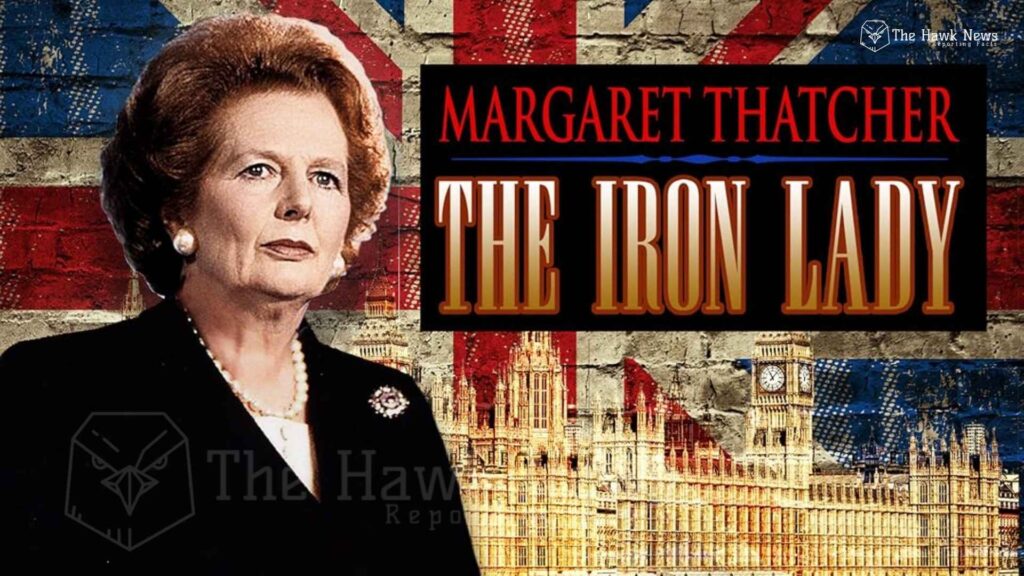
In an age where most leaders bend their beliefs to fit the moment, Margaret Thatcher remains a rare anomaly — a leader who shaped the times instead of being shaped by them. Her resignation in 1990 did not mark the fall of a weakened Prime Minister but the final proof of who she truly was: a woman who chose conviction over convenience, even when it cost her everything.
“Consensus is the process of abandoning all beliefs, principles, values and policies,” she once declared — not as a slogan, but as a philosophy she lived every day.
This is why Thatcher remains one of the most influential, divisive, and unforgettable figures in modern British history. And it’s also why she earned a name the world still uses with unmistakable clarity:
The Iron Lady.
But to understand why she was “iron,” you need to understand the steel beneath her leadership.
She Didn’t Just Lead the UK — She Redefined Leadership
Margaret Thatcher took office in 1979 at a time when Britain was drowning in economic stagnation, union strikes, and political indecision. Leaders before her tried to keep the peace by compromising with every opposing force.
Thatcher refused that playbook.
She believed that leadership wasn’t about being liked — it was about being right.
It wasn’t about noise — it was about clarity.
It wasn’t about popularity — it was about principles.
She brought with her an unusual idea for her time:
You cannot steer a nation by following it.
Where others saw chaos, she saw a chance to rebuild. Where others avoided conflict, she walked straight into it. Her policies cut deeply, challenged comfortably-held systems, and ignited massive opposition — but they also dragged the UK out of economic paralysis.
She once said:
“If you want to change the world, you have to take your enemies with you — or leave them behind.”
She did both.
She Was Called “The Iron Lady” — Not By Britain, but By Her Enemies
Many people don’t know this:
The nickname “The Iron Lady” originally came from a Soviet military newspaper.
They meant it as an insult — a warning that she was too tough, too stubborn, too uncompromising against communism.
Instead of rejecting it, she embraced it.
“I am proud to be known as the Iron Lady,” she said, turning an insult into an identity.
But the name stuck not because of her rhetoric — it stuck because she lived it.
Iron doesn’t flex.
Iron doesn’t fear heat.
Iron doesn’t negotiate its shape with pressure.
Whether she was taking on the unions, confronting the IRA, standing against the Soviet Union, or reshaping the economy, her leadership carried a trademark firmness that many admired — and many feared.
She Was the Last British Leader Unafraid to Be Disliked
In today’s world, leaders check polls, hire PR consultants, and make decisions based on what keeps them safest.
Thatcher broke that mold completely.
She did not ask: “Will this make people like me?”
She asked: “Is this the right thing for the country?”
Her speeches often said what no one wanted to hear.
Her policies often sparked riots and backlash.
Her approach made her a storm — but a storm that cleared the skies.
This is what set her apart:
She believed that politics wasn’t theatre — it was duty.
And duty sometimes hurts.
Her rivals accused her of being stubborn.
Her supporters praised her for being courageous.
Both sides were right.
Her Downfall Wasn’t Weakness — It Was Proof of Her Conviction
Most leaders survive by softening their edges.
Thatcher did the opposite.
Her own party eventually pushed her to resign because she refused to dilute her beliefs, especially over the controversial poll tax. She saw compromise as moral surrender — something she would never accept, even if it cost her power.
And it did.
When she walked out of 10 Downing Street for the last time, she didn’t walk out defeated.
She walked out consistent.
She walked out unchanged.
She walked out exactly as she had governed.
Her fall revealed her greatest truth:
Her strength was her downfall — but also her legacy.
Very few leaders lose power without losing themselves. She was one of them.
A Woman Who Outperformed, Out-thought, and Outlasted Most Men in Her Era
Thatcher didn’t only break the glass ceiling — she made people forget the ceiling existed.
In a political environment dominated by men, she carved her path through sheer force of will and intellectual sharpness. Her mastery of debate, her command over economic policy, and her extraordinary endurance earned her respect even from her fiercest opponents.
She didn’t follow history.
She wrote it.
And she did it at a time when women were expected to stay quiet, agreeable, and in the shadow.
Thatcher was none of those things — and she refused to apologise for it.
A Legacy That Forces Us to Rethink Leadership
Thatcher’s story isn’t about left or right.
It’s not about conservative or liberal.
It’s not even about whether she was right or wrong.
It’s about something far deeper:
The courage to stand alone when the world wants you to kneel.
Her life raises a question that confronts every generation:
Should leaders bend for the sake of peace,
or stand firm for the sake of principle —
even if it breaks them?
Thatcher answered that question with her entire life.
She believed that:
“Being powerful is like being a lady. If you have to tell people you are, you aren’t.”
Power, to her, was demonstrated through conviction — not the illusion of consensus.
Why Her Story Still Matters
In a world drowning in noise, confusion, and leaders who shift their beliefs every week, Thatcher’s unbroken line of principle stands out like a lighthouse.
Whether one agrees with her or not, her example forces us to rethink what leadership ought to be:
Not soft.
Not safe.
Not strategic.
But anchored.
Anchored in belief.
Anchored in courage.
Anchored in the willingness to pay the price for doing what one believes is right.
In the end, she was called “The Iron Lady” not because she was cold, but because she was unbending.
And iron, does not break.
It shapes history.