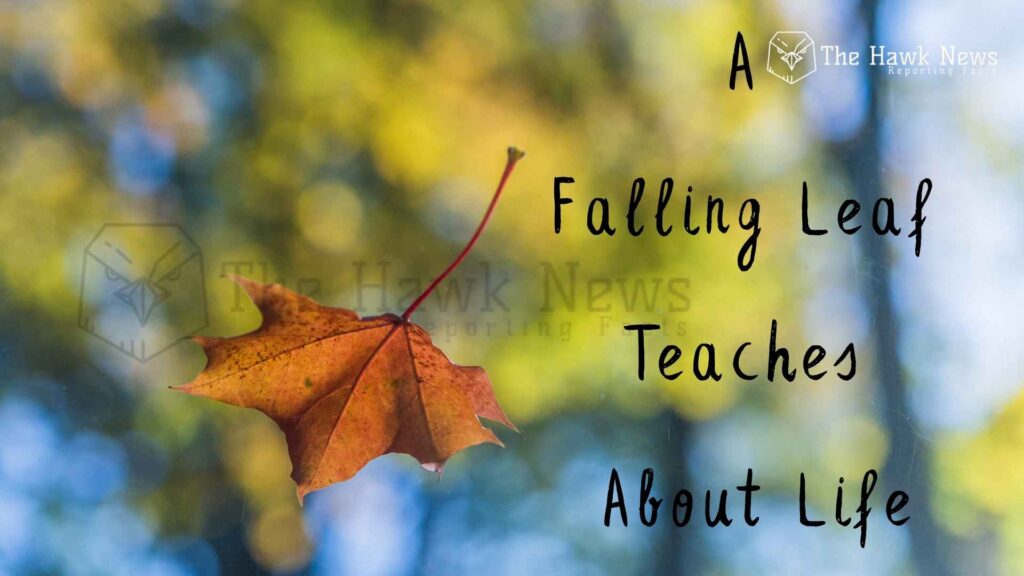
“The trees are about to show us how beautiful it is to let things go.”
When a dry leaf falls, it whispers a truth to the living ones — nothing lasts forever, and change touches us all. If you pause to watch it — the slow spiral, the surrender to the wind — you can almost hear it exhale peace.
The leaf doesn’t fight its fall. It doesn’t cling to the branch that once nourished it. It simply lets go, trusting that in its release lies renewal.
Maybe that’s what life has been trying to teach us all along — that grace is not in holding on, but in knowing when to let go.
The Tree That Teaches Us Renewal
In nature, no season resists another. The trees shed their leaves not in despair but in preparation — for rest, for growth, for something new.
We, on the other hand, cling to what’s fading — relationships past their bloom, jobs that drain our joy, routines that no longer serve us. We call it loyalty, when sometimes it’s just fear.
The falling leaf has no fear. It trusts the process that it cannot control. It understands what we often forget: that change is not loss — it’s transformation in motion. Each fallen leaf becomes nourishment for the soil beneath. In dying, it gives life.
Maybe that’s how we’re meant to live — by allowing certain parts of us to fall away so others can flourish.
The Art of Letting Go
We live in an age that glorifies accumulation — more things, more goals, more noise. Yet, the more we fill our lives, the less space we have to breathe. Look around: closets overflowing, calendars packed, minds racing. But for what?
“Letting go gives us freedom, and freedom is the only condition for happiness.” – Thich Nhat Hanh
The leaf reminds us that emptiness isn’t absence — it’s potential. In letting go, the tree becomes lighter. The same is true for us. When we release what no longer belongs — old grudges, self-doubt, toxic attachments — we make room for growth, love, and clarity.
Every autumn, nature declutters. Perhaps that’s why it feels so peaceful — because the world collectively exhales. Maybe we should too.
Minimalism of the Mind
Lifestyle experts often speak of decluttering our homes, but few speak of decluttering our hearts. Yet, that’s where true lightness begins.
Letting go of what’s no longer meant for you — not out of bitterness, but wisdom — is the highest form of emotional hygiene.
Think of it like sharpening focus:
- The conversations that drain you? Step back.
- The digital chaos that eats your time? Disconnect.
- The expectations that choke your joy? Release them.
As the saying goes, “The trees are about to show us how beautiful it is to let things go.”
The Seasons Within Us
Every person carries seasons within them. There’s the spring of new beginnings, the summer of growth, the autumn of change, and the winter of stillness.
Yet, we often resist autumn — the time of shedding. We want endless summers. But constant bloom isn’t natural — not for trees, not for souls.
Even our hearts have seasons: moments of laughter, heartbreak, healing, and hope.
To deny one is to disrupt the balance of all.
Solomon, in all his wisdom, once wrote, “To everything there is a season, and a time to every purpose under heaven.”
If the wisest king in history understood the rhythm of change, maybe we too can learn to accept it — to see each ending not as loss, but as an invitation to rest, reflect, and renew.
The Balance Between Holding On and Moving On
Of course, balance is everything. Not every leaf must fall at the first gust of wind, and not every problem demands escape. There’s wisdom in endurance too. The art lies in discernment — knowing when to persevere and when to release.
In a world that swings between extremes — overworking or quitting, isolating or oversharing — balance is the quiet strength we must master.
The falling leaf doesn’t abandon its tree out of rebellion; it does so in rhythm. That’s what we must learn — to move not from impulse, but from inner peace.
The Whisper That Modern Life Ignores
Today’s world doesn’t reward stillness. We scroll, rush, consume — always chasing the next version of ourselves. But in doing so, we miss the quiet truths floating all around us.
When was the last time you let silence speak to you? The leaf doesn’t need words to communicate. Its quiet descent says everything — change is inevitable; peace is optional.
The leaf doesn’t beg to be remembered. It simply becomes part of the earth again. Maybe the secret to a fulfilling life is not to resist change, but to be so rooted in who you are that you can let go of everything else.
Change as a Form of Healing
Not all change is easy. Some comes like autumn breezes; others like winter storms. Yet every shift, no matter how painful, carries healing within it. Breakups, failures, relocations — they strip us, yes, but they also shape us.
Like the leaf, we are meant to shed — not to become less, but to make space for what’s next. “Sometimes, the leaf falls not because it’s weak, but because it’s time for it to grow elsewhere.”
Even endings that break us may actually free us.
The Legacy of the Leaf
“Autumn is a second spring when every leaf is a flower.” – Albert Camus
Everywhere a leaf falls, it leaves a mark — silent, soft, yet undeniable. Likewise, every choice, every act of kindness, every word leaves an imprint on others. The goal, then, is to ensure our mark is one of grace, not regret.
You can’t choose whether you’ll fall one day — you can only choose how beautifully you’ll land.
The Final Whisper
When a dry leaf falls, it doesn’t mourn its time. It has lived its purpose — to shade, to breathe, to feed the earth. Its quiet fall is its final offering.
Maybe that’s the wisdom for us too — to live well enough that when it’s time to let go, we can do so without fear. Because in the end, every fall is a new beginning disguised as goodbye.
So, the next time you see a leaf drift to the ground, pause. Listen. You might just hear the whisper of your own soul — reminding you that nothing lasts forever, and that’s the beauty of it all.