Introduction: More Than Just a Vessel
A teapot may seem like one of the most ordinary objects in our homes, tucked away on a shelf or placed on a dining table. But if you look closer, it is not merely a container for brewing tea — it is an object of beauty, culture, design, and even philosophy.
From the elegant porcelain teapots of China to the humble aluminum kettles of Indian tea stalls, the teapot carries with it centuries of history and layers of meaning.
In a world racing toward speed and convenience, the teapot quietly insists on ritual, patience, and reflection. It is not just about holding tea; it’s about holding time.
The Teapot as Art
The teapot is one of the few household items that consistently straddles the line between utility and art. Its design requires functionality — a balanced handle, a spout that pours smoothly, and a lid that fits securely. Yet, artisans across cultures have turned the teapot into a canvas of expression.
- In China, the famous Yixing clay teapots are crafted with extraordinary precision. Each teapot is unique, absorbing the flavors of tea over time and reflecting the hands of the maker.
- In Japan, the cast-iron Tetsubin teapot is revered not just for brewing tea but also as a symbol of strength and mindfulness.
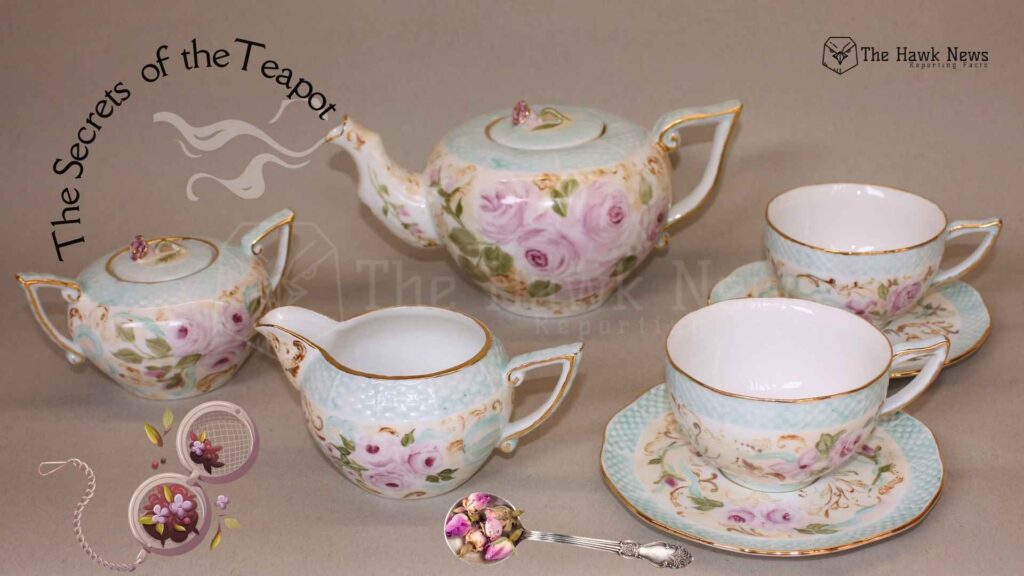
- In Europe, porcelain teapots painted with floral motifs became a marker of elegance in aristocratic homes.
- Today, designers experiment with glass, steel, and even digital temperature-controlled teapots — blending old-world charm with modern innovation.
The teapot thus becomes art in motion, where form and function are inseparable.
Cultural Symbolism: More Than a Drink
A teapot always comes with cultural baggage — it speaks volumes about the society it belongs to.
- In Britain, the teapot is central to the afternoon tea ritual. A beautifully set table with a teapot at its heart signifies elegance and tradition.
- In India, the battered roadside kettle is a symbol of community. At a roadside chai stall, pouring tea from a steaming aluminum pot creates bonds that cut across class and background.
- In Morocco, the silver teapot with long spout is part of a ceremonial act — tea is poured high above the glass to create froth, signifying hospitality.
Every culture has invested meaning into the teapot — making it not just a vessel, but a storyteller.
The Philosophy of a Teapot
The shape of a teapot itself tells us something profound about life. It balances body, handle, and spout — a metaphor for harmony. The act of brewing tea in a pot is slow; it forces us to wait, to savor, to pause.
In Japan’s Zen traditions, the teapot is tied to mindfulness. Every pour is deliberate. In the West, philosophers like Alan Watts compared the tea ritual to a meditation on being present.
There is a quiet philosophy here: life, like tea, needs time to steep.
Design Evolution: Tradition Meets Modernity
The earliest teapots appeared in 16th-century China, modeled after wine ewers. From there, the design spread worldwide:
- Porcelain and ceramic teapots defined Europe’s tea culture in the 17th century.
- Industrial-era teapots became mass-produced, allowing the middle classes to embrace tea-drinking as part of daily life.
- Today, we see sleek Scandinavian designs with minimalism, high-tech glass teapots with infusers, and even smart kettles that connect to your phone.
And yet, despite evolution, the core design has remained remarkably stable: handle, spout, lid, body. Proof that the teapot is one of humanity’s most perfected inventions.
The Teapot as a Status Symbol
Interestingly, the teapot also straddles class divides.
- Luxury brands sell collectible teapots that cost lakhs of rupees, made of silver, gold, or hand-painted porcelain. For the elite, these are not just teapots — they are heirlooms and symbols of refinement.
- Yet, affordable versions are everywhere. A simple IKEA ceramic teapot or an Amazon stainless steel version allows middle-class families to enjoy the same sense of style.
- At the other end of the spectrum, India’s roadside chai kettles are often battered, blackened with years of use — and yet, they carry their own aura of authenticity.
The teapot, then, is an inclusive status symbol: a bridge between aspiration and accessibility.
Teapots as Storytellers
Ask anyone about the teapot in their home, and chances are, it carries memories. A wedding gift porcelain set, a grandmother’s chipped ceramic pot, or the glass infuser bought during a trip abroad — these objects hold stories.
Sociologists argue that teapots are not just items of consumption, but repositories of emotion. Around a teapot, conversations flow.
Secrets are shared. Comfort is given. In its quiet way, the teapot is present at many of life’s most intimate moments.
Why the Teapot Still Matters in 2025
With the rise of instant tea bags, coffee pods, and energy drinks, one might assume the teapot is obsolete. Yet, the opposite is true.
Across the globe, there is a revival of slow-living movements, artisanal tea blends, and mindfulness practices. And at the heart of all of these lies the teapot.
In an age of screens and speed, the teapot represents pause. It reminds us that not everything should be instant, not every sip should be rushed. Sometimes, to live fully, we need to steep a while.
Conclusion: Holding Tea, Holding Time
So yes, the humble teapot is funny in a way — funny because it hides in plain sight, carrying a world of meaning we often forget to see. It is art, philosophy, culture, status, and memory all in one.
The next time you pour from a teapot, pause and look at it. You may realize that you’re not just drinking tea — you’re partaking in a centuries-old ritual that unites function, beauty, and life itself.
Because, after all, the teapot is not only made to hold tea.
It is made to hold time.