Spain’s transition to democracy was still young, still tender, still unsure of its own strength.
Only a few years had passed since the death of Francisco Franco, whose four-decade dictatorship had shaped every corner of Spanish life.
Freedom was new. Institutions were delicate. Hope was real, but fragile.
Then came 23 February 1981 — a night that would test whether Spain’s new future could survive its old shadows.
When the Chamber Fell Silent
On that afternoon, as Parliament gathered to elect a new prime minister, something unthinkable happened: armed Civil Guards stormed the chamber.
Gunshots cracked across the floor. Lawmakers fell under desks. Television screens went black across Spain.
It wasn’t just a coup attempt.
It was a deliberate move to drag the country backward.
Some in the military believed democracy was chaos, that only a strong hand could rule Spain.
They rolled their dice that night — hoping fear would do the rest.
Spain stared into its past once again.
A King Steps Into the Storm
while Panic spread, one man held the legal authority to command the armed forces — King Juan Carlos I. Most had assumed he was merely a ceremonial figure. Few had seen him in crisis.
Even fewer knew which side he would choose.
But Juan Carlos understood the moment’s gravity.
A coup in 1981 would not just rearrange power — it would erase everything Spain had built since 1975.
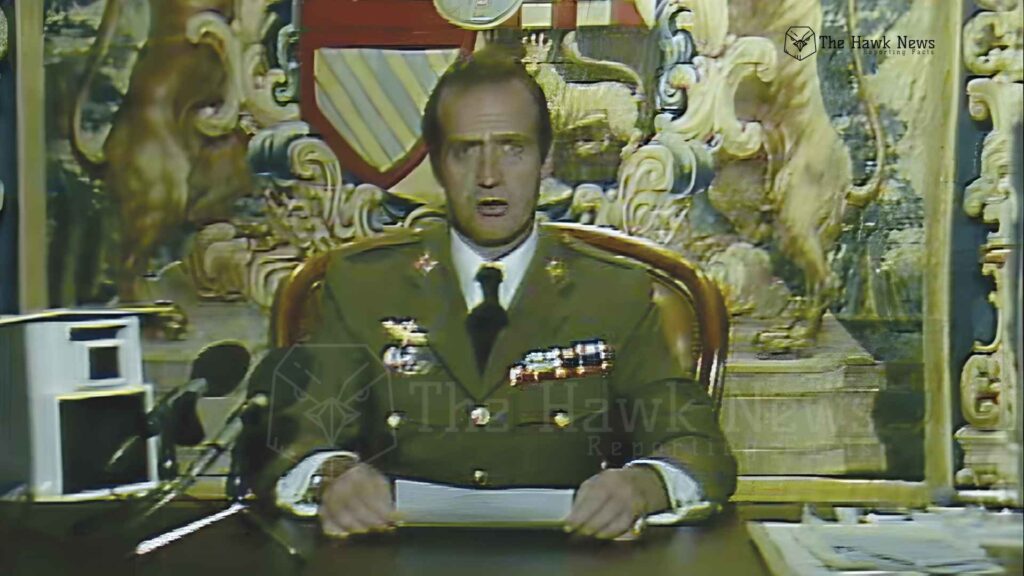
Late that night, televisions flickered back to life.
The king appeared in full military uniform, calm but unmistakably firm.
He delivered the sentence that would change the night:
“The Crown cannot tolerate in any form any act which tries to interfere with the Constitution which has been approved by the Spanish people.”
And then, even more decisively, he ordered the military to remain loyal to the democratic constitution and to stand down.
This was not symbolism.
This was command.
The Moment the Tanks Lost
His speech rippled instantly through the chain of command.
Officers who had wavered now shifted firmly toward the constitution.
Those sympathetic to the coup lost the moral cover they hoped for.
The rebel units found themselves isolated.
By dawn, the coup had collapsed.
The tanks would not roll.
The chamber would reopen.
Democracy would breathe again.
Spain had been inches away from a different history — and the difference was one man’s resolve.
What That Stand Achieved
The king’s intervention didn’t just neutralize a coup. It reset Spain’s future.
Democratic legitimacy hardened.
Never again would the military attempt to seize political control.
The constitution came alive.
It shifted from a legal document into a lived reality that people defended.
Europe took notice.
Spain’s path to joining the European Community and NATO accelerated.
Confidence in Spanish democracy surged domestically and internationally.
A civic identity emerged.
Spaniards saw their new freedom not as an experiment, but as something worth guarding.
23-F became a boundary line: before it, democracy was vulnerable; after it, democracy was anchored.
Why This Night Still Speaks Today
Juan Carlos’s later controversies complicate his legacy, but they cannot erase what happened in those critical hours.
Democracy everywhere faces pressures — polarization, misinformation, opportunistic leaders, institutional fatigue.
Nations can fracture when systems are tested.
History shows that hard-earned freedom can be lost faster than it was gained.
And that is why the story of 23-F remains powerful.
It reminds us that democratic systems survive only when individuals choose to protect them.
They survive when someone stands up — not because it is easy, but because it is necessary.
A Future Saved in a Single Decision
Spain’s democracy didn’t survive that night because of luck.
It survived because a king chose law over force, principle over fear, and future over past.
The tanks were real.
The danger was real.
And yet, so was the courage.
That courage gave Spain the future it lives in today.