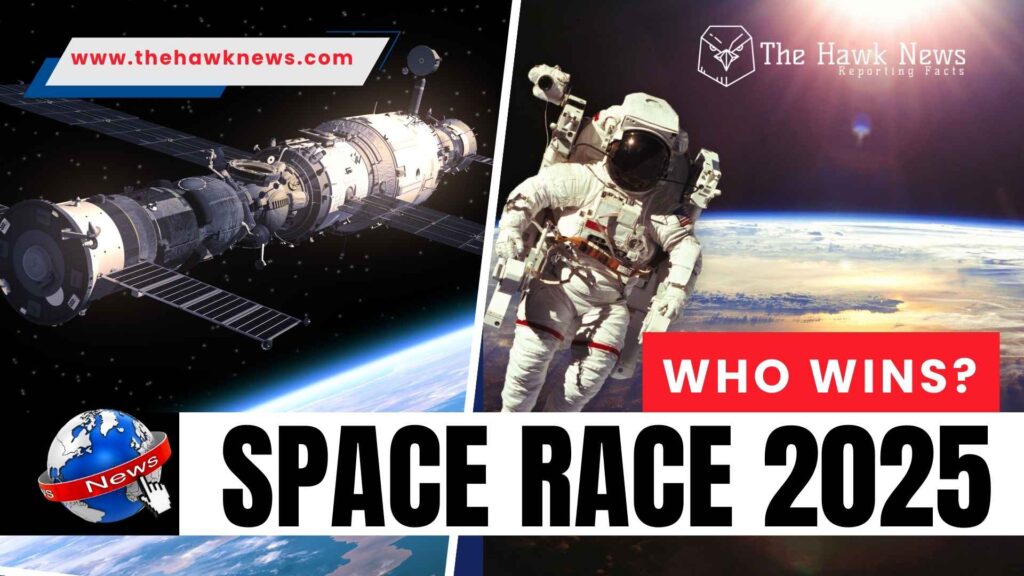
The 20th century’s space race between the United States and the Soviet Union was a contest of political ideology, technological prowess, and national pride. Fast forward to the 21st century, and a new space race has emerged—but this time, the players are not just nation-states.
Private companies, backed by billionaires and investors, are competing with traditional space agencies to chart humanity’s path to the Moon, Mars, and beyond.
The surge of ambition in space exploration is ushering in an era that blends science, commerce, and geopolitical rivalry, making the question of “who wins the space race by 2025?” more complex than ever before.
A Race Rekindled: From Cold War to Collaboration and Competition
The first space race climaxed in 1969 when Neil Armstrong took humanity’s first steps on the Moon. Afterward, space exploration slowed, overshadowed by geopolitical détente, budget constraints, and shifting priorities. But in the last two decades, new forces have reignited the competition.
- National Agencies: NASA, the European Space Agency (ESA), Russia’s Roscosmos, China’s CNSA, and India’s ISRO are all investing heavily in lunar, planetary, and interplanetary exploration.
- Private Players: Companies like SpaceX, Blue Origin, Virgin Galactic, and Axiom Space are reshaping the commercial frontier, introducing space tourism, reusable rockets, and private space stations.
Unlike the Cold War era, the new race is not just about planting flags. It is about economic opportunity, scientific discovery, and long-term survival of humanity.
Back to the Moon: The Gateway to Mars
The Moon has once again become the focal point of global space ambitions.
- NASA’s Artemis Program aims to return astronauts to the lunar surface by 2026, including the first woman and the first person of color. Its long-term vision is to establish a sustainable base camp on the Moon that can serve as a launching pad for Mars missions.
- China’s Lunar Missions are equally ambitious. In 2024, China’s Chang’e 6 mission brought back lunar samples, while plans are underway for a permanent lunar research station in partnership with Russia.
- India’s Milestone: ISRO made history with Chandrayaan-3 in 2023 by landing near the Moon’s south pole, a region rich in ice reserves—potentially a crucial resource for future colonies.
The Moon is no longer just a destination; it is the gateway to deeper space exploration. Whoever establishes long-term infrastructure there first could control key resources like water ice, which can be converted into oxygen and rocket fuel.
The Red Planet Beckons: Mars as Humanity’s Next Home
If the Moon is the training ground, Mars is the ultimate prize.
- NASA’s Perseverance Rover, launched in 2020, continues to explore the Martian surface, collecting samples for eventual return to Earth.
- SpaceX’s Bold Vision: Elon Musk has consistently declared that SpaceX’s ultimate goal is to make life “multi-planetary.” The company’s Starship—the most powerful rocket ever built—is being designed for crewed missions to Mars within the coming decade.
- China’s Ambitions: China has its own Mars plans, having already landed the Zhurong rover in 2021. It envisions crewed missions to Mars in the 2030s.
The challenges of Mars colonization—radiation, distance, and psychological endurance—are immense. But the race to be “first on Mars” has already become the crown jewel of 21st-century space exploration.
Space Tourism: From Science Fiction to Market Reality
One of the most surprising developments of the new space race is the rise of space tourism.
- Virgin Galactic has successfully launched paying customers into suborbital space, offering minutes of weightlessness and breathtaking views of Earth.
- Blue Origin’s New Shepard has carried high-profile passengers, including celebrities and entrepreneurs, making space travel a luxury experience.
- SpaceX’s Crew Dragon has taken private citizens on orbital missions, including multi-day journeys circling Earth.
While critics argue that space tourism caters to billionaires, supporters see it as a critical step toward democratizing access to space and funding broader space infrastructure. By 2030, analysts estimate space tourism could be a multi-billion-dollar industry.
Building in Space: Private Space Stations and Industrial Dreams
As the International Space Station (ISS) nears retirement, private companies are stepping in.
- Axiom Space is developing the first commercial space station, with NASA’s support.
- Space Factories: Companies are exploring the potential of manufacturing in zero-gravity, which could revolutionize industries from medicine to semiconductors.
- Satellite Economies: The growing demand for satellite internet, Earth observation, and communications technology is creating a trillion-dollar industry orbiting above us.
Space is no longer just about exploration—it is about commerce. Nations and corporations are racing to stake their claims in the coming space economy.
The Geopolitical Dimension: Space as the New High Ground
Space has always had a geopolitical edge, and today’s space race is no exception.
- US vs. China Rivalry: Just as the U.S. and USSR once competed, today the U.S. and China are vying for dominance in space. Both nations see lunar bases and Mars missions not only as scientific goals but as strategic footholds.
- India’s Rising Role: With Chandrayaan-3 and the upcoming Gaganyaan human spaceflight mission, India is positioning itself as a serious space power, balancing science, prestige, and soft power.
- Space Militarization: The establishment of the U.S. Space Force and similar moves by other nations highlight how controlling space could become critical in future defense strategies.
The question is no longer just “who explores space first,” but also who governs it, regulates it, and secures it.
Who Wins the Space Race by 2025?
The answer depends on how we define “winning.”
- If it’s lunar exploration, China and the U.S. are leading, with India close behind.
- If it’s Mars ambition, SpaceX stands out with its aggressive timelines, though NASA remains the most technically experienced.
- If it’s commercialization, private companies—SpaceX, Blue Origin, and Virgin Galactic—are clearly ahead.
By 2025, the “winner” may not be a single nation or company but rather an ecosystem of players—public and private—pushing humanity forward in parallel. What’s clear is that the new space race is not slowing down; if anything, it’s accelerating.
What It Means for Humanity
The renewed rush into space forces us to ask fundamental questions:
- Is this race about human progress or about profit and power?
- Will space be a shared frontier for all humanity or the domain of a few wealthy nations and corporations?
- Most importantly, will space exploration help us solve problems on Earth—such as climate change, resource scarcity, and energy needs—or will it become a distraction from them?
Space has always inspired awe and wonder. But as we approach 2025, it is also becoming a mirror of human ambition, inequality, and ingenuity. The new space race might not have a single winner, but it will certainly define the future of humanity—on Earth and beyond.
Conclusion
From the Moon to Mars, from space tourism to commercial space stations, the new space race is transforming our century. It is no longer just a duel between superpowers but a complex, multi-layered contest involving nations, billionaires, scientists, and dreamers.
By 2025, we may see astronauts return to the Moon, tourists orbiting Earth, and preparations for a Mars mission in full swing. The question of who emerges victorious may be less important than the collective realization that humanity is, once again, reaching for the stars.