Introduction – A Slice of History
Few foods have achieved the universal appeal of pizza. From street corners in Naples to the buzzing streets of New Delhi, pizza has transcended cultures, borders, and culinary traditions.
But behind its status as the world’s favorite comfort food lies a fascinating history that stretches back thousands of years.
Tracing pizza’s journey from ancient civilizations to modern-day India reveals not only how food evolves but also how it mirrors globalization itself.
Flatbreads: The Ancient Ancestors of Pizza
Before mozzarella and tomato sauce ever met, civilizations were already experimenting with bread topped with ingredients. The Egyptians baked flatbreads topped with herbs and oils as early as 6,000 years ago.
The Greeks had plakous, flatbreads with garlic, onions, and cheese. The Romans enjoyed focaccia, often seasoned with olives and meat.
Interestingly, India’s own culinary heritage has parallels. Naan, kulcha, and parathas served with toppings or fillings could easily be seen as pizza’s distant cousins.
Food historians often note that while pizza as we know it is distinctly Italian, the idea of bread as a canvas for toppings is truly universal.
Naples: The Birthplace of Pizza
Modern pizza as we know it was born in the crowded streets of Naples in the late 18th century. It was the food of the poor—simple flatbreads topped with tomatoes, garlic, oil, and sometimes cheese. Street vendors sold it to workers who needed cheap, filling meals.
The dish earned royal recognition in 1889 when Queen Margherita of Savoy visited Naples. A local pizzaiolo, Raffaele Esposito, created a pizza topped with tomatoes, mozzarella, and basil—representing the Italian flag. Thus, the Margherita pizza was born, cementing pizza’s place in Italian culinary identity.
Pizza Crosses the Atlantic and Conquers the World
In the late 19th and early 20th centuries, Italian immigrants carried pizza to the United States. In New York, Chicago, and other immigrant hubs, pizzerias flourished. After World War II, returning American soldiers who had tasted pizza in Italy brought home a craving that fueled pizza’s rise into mainstream culture.
By the mid-20th century, pizza was no longer just an immigrant food—it was a global phenomenon. Chains like Pizza Hut (founded 1958) and Domino’s (1960) industrialized and internationalized pizza, turning it into a fast-food staple.
Pizza Lands in India: A 1990s Revolution
Pizza’s story in India is closely tied to economic liberalization. When India opened its economy in the 1990s, Western fast-food brands rushed in. Domino’s set up its first outlet in New Delhi in 1996, quickly followed by Pizza Hut.
Initially, pizza was a novelty—something eaten in 5-star hotels or mall food courts, often by middle- and upper-class families.
At first, Indians found the concept alien. Cheese-heavy bread was far from traditional Indian meals. But the younger generation, exposed to Western pop culture and MTV, quickly adopted it as a trendy, aspirational food.
By the early 2000s, pizza had become synonymous with youth culture, birthday parties, and college hangouts.
India’s Desi Pizza Revolution
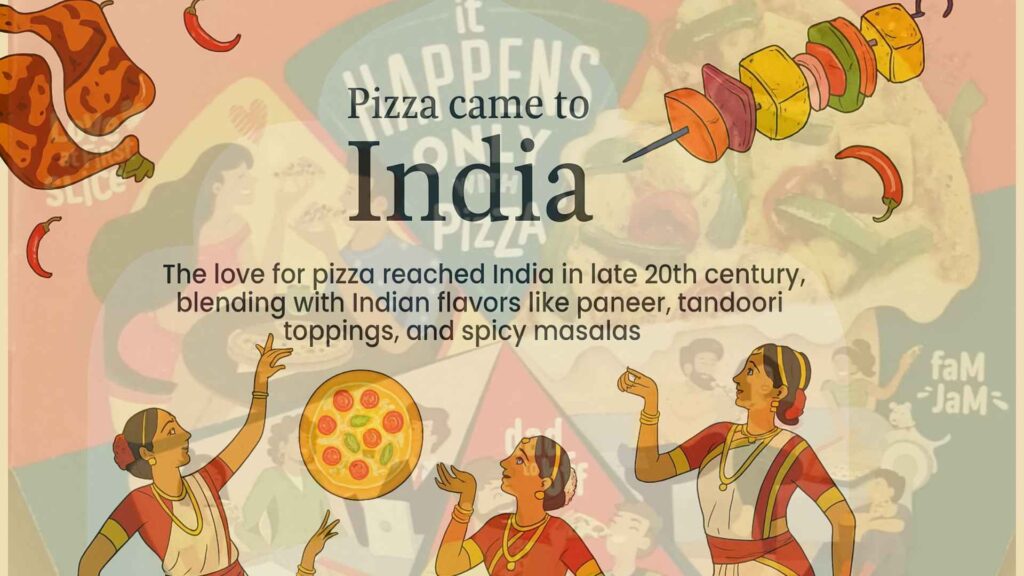
One of the keys to pizza’s success in India was adaptation. Chains realized that pepperoni and plain Margherita would not appeal widely, so they introduced Indianized versions: paneer tikka pizza, chicken keema pizza, tandoori chicken toppings, and masala spice mixes.
Even crusts evolved, with stuffed options filled with spicy sauces and cheese.
Meanwhile, Indian street vendors created their own versions. The “tawa pizza” made on an iron griddle, the “dosa pizza” in South India, and even pav-bhaji pizza are examples of how India localized the dish.
Today, one can find pizza in ₹99 roadside stalls as well as ₹1,000 artisanal wood-fired outlets in cities like Bengaluru and Mumbai.
Pizza in Pop Culture and Globalization
Pizza’s rise in India was also fueled by pop culture. Shows like Friends glamorized pizza as a symbol of friendship and youth. Cartoons like Teenage Mutant Ninja Turtles made it fun for kids. Pizza delivery became shorthand for urban convenience, reshaping eating habits in metro cities.
It also became a symbol of globalization—eating pizza in the 1990s and 2000s was often seen as participating in modern, global culture. Just as burgers represented America, pizza came to represent cosmopolitan lifestyles.
The Future of Pizza in India
Today, pizza in India is more than just fast food—it is an ever-evolving canvas of culinary creativity. Artisanal pizzerias serving Neapolitan-style thin crusts coexist with budget chains delivering in 30 minutes or less.
New health trends have given rise to whole-wheat, gluten-free, and vegan pizzas. Homegrown brands are competing with global giants, proving that pizza has been truly Indianized.
As India continues to balance tradition and modernity, pizza stands as an edible metaphor for globalization: rooted in history, adapted to local tastes, and constantly reinventing itself.
Conclusion – A Slice That Tells a Story
From the flatbreads of ancient Egypt to wood-fired ovens in Naples, from American fast-food chains to Delhi’s street corners, pizza’s journey has been remarkable.
In India, it has evolved from a foreign curiosity into a beloved staple, one that speaks to the nation’s openness to global influences while preserving its own culinary identity.
The next time you bite into a slice of pizza—whether it’s topped with mozzarella or masala—you’re not just eating food. You’re tasting centuries of history, culture, and globalization, all on a single piece of bread.