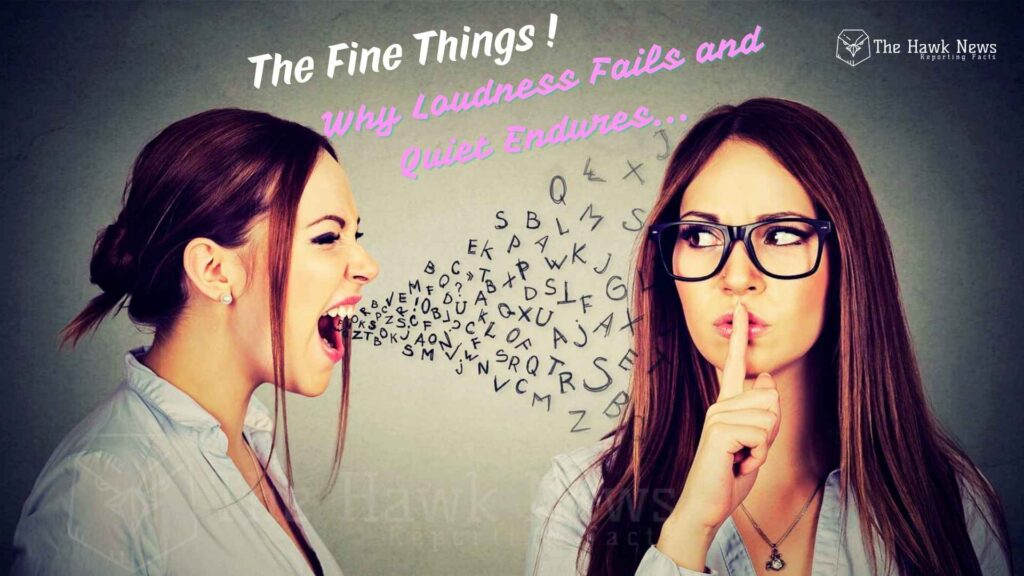
“There are many fine things which we cannot say if we have to shout,” wrote Henry David Thoreau, meditating on the dignity of silence.
More than a century and a half later, his words still cut through the noise. In our world, loudness is often mistaken for leadership, abrasiveness for authority, and spectacle for strength.
We live in a culture that equates noise with power — and yet the finest things in life, the things that endure, rarely shout.
They speak in whispers, in stillness, in the kind of quiet that ennobles rather than overwhelms.
The Age of Noise
Look around: the loudest voices dominate our politics, the boldest headlines rule our newsfeeds, and the brashest personalities trend on our screens.
Social media rewards outrage, workplaces promote those who take up space, and leaders equate volume with vision. We confuse confidence with arrogance, and we mistake noise for power itself.
But noise is not power. Noise is the performance of power. It dazzles for a moment, like fireworks in the night sky, only to vanish into darkness.
True power — the kind that shapes hearts, shifts cultures, and stands the test of time — is quieter, subtler, and infinitely more enduring.
The Illusion of Loudness
Why do we glorify loudness? Perhaps because it feels decisive, commanding, hard to ignore. Shouting fills a room the way force fills a void: immediately noticeable, but not necessarily lasting.
History is full of examples. Loud rulers, bullies, and demagogues often rise quickly, carried by volume and spectacle. But their legacies fade, leaving behind scars rather than strength.
Contrast this with the quiet reformers, thinkers, and healers — the ones who rarely raised their voices but whose influence echoes centuries later.
Socrates asked questions in calm dialogue. Gandhi’s nonviolence spoke louder than armies. Rosa Parks said “no” in a quiet voice that changed the course of a nation.
Loudness is an illusion of permanence. Quiet is its reality.
The Strength of Silence
Silence has a power we underestimate. In silence, thought matures. In silence, truth clarifies. In silence, people feel seen rather than drowned out.
Thoreau’s words remind us that some things can only be spoken gently: love, forgiveness, wisdom, hope. These truths, when shouted, lose their essence. Try shouting “I forgive you” or “I love you” — the words collapse under the weight of noise. They require stillness, softness, and space to be believed.
Even nature teaches us this. Seeds grow in silence. Rivers carve stone not by shouting but by persistence. Dawn breaks not with explosions but with gradual light. The most enduring forces in life are quiet ones.
Why Loudness Fails
Loudness may command attention, but it rarely commands respect. A shouted argument can silence a room, but it cannot win hearts. A leader who bellows may secure obedience, but not loyalty. An influencer who thrives on outrage may trend today, but tomorrow they are forgotten, replaced by the next noisy headline.
Loudness fails because it is reactive. It burns energy quickly. It forces compliance but never cultivates conviction. The quiet, by contrast, invites reflection. It allows space for growth. It plants seeds that continue to bloom long after the shouting has ceased.
Quiet as Endurance
Quiet endures because it roots itself in depth. It does not need applause to survive. It does not demand attention; it attracts it naturally.
Think of a tree. It does not shout as it grows, but year after year, it becomes a presence no one can ignore. Think of the ocean. Its waves crash loudly, but its real strength lies in the silent depths below. Think of the stars. They do not make noise, yet they guide travelers, inspire poets, and outlast empires.
True endurance belongs to the quiet.
Cultivating the Fine Things
So how do we reclaim Thoreau’s “fine things” in an age of noise? By practicing a different kind of strength — one rooted in quiet integrity rather than loud performance.
- Listen more than you speak. In a world that rewards shouting, listening becomes a radical act. It disarms conflict and creates space for truth.
- Speak softly, but with weight. Words don’t need to be many or loud to matter; they need to be honest and timely.
- Value depth over display. Resist the temptation to equate visibility with worth. The most valuable work is often invisible: kindness unposted, integrity unpraised, love unseen.
- Practice stillness. Carve out silence in a world of constant noise — whether in prayer, meditation, or reflection. Stillness nourishes the soul like rain nourishes roots.
By cultivating these habits, we begin to live differently. We stop chasing noise and start embodying the quiet strength that lasts.
A Call to Remember
There is a difference between being heard and making an impact. Shouting ensures the first; silence often secures the second. The culture may push us toward louder platforms, bigger displays, stronger performances — but the human soul still longs for gentleness, wisdom, and truth spoken in calm.
Perhaps this is what Thoreau meant: that shouting may drown out the very truths we most need to hear. The fine things — love, justice, wisdom, hope — cannot survive in a climate of noise. They require quiet soil to take root.
Conclusion: The Whisper That Endures
Noise will always have its moment, but quiet will always have its legacy. Loudness fails because it is shallow; quiet endures because it is deep. And the deepest truths of life — the ones that heal, guide, and transform — are never shouted. They are whispered. They are lived.
Thoreau’s words remind us that the finest things are not found in the roar of the crowd but in the strength of silence, the dignity of calm, the endurance of the quiet voice that refuses to be drowned out.
So perhaps the challenge of our age is not to shout louder than the noise, but to live so deeply, so quietly, that our very lives whisper truths that outlast the shouting. Because in the end, it is the whisper, not the roar, that endures.