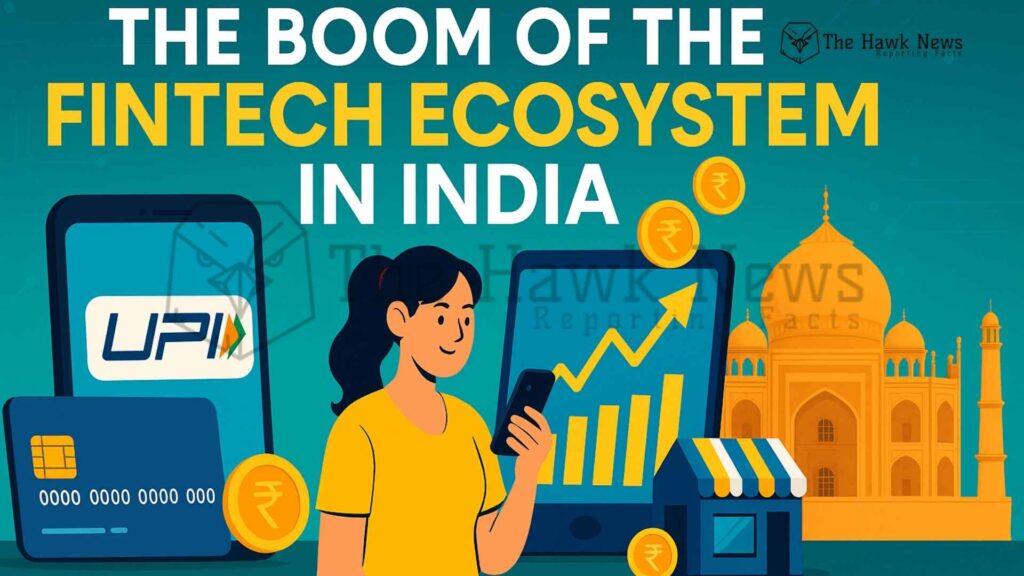
Over the past decade, India has witnessed one of the most dramatic financial revolutions in the world. From small-town shopkeepers accepting QR-code payments to urban millennials trading stocks with just a swipe on their phones, fintech has become a household reality.
In 2025, India stands tall as the third-largest fintech ecosystem globally, behind only the US and China, and experts argue that this is just the beginning of an even bigger transformation.
But what explains this meteoric rise? The story lies at the intersection of business innovation, regulatory support, and consumer behavior.
Market Growth and Investment Surge
The fintech boom is as much a story of investor confidence as it is of innovation. Despite global funding slowdowns in 2023–2024, India’s fintech startups have managed to secure billion-dollar investments, especially in digital lending, insurance-tech, and wealth management platforms.
Paytm, once under pressure due to regulatory tightening, bounced back with renewed focus on UPI payments and merchant solutions. PhonePe, which spun off from Flipkart, continues to dominate UPI transactions, claiming over 45% of market share as of mid-2025.
Razorpay and Pine Labs have solidified their positions in B2B payments, while newer entrants in neobanking such as Jupiter, Fi, and Niyo are seeing exponential user adoption.
A recent Bain & Company report estimates that the Indian fintech market could reach $150 billion in annual revenue by 2030, largely driven by mobile-first innovations and rural adoption.
Innovation in Financial Services
The backbone of this fintech explosion is UPI (Unified Payments Interface). What began as an experiment by the National Payments Corporation of India has today become the world’s most successful real-time payment system. In 2025, UPI crossed 14 billion transactions in a single month, surpassing the combined digital transaction volumes of several developed economies.
Innovations such as UPI Lite, designed for small offline payments, and credit on UPI, which allows users to link their credit cards directly, are further expanding reach. The Reserve Bank of India’s (RBI) pilot on Central Bank Digital Currency (CBDC) also signals a new era where India could pioneer state-backed digital money.
Online lending has also matured rapidly. Startups like KreditBee, Cashe, and Slice are extending credit to millions of users traditionally ignored by banks. These platforms use alternative data — mobile usage patterns, digital spending history, and gig work payments — to evaluate creditworthiness.
Meanwhile, wealth-tech platforms such as Zerodha, Groww, and Upstox have democratized stock market investing. Mutual fund SIPs (Systematic Investment Plans) are being initiated by first-time investors in Tier-2 and Tier-3 cities, underscoring how fintech has widened financial participation.
Competition and Business Dynamics
The Indian fintech story is not without its turf wars. The competition between PhonePe, Google Pay, and Paytm is reshaping how payments are bundled with other services. PhonePe has ventured into mutual funds and insurance, while Paytm is diversifying into merchant lending and financial marketplaces.
Global giants like Amazon Pay and WhatsApp Pay are struggling to keep pace, but their sheer user base makes them formidable. Traditional banks, once wary of fintech startups, are now collaborating with them. ICICI Bank, HDFC, and SBI have rolled out partnerships with fintech platforms for co-branded credit cards, digital lending, and BNPL (Buy Now, Pay Later) schemes.
The entry of Reliance Jio into fintech is also changing the game. With Jio Financial Services leveraging the massive telecom user base, analysts predict a Jio-led disruption in insurance, lending, and even CBDC integration.
Impact on Financial Inclusion
One of the most profound effects of fintech in India has been bridging the financial gap. According to World Bank data, over 80% of Indian adults now have access to a bank account, compared to just 53% a decade ago. Fintech has accelerated this progress by making digital wallets and micro-loans accessible in places where traditional banks had little presence.
Case studies are abundant. In rural Bihar, farmers now use mobile apps to access crop loans instantly. In Gujarat, women entrepreneurs in small textile businesses rely on digital lending apps for working capital. Across states, gig economy workers — from delivery agents to cab drivers — depend on instant payment wallets to manage daily expenses.
Startups are also innovating specifically for underserved markets. For instance, fintech firms are developing vernacular interfaces to make financial products accessible to non-English speakers. Biometric-based micro-ATMs are allowing villagers to withdraw and deposit cash without traveling long distances.
Challenges and Risks
The growth story, however, comes with significant challenges. Regulatory oversight has become more stringent, particularly in digital lending. The RBI has mandated stricter KYC norms, transparency in loan terms, and caps on interest rates to prevent exploitation of consumers. While these moves are essential for consumer protection, they have also slowed down aggressive expansion by some lending startups.
Cybersecurity remains another major concern. The rise in digital transactions has made India a prime target for phishing scams, wallet fraud, and account takeovers. Experts warn that without robust security infrastructure, trust in fintech platforms could erode quickly.
There is also the risk of digital exclusion. While urban India embraces fintech with ease, a section of rural and elderly populations struggle with digital literacy. Bridging this “last-mile gap” will be critical for ensuring inclusive growth.
Future Outlook
Looking ahead, the fintech boom in India shows no signs of slowing. Experts point to three key trends:
- AI in Finance: From AI-driven credit scoring to robo-advisors for wealth management, artificial intelligence is expected to redefine personalization in financial services.
- Blockchain & CBDC: Beyond cryptocurrencies, blockchain is being tested for secure cross-border payments and trade finance. India’s CBDC pilot could put the country at the forefront of digital currency adoption.
- Open Banking: The Account Aggregator (AA) framework is set to empower users with control over their financial data. This could unleash a wave of new products tailored to individual needs.
Industry insiders believe India is on track to become a global fintech hub. The combination of a young population, rising smartphone penetration, supportive regulation, and entrepreneurial energy positions the country as a leader in shaping the digital finance landscape.
Conclusion
The boom of the fintech ecosystem in India is not merely a business success story — it is a social and economic revolution. For startups, it means tapping into one of the fastest-growing digital markets in the world.
For consumers, it means access to credit, investments, and financial services that were once beyond reach. For the nation, it means moving closer to the dream of a truly cashless, inclusive economy.
As India continues this journey, the challenge will be to balance rapid innovation with consumer protection. If achieved, the country’s fintech model could become a blueprint for emerging economies worldwide.