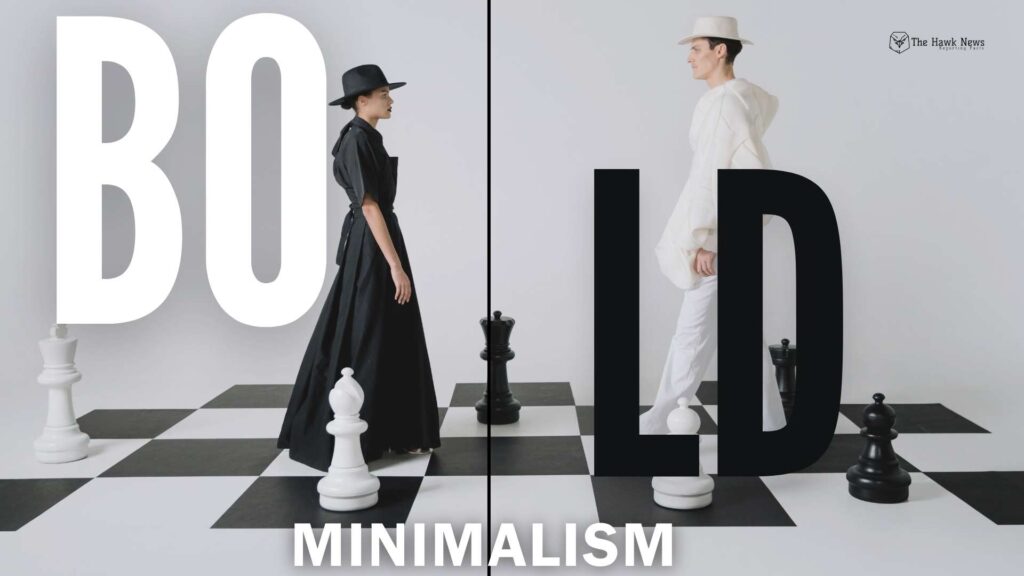
In an era obsessed with motion — reels, transitions, hyper-edited bursts of life — the most radical thing fashion photography could do was stop. And that’s exactly what it’s doing.
Across editorials, campaigns, and high-fashion lookbooks, a new visual language is taking over:
motionless symmetry, architectural framing, clean geometry, and a bold minimalism that feels like exhaling after years of visual noise.
This isn’t just a trend.
It’s a cultural shift — the new calm in a chaotic world.
When Fashion Stands Still, We Finally See It
The frenetic energy of fashion shoots used to be the norm — wind machines, flying hair, asymmetry, blurred movement, drama.
Now?
Stillness is the drama.
Designers and photographers are freezing their subjects like sculptures — models grounded, centered, and framed as if part of the architecture around them.
The message is subtle but powerful:
You don’t need to move to command attention. Presence is the new performance.
This is why minimalism’s return doesn’t feel cold — it feels like relief.
Editorial Photography Is Becoming Architectural
Look closely at today’s campaigns and magazine spreads.
They mimic blueprints more than moodboards:
- Rigid lines and verticals
- Repeated patterns
- Brutalist textures
- Long shadows and sharp corners
- Negative space treated as a protagonist
Clothes are no longer floating through the air —
they are anchored.
Models aren’t “posing.”
They are placed.
The styling molds itself to the space.
The space molds itself to the story.
Fashion becomes a structure.
A building.
A blueprint for clarity.
The Rise of Interior-Design Aesthetics in Fashion
Fashion photography is borrowing heavily from interior design and architecture:
- Symmetry from Gothic cathedrals
- Silhouette discipline from Bauhaus
- Textures from brutalism
- Palette calmness from Scandinavian minimalism
The camera doesn’t chase the model — it frames them like a room being shaped.
We have reached a point where a campaign shot in a simple white cube can feel more luxurious than one shot in a palace.
Luxury has shifted from excess to intention.
Because Chaos Has a Cost — and Structure Feels Like Safety
When life gets chaotic, humans crave order.
This is visible across culture:
- Square-toe shoes
- Geometric handbags
- Grid-pattern tailoring
- Clean skincare aesthetics
- Modular furniture
- Straight-lined photo compositions
The world is unpredictable.
Fashion photography is responding by becoming predictably balanced.
This stillness isn’t passive.
It’s protective.
Like a person standing still while the world storms around them — unshaken, unashamed, unbothered.
Why Grids and Lines Calm the Viewer
There is psychology behind this:
- Symmetry is soothing.
Studies show humans find comfort in balance and repeated patterns. - Negative space resets the eye.
It forces the viewer to breathe. - Geometric framing reduces cognitive load.
The brain doesn’t have to “decode” clutter. - Order gives a sense of control.
And control feels like oxygen in unstable times.
This is why the architectural lens feels not just modern — but necessary.
The Chess Aesthetic: Calm Strategy in a Loud Age
Black and white.
Squares and symmetry.
Calculated positions.
Measured moves.
Fashion photography has quietly adopted the chessboard mindset.
It’s not loud.
It’s not chaotic.
It’s not trying to impress you.
It’s simply announcing:
I know exactly where I stand.
And that confidence — still, poised, intentional — is more rebellious than chaos will ever be.
The Future: Fashion as Architecture, Photography as Stillness
Trends will evolve, but one thing is clear:
Stillness is no longer emptiness.
It is a form of power.
Fashion photography’s architectural era tells us something deeper about our cultural moment:
When everything rushes,
the boldest thing we can do
is stand still —
beautifully, symmetrically, unapologetically.