In a world racing toward cleaner, greener sources of energy, we often look to the skies — solar panels soaking up sunlight, wind turbines capturing gusts of air, and satellites mapping new horizons for sustainable technology.
Yet beneath our feet, or rather beneath our ships, lies one of the most untapped and powerful sources of renewable energy: the ocean’s waves.
And at the heart of this innovation is something deceptively simple — the humble buoy. Once used only as floating markers for ships, buoys are now being reimagined as engines of the future, capable of powering entire coastal cities.
It is a vision so bold and so transformative that experts call it “an innovation beyond imagination.”
The Ocean: A Giant Power Plant
The ocean never sleeps. Waves rise and fall with mechanical consistency, driven by wind and the gravitational pull of the moon. Unlike the sun, which disappears at night, or the wind, which can fall silent, waves offer continuous, predictable motion. This makes them one of the most reliable sources of renewable power on Earth.
The potential is staggering. According to estimates, harnessing just 1 kilometer of coastline using wave energy converters could generate enough electricity to power 20,000 homes. Multiply that by the length of coastlines around the world, and you begin to see why scientists believe wave power could rival fossil fuels in capacity.
Buoys as Energy Generators
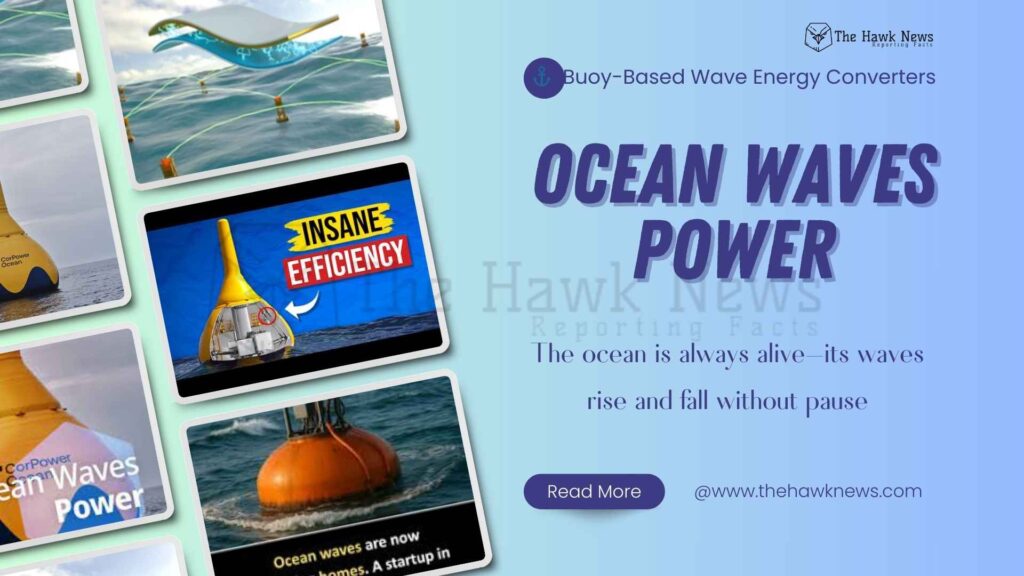
At the center of this technology are wave energy converters (WECs) — floating buoys that transform the ocean’s endless movement into electricity.
Here’s how it works:
- Floating on Waves: Specially designed buoys are anchored offshore. As waves move, the buoys rise, fall, and tilt with the water.
- Mechanical Motion: This motion drives pistons, hydraulic pumps, or turbines inside the buoy.
- Electricity Generation: The mechanical movement turns a generator, creating electricity.
- Subsea Transmission: Power is sent via underwater cables to the shore, where it connects to the national grid.
It’s a blend of engineering elegance and natural rhythm. Each buoy is a miniature power station, silently harvesting the sea’s kinetic dance.
Types of Buoy Systems
Engineers have developed several buoy-based approaches to capture wave energy:
- Point Absorbers: Small, independent buoys that bob up and down, generating power individually.
- Attenuators: Long, snake-like floating structures that flex with wave motion, converting energy along their length.
- Oscillating Water Columns: Hollow buoy structures where waves force air through a turbine.
Each design reflects a different philosophy of energy capture — from small modular stations to massive floating farms.
Wave Power Around the World
Though still in its infancy compared to wind and solar, wave energy has already been tested in several pioneering projects:
- Portugal’s Aguçadoura Wave Farm deployed large attenuator buoys known as Pelamis, which floated offshore, turning wave motion into electricity.
- Scotland’s Oyster Project tested nearshore devices that hinged with the waves.
- Australia and the U.S. have invested in buoy prototypes designed to survive extreme storms while continuing to generate energy.
These trials, though not without challenges, have proven one thing: wave energy is not just possible, it is powerful.
Why Wave Power Is a Game-Changer
- 24/7 Availability: Waves are constant, unlike the intermittent nature of sun and wind.
- High Energy Density: Waves pack more energy per square meter than wind or solar.
- Space Efficient: Buoy farms sit offshore, leaving land untouched.
- Scalable: Systems can be modular — from a single buoy powering a community to massive buoy networks powering entire cities.
For coastal nations — from island states in the Pacific to industrial powerhouses like India and the U.S. — this technology represents an opportunity to redefine their energy independence.
Challenges on the Horizon
Of course, no technology comes without hurdles. The ocean is a harsh environment. Saltwater corrodes metal, storms test durability, and installation costs remain high. Energy transmission through subsea cables also requires robust infrastructure.
But as with solar and wind, early costs are expected to drop sharply as innovation, scaling, and investment accelerate. Just as today’s sleek solar panels were once expensive curiosities, buoy-based wave power could soon become mainstream.
The Future: Innovation Beyond Imagination
What could the future of buoy-powered energy look like? Here are some visionary possibilities:
- Smart Buoys: Equipped with AI to adjust to wave conditions, maximizing energy capture.
- Floating Power Islands: Vast arrays of buoys acting as offshore energy farms.
- Hybrid Systems: Platforms combining wave, wind, and solar energy in one floating station.
- Coastal Empowerment: Remote villages and islands powered entirely by the ocean around them.
Imagine standing on a beach at night, looking out to sea. Beyond the horizon, hundreds of silent buoys bob up and down, glowing faintly, sending clean electricity back to shore. No smoke, no noise, just nature and technology working in harmony.
This is not science fiction — it’s the direction research is heading.
Why the World Should Care
As climate change accelerates, the urgency for renewable energy grows sharper. Wave energy, with its unique strengths, could play a decisive role in balancing the global energy mix. It won’t replace solar or wind but complement them, creating a trio of clean power sources that can finally free humanity from fossil fuel dependency.
For countries like India, with its vast coastline, or nations in Europe with rough Atlantic waves, buoy-based energy is more than just a dream. It’s a necessity waiting to be realized.
Conclusion
From ancient mariners using buoys to mark safe passages, to modern engineers reimagining them as tools for global energy security, the journey of the buoy is nothing short of remarkable.
If the 20th century was the age of oil, and the early 21st century belongs to wind and solar, then the decades ahead could well belong to the ocean.
In the gentle rise and fall of the waves lies a promise: a world powered by the rhythm of the sea, clean and endless, riding the tide toward a sustainable future.