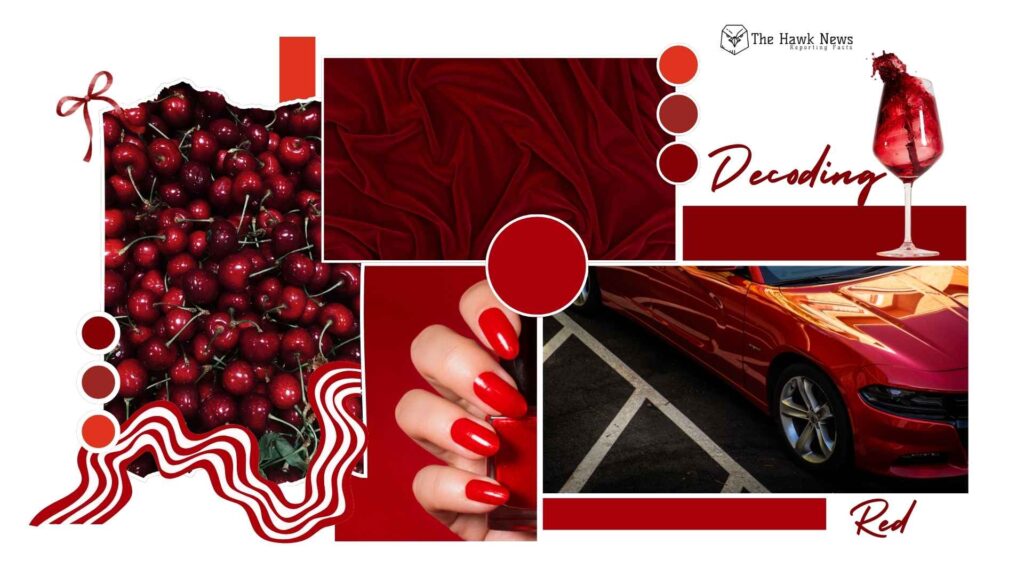
Why the world’s most commanding colour still rules our attention, emotions, and decisions.
Red is not a colour that waits to be noticed. It doesn’t whisper; it arrives like a declaration. Across cultures, industries, and eras, red has been the hue of urgency, passion, power, and even danger.
It’s the first colour our eyes detect in a crowd, and often the last one we forget. But the real story of red goes far deeper than its striking shade — it sits at the crossroads of psychology, culture, biology, and behaviour.
This is the anatomy of red, the world’s most emotionally charged colour.
The Biology of Attraction: Why We See Red First
Human eyes are wired to pick up red wavelengths faster and more intensely than most other colours.
Evolutionary psychologists believe this sensitivity comes from survival instincts — our ancestors had to spot red berries against green foliage, detect flushed skin signaling anger or illness, and identify fire or blood as signs of danger.
That wiring hasn’t changed.
Today, red still quickens the pulse. In controlled experiments, participants shown the colour red before a task had:
- higher heart rates
- increased alertness
- faster reaction times
Red demands cognitive priority — it is the colour that says, “Pay attention now.”
The Psychology of Power, Passion & Dominance
Red sits on the emotional extremes of the human palette.
1. Red as Power
In competitive sports, teams wearing red have been found to win more often, not because the colour gives them an advantage, but because opponents subconsciously perceive them as more dominant. Red intimidates — silently.
2. Red as Passion
Red lipstick, red roses, red dresses — the colour has been synonymous with desire for centuries. Its association with flushed skin under emotional arousal makes it a universal signal of attraction.
3. Red as Anger & Warning
Traffic lights, stop signs, hazard symbols — red is our global language for caution. It triggers an internal “fight-or-flight” nudge, making red an emotional accelerator.
Red is the colour that can love you and alarm you in the same breath.
Cultural Meanings: Red Is Not the Same Everywhere
While the psychological pull is universal, the interpretation varies beautifully across cultures.
🇨🇳 In China
Red is prosperity, luck, and joy. Weddings are red. New Year is red. It symbolizes an overflowing life.
🇮🇳 In India
Red is bridal, sacred, celebratory. From sindoor to sarees, red marks new beginnings.
🇯🇵 In Japan
Red is life force, energy, and the rising sun — the colour of renewal.
🇿🇦 In South Africa
Red signifies mourning and deep remembrance.
🇺🇸 In the West
Red is romance, warning, and rebellion all at once — a colour with many faces.
Cultures write their stories on colours, but red always ends up with an entire chapter.
Red in Marketing: The Colour That Sells
Brands use red because people respond to it — instantly and emotionally.
- Coca-Cola uses it to signal excitement and energy.
- Zomato & Swiggy use red/orange to spark appetite.
- YouTube uses it to imply urgency and capture attention.
Red increases click-through rates, triggers impulsive decisions, and makes logos unforgettable. It’s not an aesthetic choice; it’s a psychological strategy.
Red in Everyday Life: The Unseen Influencer
Most people don’t realize how often red shapes their behaviour:
- You walk faster at a red sign, even when no cars are coming.
- You eat more in restaurants painted in warmer hues.
- You remember brands with red logos more than blue ones.
- You feel more self-confident wearing a red outfit.
Red quietly rewires moods, decisions, and reactions — without asking for permission.
The Colour of Extremes
Red rarely stays neutral.
It is the colour of life (blood) and the colour of loss.
The colour of celebration and the colour of caution.
The colour of the festival and the colour of the battlefield.
Red commands because it represents the most intense human experiences — everything that makes us feel alive.
Why Red Still Matters in a Digital Age
In an era of screens, feeds, and notifications, red’s power has only amplified. That tiny red dot on your phone — the notification badge — is perhaps the most modern example of how red can hijack your attention in seconds.
A single red pixel can pull your eyes away from a room full of people.
The world has changed, but red hasn’t.
It still leads.
It still shouts.
It still wins.
The Final Word
If colours are languages, red is the loudest.
If colours are emotions, red is the deepest.
If colours are signals, red is the sharpest.
The psychology of red isn’t just about what we see — it’s about what we feel before we even realize we’re feeling it.
Red is not just a colour.
It’s an experience.