“Glory be to Him who perfected everything, and placed in a small creature a secret that led humanity to tremendous development.”
The Sky’s Swiftest Hunter
If you look up on a clear day and spot a dark streak plunging from the heavens at breakneck speed, you might be witnessing nature’s fastest creature — the peregrine falcon.
Known for its breathtaking “stoop dive,” this raptor can reach speeds of over 320 km/h, sometimes even touching the 400 mark, as it locks onto prey with military precision.
But what’s most astonishing is not just its speed — it’s how it survives that speed. At such velocity, the pressure from the air alone could rupture the lungs or damage the brain of most living beings.
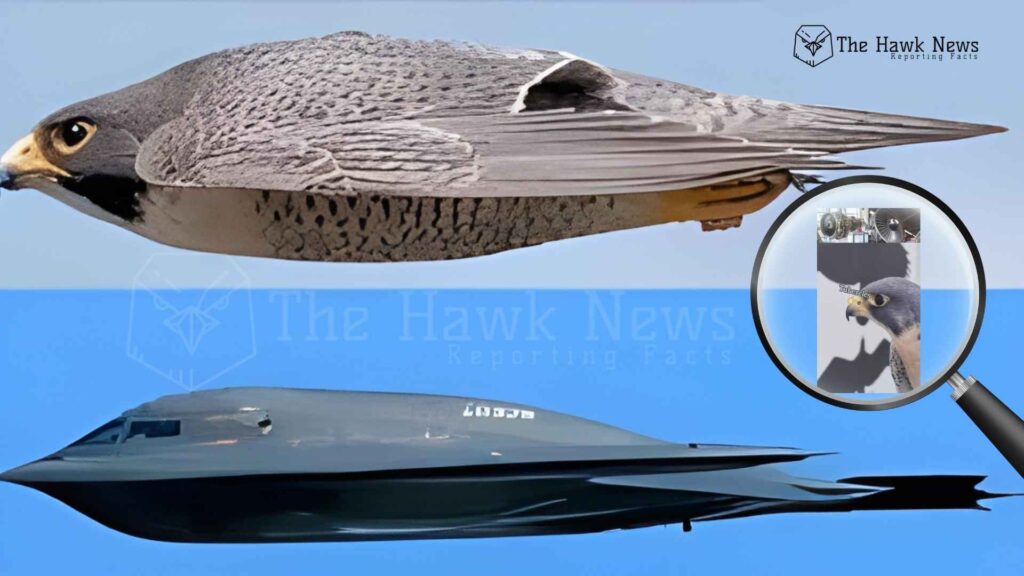
Yet the peregrine, with grace carved into every feather, dives unfazed. Its secret lies in something almost invisible: a small bony structure in its nose known as a tubercle.
The Tubercles: God’s Masterstroke
The peregrine’s nostrils aren’t just holes for breathing — they’re engineering marvels. Inside sits a tiny cone-shaped bump, or tubercle, that regulates the airflow as the bird dives.
When air rushes in at hundreds of kilometers per hour, it hits this small structure, spiraling and slowing before it enters the lungs. What could have been fatal pressure becomes a controlled stream of life-giving oxygen.
In essence, nature designed a natural air intake diffuser — the same principle that powers modern jet engines.
This discovery fascinated scientists and engineers alike. How could a creature’s nostril, no larger than a pea, master the same aerodynamics that human technology would take centuries to refine?
When Nature Becomes the Teacher
Aeronautical engineers began studying the peregrine’s nose to understand its flow control mechanism. Their goal was to design jet inlets and engine cones that could manage extreme air pressures at supersonic speeds.
The concept inspired airflow baffles in modern engines and helped refine the designs of high-speed aircraft and drones.
While popular culture often claims the B-2 bomber was inspired by the peregrine’s dive, evidence suggests that while not a direct copy, the falcon’s form — sleek, stealthy, aerodynamic — certainly influenced the thinking of aerospace designers seeking natural efficiency.
As one researcher noted, “Every feather of a falcon is shaped by flight; every bolt in an aircraft is shaped by math. Between them lies inspiration.”
Design Hidden in Simplicity
What makes the peregrine so remarkable is how many of its features work together like a symphony of motion.
- Its teardrop-shaped body reduces drag.
- Its wings form an “M” shape mid-dive, generating stabilizing vortices.
- Its third eyelid (nictitating membrane) protects its eyes from the wind while maintaining sight.
- Its tubercles safeguard its breathing system.
Each adaptation is a line in nature’s poetry — elegant, efficient, and essential.
Scientists using Computational Fluid Dynamics (CFD) simulations discovered that the falcon’s body forms micro-vortices that stabilize it even at terminal velocity.
This natural design prevents tumbling and ensures precise trajectory — something engineers still struggle to perfect in fast-moving machines.
From Feathers to Flight Decks
The peregrine falcon didn’t just teach us how to fly faster; it reminded us how to fly smarter.
Engineers borrowed nature’s blueprints not to replicate them, but to learn from them. Concepts inspired by falcon physiology now appear in:
- Jet engine inlets that diffuse high-pressure air more efficiently.
- Drone nose designs for smoother airflow and less turbulence.
- Aerodynamic surface studies that mimic feather layering to reduce drag.
This is biomimicry in its truest form — where observation becomes innovation, and creation becomes a classroom.
Lessons Beyond the Sky
Yet the peregrine falcon’s story isn’t just about technology. It’s also a meditation on humility — that some of humanity’s greatest breakthroughs come not from laboratories, but from listening to the wind over a bird’s wings.
We often think progress comes from conquering nature, but true wisdom lies in cooperating with it. The peregrine, diving through clouds and wind, teaches us that survival and mastery both come through balance — not brute force.
Its tubercle, small yet significant, becomes a metaphor: sometimes the smallest disciplines — a breath held, a boundary honored — determine whether we soar or shatter.
Faith in Design
For many who study the peregrine closely, its elegance evokes awe that transcends science. The falcon’s perfection — its speed, precision, and survival mechanism — points to an intelligence far beyond randomness.
It’s no wonder the verse echoes in the hearts of many observers:
“Glory be to Him who perfected everything.”
The falcon doesn’t just reveal aerodynamic truth; it reveals divine craftsmanship. Its nose holds lessons for engineers, but its existence holds lessons for the soul — that within every living being, there lies wisdom waiting to be discovered.
The Legacy of the Falcon
The peregrine falcon was once endangered, nearly lost to pesticide poisoning in the 20th century. Yet through conservation and care, its numbers have rebounded — an echo of resilience, much like humanity’s own.
Today, peregrines thrive atop skyscrapers, adapting to cityscapes where the wind tunnels mimic cliffs.
They dive past glass and steel, as though reminding us that nature still lives amidst our machines — and that both belong to the same sky.
A Warning in the Wind
As we marvel at this bird’s brilliance, a quiet warning hums beneath the wings:
Innovation without reverence becomes arrogance.
We must not strip wisdom from creation only to use it for destruction.
The falcon’s design, borrowed for bombers and drones, reminds us that power without conscience can turn the beauty of understanding into a weapon of harm.
If we truly wish to honor the lesson of the peregrine, then let every discovery lift us toward preservation, not domination. Let every flight of innovation begin — and end — in humility.
Conclusion: Look Up, and Learn
The peregrine falcon remains a living testament to the marriage of science and soul. A creature of velocity, grace, and divine geometry.
In its dive, we find both fear and faith.
In its nostril, both simplicity and genius.
In its existence, a whisper — that perfection is not man-made but God-breathed.
The next time you see a falcon slicing through the horizon, remember: within its flight lies the future of our skies, and the fingerprints of the One who taught us to look up and learn.