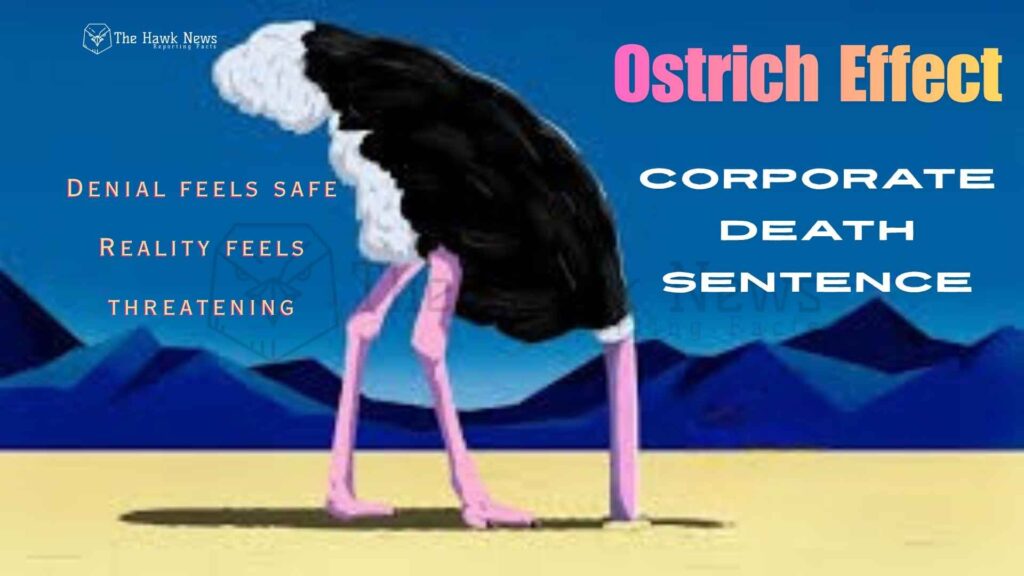
The Ostrich Effect isn’t just a bias — it’s a corporate death sentence.
There’s a myth that ostriches bury their heads in the sand. They don’t. But in corner offices across the world, many leaders do.
They avoid bad news. They silence uncomfortable conversations. They treat data like an enemy. They mistake positivity for progress.
This is the Ostrich Effect — a psychological trap where leaders ignore threatening information because it feels emotionally easier. Yet nothing destroys a company faster than a leader who refuses to look at what’s real.
Most organisations don’t collapse due to competition.
They collapse due to avoidance at the top.
What the Ostrich Effect Looks Like in Corporate Leadership
| Behaviour Ignored | Consequence |
|---|---|
| Falling sales numbers | Misdiagnosed strategies |
| Customer complaints | Brand erosion |
| Employee warnings | Talent loss |
| Market shifts | Becoming obsolete |
| Internal weaknesses | Public disaster |
A leader who avoids truth doesn’t freeze the problem — they fertilise it.
1. Why Leaders Avoid Hard Truths
Power exposes human nature, and leadership magnifies it.
Executives avoid realities because facing them requires:
- humility,
- accountability,
- admitting misjudgments,
- restructuring strategies,
- confronting investors,
- and accepting they were wrong.
Many leaders would rather protect their ego than protect their company.
Denial feels safe.
Reality feels threatening.
But avoidance doesn’t make danger disappear; it simply blinds the decision-maker who is supposed to prevent it.
The Psychological Triggers Behind Avoidance
► Cognitive Dissonance
“I’m successful — this bad data can’t be right.”
► Ego Preservation
“If I admit this, my leadership looks weak.”
► Sunk-Cost Fallacy
“We invested too much to change direction.”
► Fear of Panic
“If the team knows the truth, morale will collapse.”
► Comfort Addiction
“It’s easier to hear praise than to hear warnings.”
These internal triggers lead to external disasters.
2. What Avoidance Does to a Company
When a leader ignores truth, the entire organisation slowly suffocates.
Problems expand, innovation dries up, and the best employees quietly exit.
Symptoms of a Company in Denial:
• Decision Delay Syndrome
Problems sit untouched until they explode.
• Yes-Men Culture
Employees say what leaders want to hear, not what they need to hear.
• Fear-Driven Teams
Truth becomes dangerous.
Silence becomes survival.
• Outdated Strategies
Plans stay connected to yesterday instead of tomorrow.
• Innovation Paralysis
Teams fear proposing new ideas because leadership avoids criticism.
The organisation becomes a machine running on blind optimism instead of data-driven truth.
Internal Damage Map
 Avoidance
      ↓
     Poor Decisions
                 ↓
              Market Misalignment
                             ↓
                            Customer Loss
                                       ↓
                                      Revenue Decline
                                                   ↓
                                                  Desperation Moves
                                                                 ↓
                                                                 Company Collapse
Avoidance isn’t passive — it is an active staircase to failure.
3. Case Studies: Companies That Collapsed Because Leaders Looked Away
Nokia
Employees repeatedly warned leadership about the smartphone era.
Executives ignored it, believing their dominance was permanent.
Within years, they faded from relevance.
Kodak
Kodak invented the digital camera.
Leadership buried it, terrified it would hurt film sales.
Their fear ended up costing them the entire company.
BlackBerry
They dismissed touchscreens as a trend.
Their arrogance turned into their obituary.
Blockbuster
Netflix approached them for partnership.
Blockbuster laughed.
History didn’t.
The common thread?
Leaders who refused to see what was coming.
The Three Signs of a Leader Who Will Sink the Company
► They only want good news
► They punish dissent
► They believe current success guarantees future success
Every downfall begins with these behaviours.
4. How Avoidance Destroys Teams
The most brutal impact of the Ostrich Effect isn’t on the balance sheet — it’s on people.
Employees learn quickly:
- speaking truth = risk
- questioning leadership = disrespect
- raising concerns = career suicide
So they shut down. They stop innovating. They stop caring.
A team without psychological safety becomes a team without momentum.
Employee Behaviour Shift (Before vs After Avoidance Sets In)
| Before Avoidance | After Avoidance |
|---|---|
| Honest feedback | Strategic silence |
| Creative ideas | Safe, predictable work |
| Transparent communication | Hidden problems |
| Belief in leadership | Quiet resignation |
When leaders fear truth, employees fear leaders.
5. Why Modern Businesses Fail Faster When Leaders Avoid Reality
In the past, companies had time to correct mistakes. Today, the business world moves at the speed of a notification.
A leader who avoids truth for six months may doom their company permanently.
Because modern business punishes:
- slow reactions
- outdated models
- refusal to evolve
- emotional leadership
- ego-driven decision-making
The world is moving too fast for denial.
6. What Great Leaders Do Differently
Great leaders run toward problems, not away from them.
They:
✅ ask uncomfortable questions
✅ reward truth, not flattery
✅ confront bad data early
✅ admit mistakes quickly
✅ correct course fast
✅ build cultures where honesty is safe
They understand that clarity is not a threat — it is protection.
Poor leaders avoid reality. Great leaders adapt to it.
The Anti-Ostrich Leadership Checklist
☐ Do I get unfiltered reports?
☐ Do employees feel safe disagreeing with me?
☐ Do I admit mistakes before they become crises?
☐ Do I react defensively to bad news?
☐ Do I change strategy when the data demands it?
☐ Do I punish or reward truth?
A leader who ticks these will not crumble.
7. Final Reflection: Denial Delays Disaster — It Doesn’t Prevent It
Most companies don’t die because of competition. They die because their leaders refused to look at the truth staring them in the face. Avoidance is comfortable. Comfort is addictive. Addiction is deadly.
Truth may sting for a moment,
but denial destroys for a lifetime.
In the end, the greatest threat to any company is a leader who hides from reality. Because denial may delay disaster, but it never prevents it.