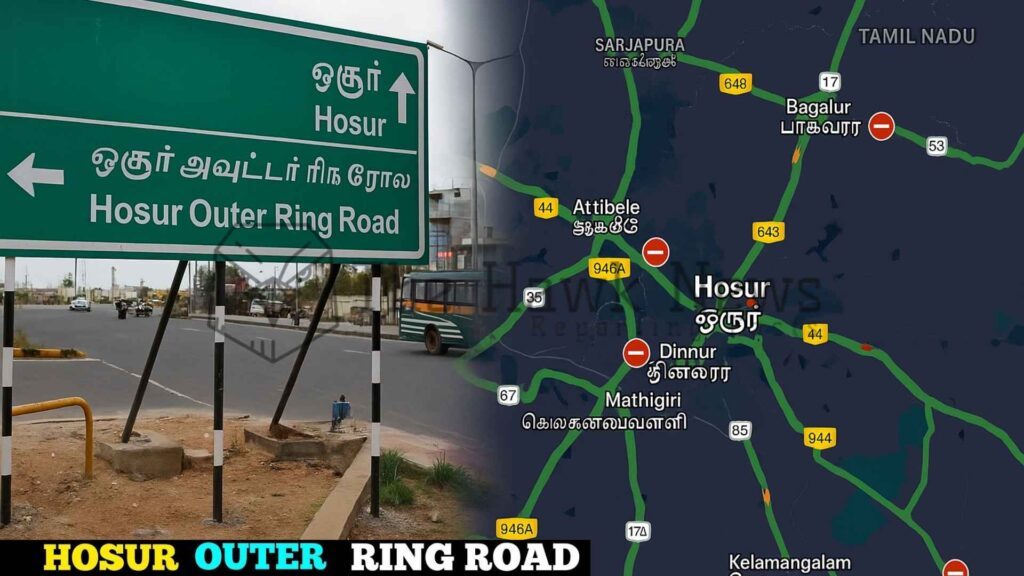
If you’ve ever driven into Bengaluru from Tamil Nadu, chances are you’ve inched your way through Hosur, a bustling industrial town that has quietly become one of India’s fastest-growing urban hubs.
But while Hosur is racing ahead in industry, its roads are stuck in traffic.
The Outer Ring Road, once seen as a savior for traffic management, has now turned into a nightmare.
The culprit? A mix of long-delayed flyover projects, repair works, and haphazard diversions that have left commuters and truck drivers frustrated.
Why Hosur Matters
Hosur isn’t just another border town. It is:
- The main gateway into Bengaluru from Tamil Nadu. Vehicles from Chennai, Vellore, Kancheepuram, and even far-off districts like Trichy and Thanjavur funnel through Hosur before entering Karnataka.
- An industrial powerhouse. Ranked as India’s 13th fastest-growing industrial city, Hosur is home to major automobile, electronics, and manufacturing companies. Tens of thousands of trucks, buses, and cars move through the city daily.
- A population hub. With thousands of workers commuting to Bengaluru every day, smooth connectivity is not just about convenience but about livelihood.
For a city that sits at such a strategic crossroads, traffic management is critical. Yet, Hosur’s roads have buckled under pressure.
The GRT Circle Flyover Crisis
At the heart of the mess lies the 20-year-old GRT Circle flyover. In June this year, cracks appeared in its structure, forcing authorities to impose restrictions:
- Heavy vehicles banned from the flyover.
- Only light vehicles allowed, leading to diversions for trucks and buses.
Repairs began quickly, but the project deadline is only by end of September 2025. Until then, Hosur’s already overburdened roads are gasping.
Commuters who once zipped through the flyover in minutes are now forced to take long detours, adding both time and fuel costs.
SIPCOT Flyover: A Project Stuck in Limbo
While the GRT Circle repairs were unavoidable, what frustrates Hosur residents most is the incomplete new flyover near the SIPCOT Industrial Area.
- Launched in 2023 with much fanfare, the flyover promised to decongest the area.
- But construction delays have left it half-done, with barricades, diversions, and bottlenecks instead of relief.
- Heavy vehicles that once passed through Hosur town are now diverted via the Outer Ring Road, creating kilometers of jams every single day.
For a city that thrives on industry, the incomplete flyover is more than just a traffic issue—it’s a roadblock to growth.
Daily Struggles of Commuters
For residents, workers, and truck drivers, every day feels like a battle on Hosur’s roads.
Here’s what they face:
- Diversions: From Darga area to Rayakottai Junction, vehicles crawl through narrow alternate routes.
- Incomplete roadworks: The stretch between GRT Circle and Samathuvapuram is dug up in parts, with no clear timeline for completion.
- Outer Ring Road overload: Once a relief road, it now bears the brunt of truck diversions, leaving commuters stuck in queues for hours.
- Multiple construction zones: With works at Bagalur Road and the unfinished SIPCOT flyover, even small trips turn into time-consuming tasks.
In short: a 10-minute drive now takes an hour.
Voices From the Ground
Residents are growing increasingly vocal. Social media posts, local petitions, and commuter forums highlight one clear message: speed up the projects.
- Office-goers complain of losing productivity due to daily traffic snarls.
- Truck drivers are forced to idle for hours, losing money in fuel and delivery time.
- Residents are seeing a drop in quality of life, with noise, dust, and endless honking part of daily existence.
One commuter summed it up: “Hosur is the gateway to Bengaluru, but right now it feels like a trap.”
Why Authorities Struggle
Infrastructure projects in India often face delays, and Hosur is no exception. The reasons include:
- Land acquisition hurdles delaying expansions.
- Coordination gaps between state highways, national highways, and local bodies.
- Funding bottlenecks slowing down large-scale projects.
- Monsoon rains further delaying repair timelines.
While officials assure that works will be completed “soon,” commuters remain skeptical. They’ve heard this before.
Bigger Picture: Growth vs. Ground Reality
Hosur’s situation is a classic example of India’s infrastructure paradox:
- On one hand, the government promotes industrial hubs, smart cities, and economic corridors.
- On the other, ground-level infrastructure—roads, flyovers, drainage—lags behind.
As Hosur continues to attract industries, its traffic woes highlight the urgent need for synchronized planning between urban development and infrastructure projects.
What Needs to Change?
Experts suggest a few immediate and long-term solutions:
- Fast-tracking flyover projects with strict deadlines and penalties for delays.
- Dedicated truck terminals outside Hosur to reduce heavy vehicle pressure inside the city.
- Smarter diversions with proper signage, so commuters aren’t left confused.
- Integrated traffic management between Tamil Nadu and Karnataka authorities.
- Public transport boost—better buses, shuttles, and even rail options for daily workers.
Conclusion
Hosur is at a crossroads—literally and figuratively. As India’s 13th fastest-growing industrial hub and a critical entry point into Bengaluru, its future depends on how quickly and effectively its road network can catch up with its growth.
For now, commuters inch forward in frustration, hoping that one day soon the flyovers will rise, the diversions will clear, and Hosur’s roads will finally breathe again.
Until then, the Outer Ring Road remains not a relief, but a choke point—a daily reminder of promises delayed.