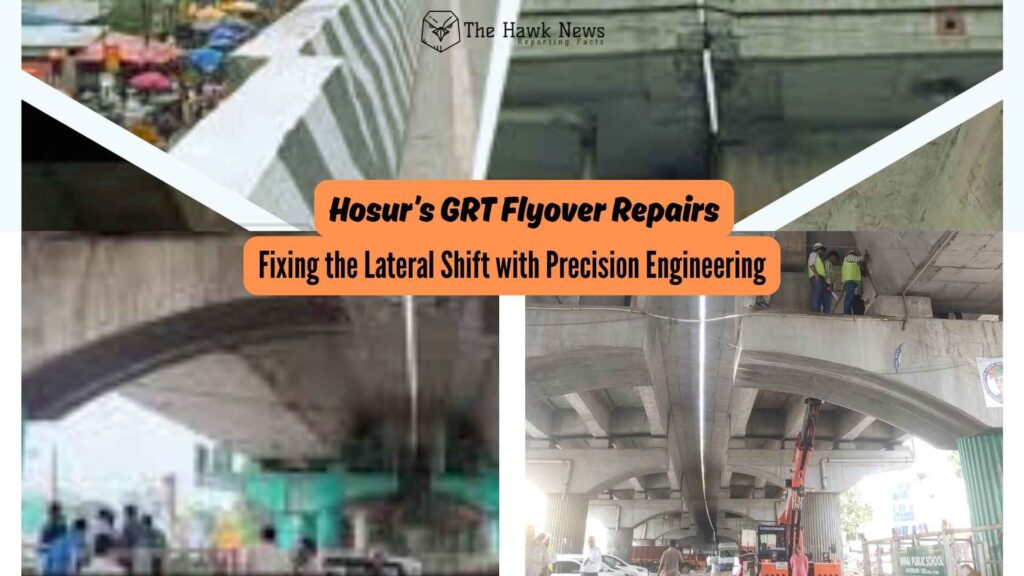
The busy Hosur–Bengaluru corridor on NH-44 came under the spotlight in June 2025 when the GRT Flyover developed a sudden lateral shift.
A 40-meter stretch of the flyover had moved sideways due to damaged bearings—small yet critical components that keep bridges stable.
The issue was detected early during inspections, prompting the closure of a 700-meter section near GRT Junction. What followed was a delicate, high-precision engineering fix that has now restored the structure.
The flyover, however, is not yet open to the public. Authorities are carrying out final safety checks before resuming full traffic.
Why the Flyover Shifted
At the root of the problem were the bearings—devices that:
- Connect the deck (superstructure) to the piers (substructure).
- Allow the bridge to expand, contract, and rotate under temperature and load changes.
- Transfer the enormous weight of vehicles safely to the supports.
When bearings fail or wear out, the bridge can lose balance. In Hosur’s case, heavy traffic and years of wear led to bearing damage, causing the deck to shift sideways.
The Repair Process
The National Highways Authority of India (NHAI) moved swiftly after detecting the fault:
- Closure & Inspection (June 21, 2025): A 700-meter stretch of the flyover was sealed off, especially toward Bengaluru, to avoid risks.
- Hydraulic Lifting (August 20, 2025): Using hydraulic jacks, engineers carefully lifted the affected section of the flyover.
- Bearing Replacement: Damaged bearings were removed and newly manufactured units—already brought to the site—were fixed in place.
- Alignment Restoration: Once the bearings were secured, the deck was lowered back, restoring the flyover’s proper alignment.
According to Golla Ramesh, Project Director, NHAI, the repairs were expected to be wrapped up within a week.
Traffic Management During Repairs
To minimize disruption:
- Hosur → Krishnagiri traffic remained unaffected.
- Krishnagiri → Hosur/Bengaluru (light vehicles): Diverted to the opposite lane.
- Heavy vehicles: Rerouted through the ESI Ring Road.
Despite diversions, traffic continued to move steadily, ensuring Hosur’s key junction did not face total gridlock.
The Role of Bearings in Bridge Safety
This incident highlighted how bearings, though small, are the lifeline of large flyovers. Without them, bridges cannot handle:
- Temperature-driven expansion and contraction.
- Daily vibration and movement from thousands of vehicles.
- Sudden stress from heavy trucks.
The lateral shift at Hosur was a stark reminder: ignoring bearing maintenance can put entire structures—and lives—at risk.
Current Status
As of late August 2025:
- The bearing replacement and structural restoration have been completed.
- The flyover is under monitoring and safety checks.
- Public reopening will follow only after engineers confirm zero residual movement.
The Bigger Picture
The GRT Flyover incident underscores the importance of routine inspections and preventive repairs for India’s growing highway infrastructure. Quick detection and prompt action by NHAI averted a potential disaster.
Once reopened, the Hosur GRT Flyover will once again serve as a vital link between Tamil Nadu and Karnataka, offering safer and smoother rides for thousands of daily commuters.