Silicon Valley is built on a myth.
A myth that brilliance excuses brutality.
That innovation cleanses character.
That world-changing ideas justify world-breaking behaviors.
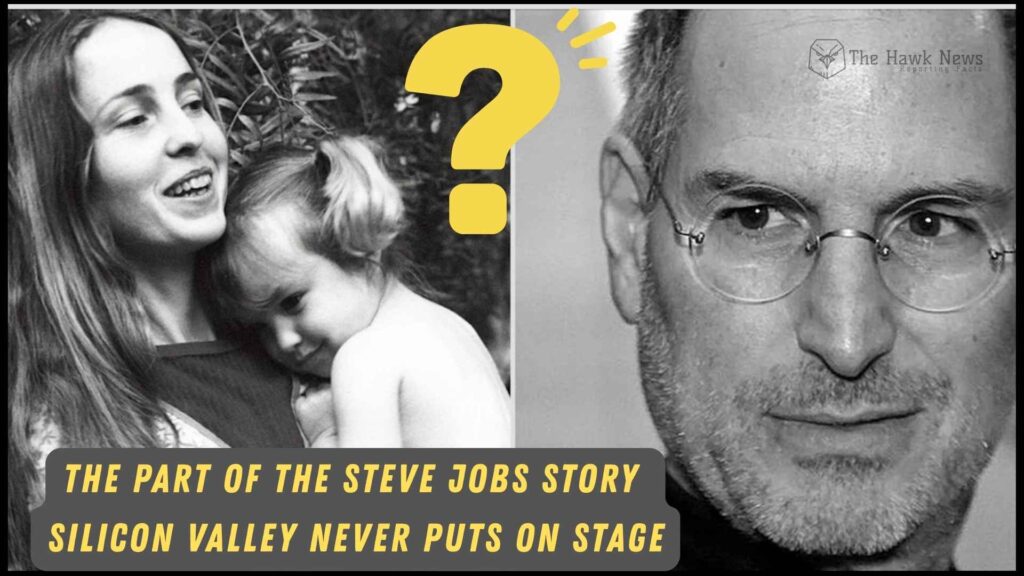
No story exposes that myth more sharply than the one between Steve Jobs and his first daughter, Lisa Brennan-Jobs — a story that sits quietly behind the screen-glow of every device he created, yet rarely enters the worship-filled conversations about his legacy.
Because this story forces us to confront a truth many don’t want to hear:
A genius can change the world and still fail the people who needed him most.
The Part of the Steve Jobs Story Silicon Valley Never Puts on Stage
On May 17, 1978, a baby girl named Lisa is born.
Her mother, Chrisann Brennan, holds her. Her father, Steve Jobs — 23 years old, ambitious, unstoppable — is not there.
He arrives three days later.
Not to embrace her.
Not to acknowledge her.
But reluctantly — after a friend insists.
Jobs denies he is her father.
Publicly.
Repeatedly.
Coldly.
When a court orders a DNA test, the results are unequivocal:
94.1% probability he is the father.
Jobs answers by telling TIME magazine:
“Twenty-eight percent of the male population of the United States could be the father.”
That’s not just denial.
That’s humiliation wrapped in mathematics.
Imagine growing up and realizing your father — the same man the world calls a visionary — reduced your existence to a statistic.
The Computer Named After the Daughter He Denied
Here’s the part most people still don’t know:
While publicly denying Lisa, Apple was quietly building a revolutionary machine.
They called it the Apple Lisa.
Officially, Apple claimed the name stood for Local Integrated Software Architecture.
A neat acronym.
A technical explanation.
A shield.
But the truth, admitted by Jobs years later:
“Obviously, it was named for my daughter.”
Pause and sit with that.
He denied her in court.
Denied her in interviews.
Denied her in her face.
But he named a computer after her.
He immortalized her in silicon before he acknowledged her in life.
The world saw Lisa-the-computer long before Lisa-the-child ever heard her father speak the truth.
A Girl Who Grew Up on Welfare While Her Father Became a Multimillionaire
When Apple went public in 1980, Jobs became worth over $200 million.
His child support?
$500.
Lisa and her mother lived in poverty.
Her mother cleaned houses to survive.
Lisa went to public school, wore second-hand clothes, and lived the childhood of a girl abandoned by a man the world worshipped.
All while the magazines showed Steve Jobs smiling next to the machine named after her.
That contrast is not a footnote.
It’s the heart of the story.
The Moment the Truth Finally Slipped Out
For years, Lisa would ask her father if the computer was named after her.
Every time, he said no.
Until one day, years later, Lisa, Steve Jobs, and Bono (yes, Bono from U2) were having lunch. Bono asked about Apple’s early days — and Jobs casually revealed:
“Yes, the Lisa computer was named after my daughter.”
That was the first time he ever admitted it to her.
Not in private.
Not as a father.
But because another famous person was sitting at the table.
Lisa later said:
“That’s the first time he’s said yes. Thank you for asking.”
Imagine needing a rock star to crack open your father’s honesty.
Did Steve Jobs Change? Yes. But Change Doesn’t Erase the Beginning.
To his credit, Jobs eventually apologized.
He reconnected with Lisa.
She lived with him as a teenager.
He cried, regretted, tried to repair.
But redemption does not erase damage.
Repair is not reversal.
Apology is not absolution.
And this is the part Silicon Valley refuses to face:
You can be a revolutionary and still be wrong. You can change the world and still break the people closest to you.
THE VANTAGE POINT NO ONE DISCUSSES
Here it is — the eye-opener:
Genius Is Not a Moral Currency. It Doesn’t Buy You Out of Responsibility.
Our culture is obsessed with exceptionalism.
We worship brilliance.
We forgive cruelty when it comes packaged with innovation.
But brilliance is not a virtue.
It’s a skill.
Kindness is a virtue.
Integrity is a virtue.
Responsibility is a virtue.
Steve Jobs didn’t fail the world — he transformed it.
But he failed his daughter long before he tried to fix the damage.
And that matters.
Because behind every celebrated genius, there is someone who pays the cost we don’t see.
THE REAL QUESTION THIS STORY FORCES US TO ASK
Silicon Valley always talks about sacrifices necessary for greatness.
But who gets sacrificed?
Who decides that a child’s emotional security is an acceptable price for innovation?
Who decided that Lisa — a little girl who never asked for anything except her father’s love — could be dismissed as statistical noise?
The world got the iPhone.
The iPad.
The future.
Lisa got denial.
This is not about Steve Jobs alone.
It is about every system — tech, corporate, cultural — that excuses cruelty in the name of brilliance.
The Blind Worship Must End
Genius deserves admiration.
But not immunity.
Vision deserves celebration.
But not absolution.
Progress should elevate us — not excuse us.
And greatness?
Greatness means nothing if it comes at the cost of the very people who needed you most.
Because the world got Steve Jobs the visionary.
But Lisa Brennan-Jobs — before she became a Harvard graduate, a writer, a woman who rebuilt herself — had to grow up wondering why the man who changed the world couldn’t show up for his own child.
And that is the story we must stop overlooking.