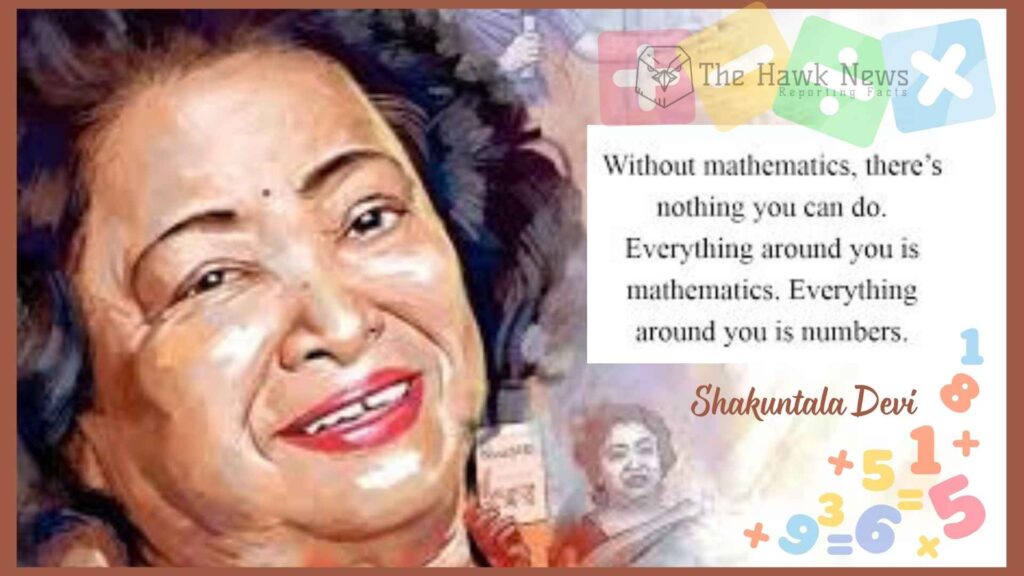
For most people, mathematics is remembered as a subject of dread—long equations, endless tables, and the occasional panic before exams. But for Shakuntala Devi, famously nicknamed the “Human Calculator,” math was never about anxiety or boredom. It was about joy, energy, and performance. She not only mastered numbers but transformed them into a spectacle that mesmerized the world.
Long before the words “edutainment” or “STEM influencers” entered our vocabulary, Shakuntala Devi was already living them. With a mix of brilliance, charisma, and stage presence, she proved that numbers could be as entertaining as music, dance, or theater.
This is the story of how Shakuntala Devi turned mathematics into entertainment—from live stage performances to global media appearances, all the way to her legacy on the silver screen.
The Math Entertainer
Born in 1929 in Bangalore, Shakuntala Devi discovered her gift for numbers at the age of three. By the time most children were learning basic addition, she was already solving complex equations without any formal education. Her father, a circus performer, noticed her ability early on and took her on tour to showcase her extraordinary skill. What started as small demonstrations grew into international performances that would eventually put her in the Guinness Book of World Records.
But what set Shakuntala Devi apart wasn’t just her ability to calculate—it was her ability to entertain. When she performed massive calculations in front of crowds, she did not appear nervous or robotic. She smiled, joked with the audience, and created suspense before revealing the correct answer—always faster than a calculator. In other words, she didn’t just solve math problems; she performed them.
The Stage Performer
Throughout the 1960s and 70s, Shakuntala Devi traveled across India, the United States, and Europe, performing live on stage. Universities, auditoriums, and even TV studios became her playground. She would take numbers suggested by audience members—often 10-digit figures multiplied by another 10-digit figure—and within seconds, deliver the correct answer. Audiences gasped, applauded, and even stood in ovation.
One of her most famous feats occurred in 1980 at the Imperial College in London. She multiplied two randomly chosen 13-digit numbers in just 28 seconds. To put that in perspective, it was a calculation that would have taken early computers minutes to solve. When her answer was confirmed as correct, the crowd erupted in disbelief and admiration. This performance officially landed her a spot in the Guinness Book of Records.
The remarkable part was not just the math but the showmanship. She turned arithmetic into theater, leaving audiences as thrilled as if they had just watched a magic trick. Except, unlike magic, there were no secrets—only raw human genius.
Math as Entertainment
What made Shakuntala Devi so unique was her ability to connect with her audience. She didn’t stand stiffly behind a blackboard. She walked, spoke, laughed, and made math feel lighthearted. She knew that for most people, numbers were intimidating, so she deliberately softened the experience with humor and storytelling.
She often joked with students about their fear of math, quizzed volunteers in the crowd, and playfully teased skeptics who doubted her skills. For many children in the audience, this was the first time they saw math associated with fun rather than stress.
In many ways, she was a performer akin to a stand-up comedian or magician, but her tricks were real calculations. By framing math as a performance rather than a problem, she created an atmosphere of excitement that was rare for an academic subject.
A Global Phenomenon
Shakuntala Devi’s fame spread far beyond India. She performed in the United States, often impressing professors at MIT and Stanford. She also toured Europe, where audiences who didn’t share her language still connected with her demonstrations. After all, numbers are universal.
Foreign journalists dubbed her “The Human Computer,” though she disliked the title. She argued that she was not a machine but a human being whose talent came from intuition, practice, and creativity. “A computer has to be programmed,” she once said. “I have to think.”
Her insistence on being recognized as human rather than machine is part of what made her so relatable. She wasn’t just showing off talent; she was showing what the human mind could achieve.
The Media and Screen Legacy
As her fame grew, Shakuntala Devi appeared on numerous television programs worldwide. She became a global celebrity, often featured in interviews that highlighted her charisma as much as her brilliance. On-screen, she radiated confidence and wit, effortlessly charming audiences who tuned in not just to watch math but to experience her personality.
Decades later, her life was immortalized in the 2020 Bollywood biopic Shakuntala Devi, with Vidya Balan playing the lead role. The film portrayed her not just as a math genius but as a vibrant, flawed, and ambitious woman who wanted to live life on her own terms. By bringing her story from stage to screen, the film introduced her legacy to a new generation, sparking renewed conversations about women in STEM and the importance of making education engaging.
Shakuntala Devi: A Pioneer of Edutainment
In many ways, Shakuntala Devi was a pioneer of “edutainment”—a concept that combines education with entertainment. Today, we have YouTube math channels, gamified learning apps, and TED Talks that blend knowledge with showmanship. But Shakuntala Devi was doing it in the 1950s and 60s, without digital tools, PowerPoint slides, or flashy graphics.
Her ability to turn an intimidating subject into something enjoyable was revolutionary. She gave people a new perspective: math wasn’t something to fear; it was something to marvel at. This philosophy of learning through enjoyment is something educators and creators are still trying to master today.
Beyond Numbers
While Shakuntala Devi will always be remembered for her mind-boggling mathematical skills, her contributions went beyond numbers. She was also a prolific author, writing books on puzzles, astrology, and mathematics. But perhaps her most groundbreaking work was her 1977 book The World of Homosexuals, one of the first in India to openly discuss homosexuality. At a time when the topic was taboo, she argued for acceptance and empathy.
This showed that Shakuntala Devi was not just a math genius but a visionary thinker who dared to challenge social norms. She wanted to use her intellect not just to impress but to enlighten.
The Legacy Lives On
Today, as educators look for ways to make learning more engaging and less stressful, Shakuntala Devi’s life serves as an inspiration. She didn’t just solve equations; she solved the problem of how to make math fun. She proved that entertainment and education don’t have to be separate worlds—they can enhance each other.
Shakuntala Devi once said, “Numbers have life; they’re not just symbols on paper.” Her performances embodied that belief. She gave numbers a stage, a voice, and a personality. And in doing so, she left behind a legacy that continues to inspire mathematicians, educators, entertainers, and ordinary learners alike.
Her story is a reminder that brilliance is not just about what you know but how you share it. By blending intellect with performance, Shakuntala Devi redefined what it means to be a genius—and ensured that math could make people smile.