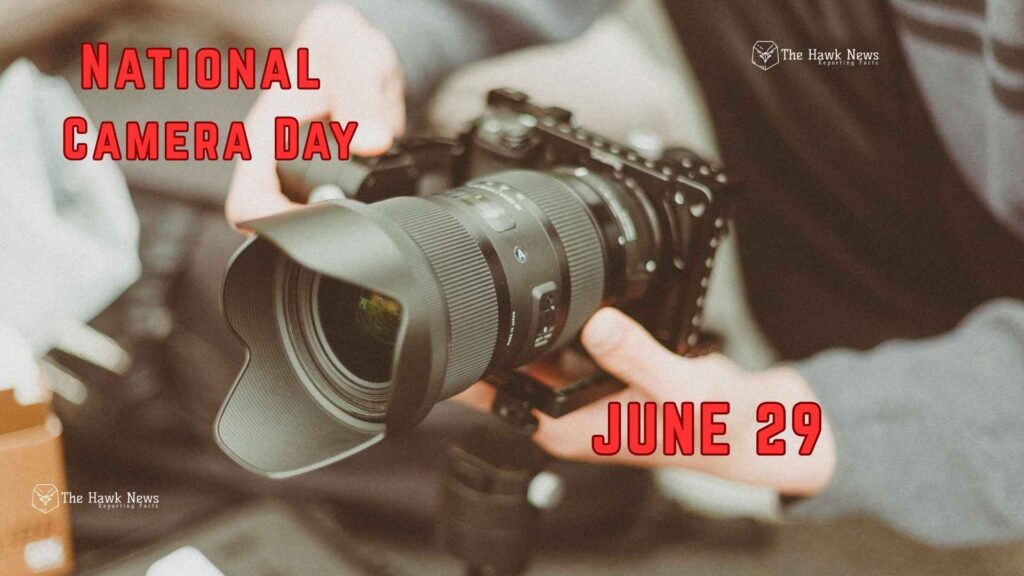
Each year on June 29, a simple click unites people across generations and geographies.
From vintage film cameras to sleek smartphones, from professional DSLRs to drones hovering above cityscapes — the world collectively pauses to celebrate National Camera Day, a tribute to the invention that changed how humanity sees itself.
This day honors not just the camera as a device, but as a mirror of progress, a window to the world, and a keeper of memories.
It’s a celebration of human curiosity, invention, and the unending desire to capture time through light.
The Origins of the Camera: Light Meets Legacy
Long before filters and megapixels, there was patience — and persistence. In the early 19th century, Joseph Nicéphore Niépce, a French inventor, managed what no one had before him: he produced the first permanent photograph in 1826.
Using a pewter plate and bitumen of Judea (a type of asphalt), Niépce captured a grainy but unmistakable image from his window — View from the Window at Le Gras.
That single image marked the beginning of photography — the moment humanity learned to stop time.
Niépce’s work inspired others, notably Louis Daguerre, who developed the daguerreotype process in 1839, allowing clearer images with shorter exposure times. Across the Atlantic, William Henry Fox Talbot invented the calotype, which introduced the concept of negatives — the foundation of film photography.
These pioneers weren’t just inventors; they were visionaries trying to make light stand still.
The Democratization of Photography: Eastman’s Revolution
For decades, photography remained an elite pursuit — complex, expensive, and technical. That changed in 1888 when George Eastman, an American entrepreneur, introduced the Kodak camera with a simple slogan:
“You press the button, we do the rest.”
This marked a turning point. The Kodak camera was portable, preloaded with film, and could take 100 photos before being sent back to the factory for processing. Suddenly, photography became accessible to the masses.
Moments that had once slipped away — family gatherings, travels, laughter — could now be preserved forever.
Eastman didn’t just invent a product; he launched a cultural movement. The camera became a household companion, documenting births, celebrations, and the changing tides of life itself.
From Film to Pixels: The Digital Shift
By the late 20th century, the world stood on the edge of another revolution: digital photography. In 1975, Kodak engineer Steve Sasson built the first digital camera, a bulky device that recorded black-and-white images to a cassette tape.
Though primitive by today’s standards, it marked the dawn of a new era.
The decades that followed saw digital sensors replace film, memory cards replace rolls, and screens replace darkrooms. Photography became instantaneous.
No longer limited by cost or chemistry, anyone with a digital camera — and later, a smartphone — could take thousands of pictures with ease.
As smartphones evolved, so did photography itself. What began as an art form became a daily language of expression, from news reporting to personal storytelling.
National Camera Day now celebrates not just invention but innovation, acknowledging the devices that allow us to capture the world at our fingertips.
Modern Milestones: Beyond the Lens
Today’s cameras are marvels of technology.
- DSLRs and mirrorless systems capture images at breathtaking speeds and resolutions.
- Smartphones combine AI with computational photography to enhance color, focus, and detail automatically.
- Drone cameras redefine perspective, offering aerial imagery once reserved for helicopters or satellites.
- Underwater cameras, action cams, and 360° devices expand the boundaries of how we see and share reality.
Yet at the heart of it all remains the same impulse — to freeze a fleeting moment before it passes forever.
Through the Journalistic Lens: Cameras as Witnesses
In journalism, the camera is more than a tool — it’s a witness to truth. From the battlefields of the world wars to civil rights marches and climate protests, cameras have documented humanity’s greatest triumphs and tragedies.
A single photograph can shift perspectives, shape narratives, and spark movements.
Think of Dorothea Lange’s “Migrant Mother”, Nick Ut’s “Napalm Girl”, or the quiet resilience in portraits of ordinary people living through extraordinary times.
National Camera Day, from this vantage point, is a salute to the power of visual storytelling.
It’s a day that honors the men and women who risk everything to bring truth into focus and remind us of our shared humanity.
The Meaning of June 29
Unlike some holidays born from official declarations, National Camera Day emerged organically — from enthusiasts, artists, and tech communities who wanted to honor the instrument that changed how we document life.
June 29 stands as a moment of reflection — a day to appreciate both the technological journey and the human emotion behind every captured frame.
It’s not just about cameras, but about what they enable us to do — to remember, to connect, and to see.
The Soul of Photography: From Light to Legacy
At its core, photography is a paradox — a still image that speaks movement, silence that tells stories, a moment that lasts forever.
Every click is a conversation between the photographer and the world, between light and shadow, between what is and what is remembered.
National Camera Day is not just for professionals or hobbyists. It’s for anyone who has ever paused to frame a moment — for parents capturing their children’s first steps, travelers recording sunsets, and journalists chasing truth through their lenses.
Each photo, whether artistic or spontaneous, is a fragment of history, a visual heartbeat of humanity.
Conclusion: A World in Focus
From Niépce’s rooftop in 1826 to the billions of images uploaded daily across the globe, the camera has evolved from invention to extension of human vision. It has shaped art, journalism, science, and memory itself.
National Camera Day reminds us that behind every photograph lies a story — not just of what’s seen, but of how we choose to see.
So this June 29, as shutters click and screens glow, remember that every photo you take adds to a shared visual legacy.
Because in a world that changes faster than the blink of an eye, the camera remains our most faithful witness — capturing not just images, but life itself.