Bengaluru, India’s bustling technology capital, is no stranger to urban challenges. From traffic congestion to rapid population growth, the city has been racing against time to upgrade its infrastructure. But every now and then, Bengaluru offers a glimpse of how engineering brilliance can transform daily life.
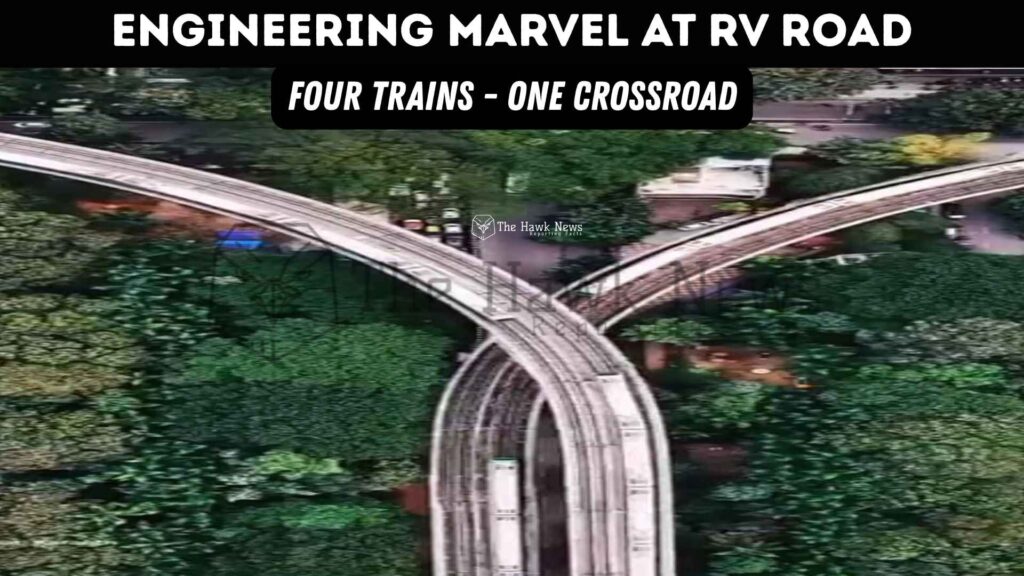
One such moment was recently captured at RV Road, where four Namma Metro trains crossed paths simultaneously—a sight that sparked admiration, pride, and a sense of futuristic progress among citizens.
This rare visual wasn’t just about trains on steel and concrete; it was a symbolic representation of Bengaluru’s aspirations, its struggle with urban mobility, and its march toward becoming a global city.
A Turning Point for Bengaluru’s Urban Transport
The Namma Metro project, launched in 2011, was envisioned to ease Bengaluru’s mounting traffic woes. With over 1.3 crore residents and more than 80 lakh registered vehicles, Bengaluru ranks among India’s most congested cities.
According to the TomTom Traffic Index, the city has consistently been listed among the world’s top ten congested metros, with commuters often spending more than 200 hours a year stuck in traffic.
Against this backdrop, the expansion of the Metro network is more than a convenience—it is a necessity. The sight at RV Road, where Green Line trains and extensions intersect seamlessly, symbolizes the city’s leap into a new era of integrated transport.
The RV Road Junction: A Symbol of Complexity
RV Road station lies at a crucial node in Bengaluru’s expanding metro grid. With multiple lines intersecting—including the Green Line and the upcoming Pink Line—this junction has been engineered to handle complex train movements without delays or conflicts.
For a moment, four trains moved across elevated tracks, gliding in different directions, showcasing precision engineering and system synchronization. To the untrained eye, it was a beautiful visual. But for engineers and city planners, it was a demonstration of how far urban mobility in India has progressed.
Engineering Behind the Marvel
The RV Road junction embodies several advanced engineering techniques:
- Elevated Interchanges: Multiple levels of tracks allow seamless crossing without interference, much like highway flyovers but designed for high-capacity trains.
- Signaling Precision: Automatic Train Control (ATC) and advanced signaling systems ensure that trains can move in close succession without collision risks.
- Load-Bearing Structures: Flyovers for trains must support immense weight and dynamic forces. The viaducts at RV Road are reinforced with pre-stressed concrete and steel to ensure longevity.
- Noise & Vibration Management: Special dampening systems have been installed to minimize the impact of vibrations on surrounding neighborhoods.
This is infrastructure not just built for today but designed to last decades.
Why It Matters to Bengaluru
The sight of four trains crossing is symbolic of something larger—the transformation of Bengaluru’s daily commute. For years, the city’s growth was hindered by lack of mass rapid transit options, forcing residents to depend heavily on two-wheelers, cars, and buses.
The Metro now offers:
- Reduced Travel Time: Commuters traveling from Yeshwanthpur to JP Nagar, once a 90-minute ordeal, can now complete their journey in under 35 minutes.
- Cleaner Environment: With each Metro coach capable of carrying 300+ passengers, the system reduces dependency on fossil-fuel vehicles.
- Boost to Business Hubs: Areas around Metro stations are seeing a surge in real estate, commerce, and office space development.
A Pride Moment for Citizens
For many Bengalureans, the viral video of four trains crossing sparked feelings of pride and relief. Social media was abuzz with comments like “Finally, our city is catching up with global standards” and “Engineering brilliance at its finest.”
The visual has become more than just a technical showcase—it is a morale booster for a city that often struggles under headlines of potholes, traffic jams, and flooding.
Bengaluru in the Global Context
Metro interchanges like RV Road are common in global megacities such as Tokyo, London, and Shanghai. With this engineering feat, Bengaluru is entering that league of modern transit systems.
Comparisons are now being drawn between Namma Metro and Delhi Metro, which revolutionized urban mobility in India. While Delhi has over 350 km of operational network, Bengaluru is catching up fast with aggressive expansion plans.
Challenges That Remain
While the RV Road marvel is inspiring, challenges remain:
- Last-Mile Connectivity: Many areas still lack proper feeder buses, auto-rickshaw integration, and pedestrian-friendly pathways.
- Affordability: Metro fares, while reasonable for middle-class commuters, remain steep for daily wage earners.
- Project Delays: Several extensions, including the Yellow Line toward Electronic City, have faced repeated delays.
Unless these issues are addressed, the Metro’s full potential may remain untapped.
Looking Ahead: The Future of Namma Metro
By 2030, Bengaluru aims to have over 300 km of Metro network, making it one of the largest in Asia. Future expansions will connect Whitefield, Electronic City, Kempegowda International Airport, and emerging IT corridors.
If executed as planned, Bengaluru will witness a paradigm shift in urban mobility—from chaotic road traffic to streamlined, eco-friendly, and punctual transport.
Conclusion: A Dance of Steel and Progress
The crossing of four trains at RV Road is more than a viral moment; it is a snapshot of Bengaluru’s resilience and determination to overcome urban chaos. Just as the IT industry placed Bengaluru on the global map, the Metro is now scripting a new narrative for the city’s identity.
In the words of an onlooker who shared the video: “Let’s admire and have pride in such engineering marvels.”
Indeed, the synchronized dance of four trains is not just about concrete, steel, and tracks—it is about the hope of a city moving forward together.