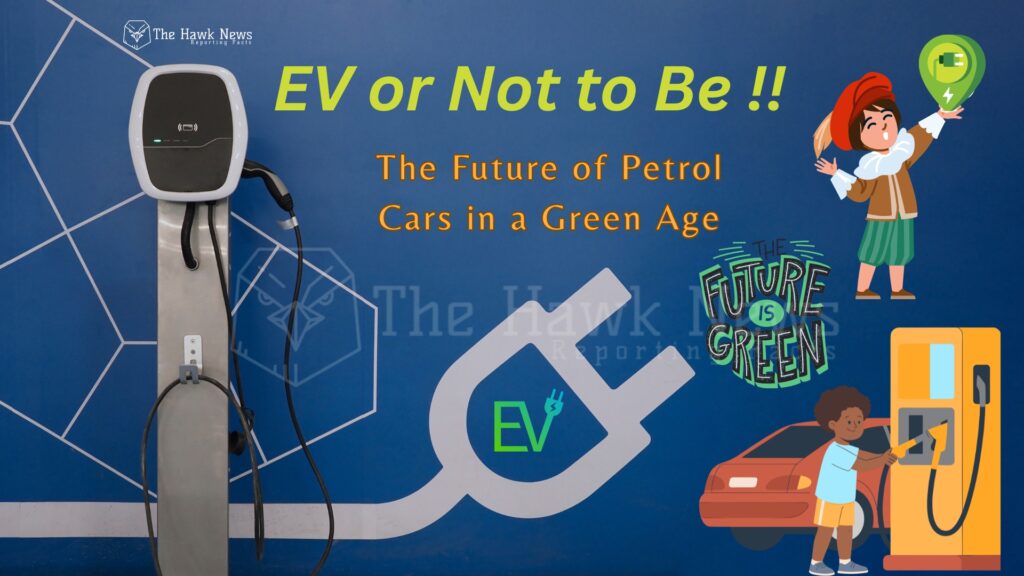
“To be, or not to be—that is the question.”
Centuries ago, Shakespeare penned those immortal words as Hamlet wrestled with existence itself. Today, humanity finds itself on a different stage, grappling with another existential question: EV, or not to be?
Shall the roar of the petrol engine endure, or shall the quiet hum of the electric chariot take its crown? Is this the twilight of petrol’s reign, or the dawn of something greener?
The play unfolds, and we, the audience, must decide whether to cling to the old script or embrace a new act in the drama of mobility.
Act I: The Legacy of Petrol
Once upon a time, the world was intoxicated with the petrol engine. It was more than a machine; it was a symbol of freedom.
The purr of an idling car at dawn, the growl of a motorcycle chasing the horizon — these sounds became the soundtrack of the modern age. Petrol cars carried lovers on midnight rides, soldiers home from war, families on road trips, and dreamers toward their destinies.
But every romance, like every Shakespearean tale, bears a shadow. With the exhaust came smog. With mobility came dependence on oil. With horsepower came carbon footprints heavy enough to scar the earth. The petrol engine, once our liberator, slowly revealed itself as both gift and burden.
Act II: The Entrance of EVs
And then, upon the stage, entered a new protagonist: the Electric Vehicle. Quiet as a whisper, sleek as a falcon, it made its entrance not with thunder, but with promise.
The EV is unlike the petrol hero of old. It carries no fumes, breathes no smoke, and sings no roar — only the gentle hum of progress. Where petrol left a trail of pollution, the EV offers cleaner streets and fresher skies. Where petrol drank greedily from the earth’s wells, the EV draws from renewable fountains, if only we will build them.
Yet, like every newcomer, the EV has its doubts whispered in the wings. Charging stations are sparse. Costs, though falling, remain steep for many. And skeptics scoff: “Can this silent hero truly endure the long road, or will its power falter before the journey’s end?”
Act III: The Human Dilemma
Here lies the rub. Humanity does not surrender old loves easily. The petrol car is familiar — we know its growl, we trust its rhythm, we love its drama. To abandon it feels like betraying a friend who carried us through thick and thin.
But as Shakespeare once wrote, “There is a tide in the affairs of men, which, taken at the flood, leads on to fortune.” To resist this tide is to be stranded upon the shoals of irrelevance. The world is changing. Governments legislate, industries innovate, and the earth herself groans for relief.
The question is not whether we love the petrol engine, but whether we can afford to let nostalgia chain us to yesterday.
Act IV: A Greener Tomorrow
Imagine a tomorrow where cities breathe freely, no longer suffocated by smog. Imagine highways lined with silent vehicles gliding like swans across lakes. Imagine a generation that grows up without the scent of petrol on their hands, yet with the thrill of speed still alive in their hearts.
The EV is not an enemy but an evolution. It does not demand we discard our love for mobility; it invites us to refine it. It does not silence the song of travel; it composes a gentler melody.
In truth, the EV is not here to erase history but to write its next chapter. Petrol had its glory; now EVs bring hope of resilience, innovation, and stewardship. The future is not a duel between the old and the new — it is a duet, until the final curtain falls on petrol’s reign.
Finale: To Adapt or To Fade
So, EV or not to be? That is indeed the question. If we embrace change, we adapt, survive, and thrive in a greener tomorrow. If we resist, clinging to petrol’s smoke-stained script, we risk being cut off from the stage of progress, left behind as the world writes a new play without us.
In the end, the choice is ours. Like Hamlet standing in contemplation, we too must choose. Not between life and death, but between the death of our old ways and the life of something more sustainable.
Let us then declare: “EV, to be!” For to adapt is to endure, and to endure is to live.
Reflection: Every age must write its own story. The age of petrol has given us wings; the age of EVs invites us to soar cleaner, wiser, and farther. The curtain is rising. Will we step boldly into the new act?