“The truth has no defense against a fool determined to believe a lie.” – Mark Twain
The Age of the Loud Fool
We live in an age where noise has become a form of authority. The louder one speaks, the more “right” they appear — at least in the fleeting theatre of social media and boardrooms.
It’s an era where confidence has outpaced competence, and humility has been mistaken for weakness.
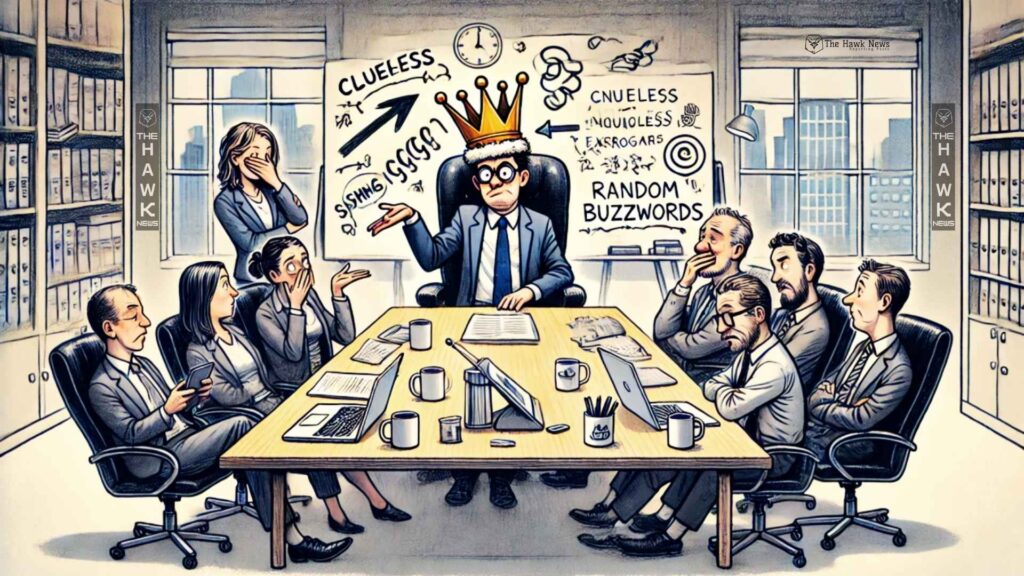
The cartoon of a “clueless king” surrounded by baffled colleagues captures this irony: a leader crowned not for his wisdom, but for his conviction in nonsense.
It is both amusing and tragic — a mirror held up to a generation drowning in information yet starving for understanding.
When Information Breeds Ignorance
A century ago, ignorance came from the absence of knowledge. Today, it comes from the overload of it.
We are saturated with half-truths, viral opinions, and algorithm-fed “facts.”
The illusion of knowing — that sense of “I read something about it once” — has become a psychological trap. People feel informed because they’ve scrolled through summaries and headlines, yet their understanding remains as thin as glass.
It’s a phenomenon psychologists call the Dunning-Kruger effect — where those who know the least are the most certain of their expertise.
In a digital world that rewards speed over reflection, the shallow swimmer often appears to be the fastest.
The Blindside of Arrogance
Arrogance is not merely pride — it is blindness disguised as clarity. It convinces the mind that there’s no need to look deeper, no room for correction, no wisdom beyond one’s own.
The arrogant mind builds a fortress of self-certainty, and within that fortress, truth cannot enter. Facts bounce off its walls, reason is twisted into self-defense, and humility is cast out as weakness.
Arrogance, at its root, is fear wearing a crown — fear of being wrong, fear of feeling small, fear of losing control in a world too complex to master. It’s easier to pretend omniscience than to admit confusion.
The Comfort of Lies
Twain’s insight points us to an uncomfortable truth: sometimes, falsehoods survive not because they are persuasive, but because they are comforting.
Lies give us something truth often cannot — simplicity.
The lie says, “You already know.”
The truth says, “You need to learn.”
One soothes the ego; the other demands surrender.
That’s why people cling to their own “realities.” Whether it’s conspiracy believers, workplace know-it-alls, or digital pundits, the pattern remains the same — they are emotionally invested in their version of the world.
Convincing them otherwise isn’t about presenting better data; it’s about confronting a psychological need.
The Modern Epidemic: Emotional Echo Chambers
We curate our feeds, follow like-minded voices, and silence opposing ones — not to seek truth, but to affirm our comfort.
Every “like” becomes an echo, every “share” a confirmation that we were right all along.
Over time, this digital cocoon forms an illusion of universal agreement — “everyone thinks like me.”
The moment someone disagrees, it’s not a difference in perspective; it’s a threat to identity.
And so, the more we connect, the more divided we become. The internet promised the world a library; it gave us an argument instead.
Humility: The Lost Virtue of Intelligence
Real intelligence begins with not knowing.
Socrates said, “I know that I know nothing.” Yet today, that statement would be mocked as weakness, not wisdom. The world applauds certainty, not curiosity. But humility — the willingness to be wrong — is the foundation of all growth.
The wise don’t fear correction; they invite it. They see truth not as a possession but as a pursuit. The fool, however, sees learning as surrender — as if being corrected is an attack on their worth rather than a step toward enlightenment.
True strength lies in saying, “Teach me.”
That phrase rebuilds what arrogance tears down — the bridge between mind and understanding.
The Workroom of Wisdom
Imagine that meeting table again. The “crowned fool” at the head, tossing jargon into the air, while everyone else suppresses sighs. The tragedy here isn’t one man’s ignorance — it’s the system that rewards it.
Corporate cultures, political panels, and online forums often elevate appearance over insight. The confident fool becomes the leader because he sounds sure.
But wisdom is quiet. It doesn’t interrupt. It listens, digests, questions, and speaks only when it must.
Noise fills space; silence fills meaning.
How to Speak to a Fool
When faced with willful ignorance, the instinct is to argue — to hurl facts like stones. But as Twain observed, truth cannot defend itself against a mind determined to reject it.
So what then?
Instead of battling the lie, seek the emotion behind it.
Why does this person need to believe what they do? What fear, what insecurity, what belonging does that falsehood fulfill?
Address that — not the facts — and sometimes, the armor cracks.
From Knowing to Understanding
It’s not knowledge that saves a society; it’s understanding. Knowledge fills the mind; understanding transforms it.
We cannot escape the storm of misinformation, but we can choose how we stand in it — whether as noise or as clarity, as arrogance or as awareness.
The next time you catch yourself saying, “I already know that,” pause.
Ask instead, “But do I understand it?”
That single shift in mindset — from knowing to seeking — is what separates the wise from the foolish.
The Final Reflection
Truth is not fragile. It doesn’t need defenders; it needs discoverers.
But discovery requires silence, humility, and courage — to admit ignorance, to listen deeply, to unlearn proudly.
As Mark Twain’s timeless line reminds us, the danger is not the absence of truth, but the stubbornness of those who refuse to see it.
And in this loud, digital age, perhaps the greatest act of rebellion — and wisdom — is simply to be silent long enough to think.