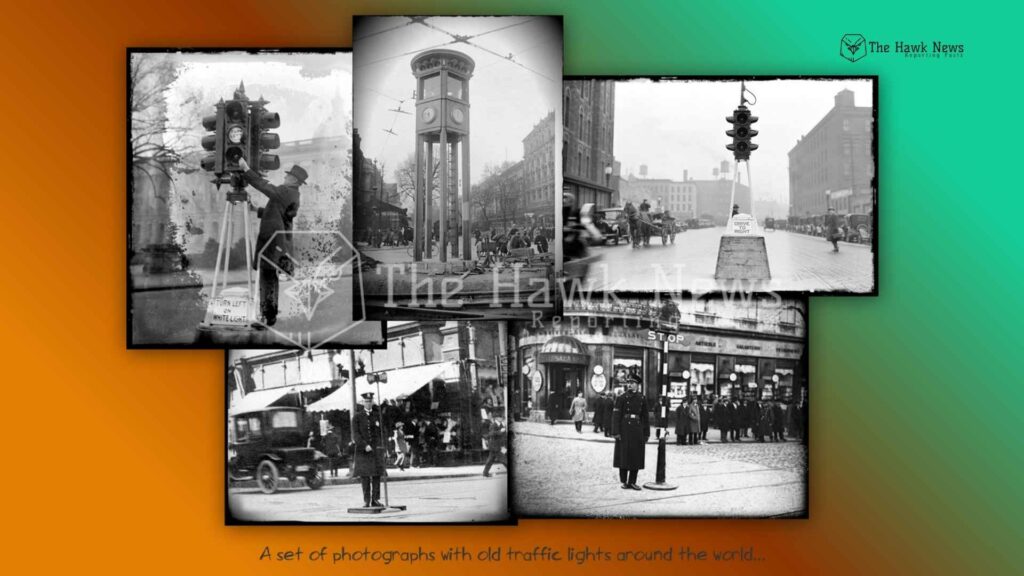
On August 5, 1914, a quiet intersection in Cleveland, Ohio changed the course of urban life forever.
At the corner of Euclid Avenue and East 105th Street, a pair of lights — one red, one green — were mounted high above the street. They buzzed, blinked, and silently issued a revolutionary command: order over chaos.
This was the United States’ first traffic light, a modest device with a profound impact, designed by James Hoge.
Over the next decade, another inventor, Garrett Morgan, would refine the system, laying the foundation for the three-light traffic system still used worldwide today.
The Urban Problem: A World on Wheels
The early 20th century was a period of rapid transformation. The automobile was reshaping cities.
Streets that had once carried horse-drawn carriages were now filled with cars, trucks, and trolleys — all moving faster, all vying for space. Cleveland, a booming industrial hub, felt the strain acutely.
Crowded intersections, impatient drivers, and constant threats of accidents created chaos. A solution was urgently needed — a way to bring order to movement and protect lives.
James Hoge: The First U.S. Traffic Light
James Hoge, a visionary inventor, introduced the first American traffic light in 1914. His system used two colored lights — red for stop and green for go, mounted on a post above the intersection and operated manually by a police officer.
Hoge added a buzzing sound to alert drivers of an impending change — an early example of human-centered design. It wasn’t just technology; it was a philosophy: progress requires rules, and technology can help enforce them gently but decisively.
At first, the public was both curious and skeptical. Drivers laughed, some ignored the lights, while pedestrians watched with fascination. Within weeks, accidents at the intersection dropped, and residents began to embrace the signals.
Hoge’s invention demonstrated that urban order could be engineered, that streets could move safely, and that innovation could shape society’s behavior.
Garrett Morgan: Innovation Born from Observation
Nearly a decade later, Garrett Morgan witnessed a problem Hoge’s system could not fully solve.
After seeing a serious car accident, Morgan realized that the two-signal system (red and green) left no warning for drivers before the light changed.
Confusion often led to collisions, and lives were at stake.
Morgan, an African American inventor living in Cleveland, devised a solution: a three-position traffic signal with:
- Stop (Red)
- Go (Green)
- All-Stop (Yellow) — a warning light giving drivers time to slow down safely.
In 1923, Morgan patented his invention (U.S. Patent No. 1,475,024). His innovation directly addressed driver safety and introduced the concept of reaction time to traffic control.
The yellow light, now universal, is a warning system that anticipates human behavior — a true human-centered design.
Morgan’s traffic signal would inspire modern automated systems and is considered a cornerstone in urban planning and traffic safety.
Public Reaction and Adoption
Hoge’s initial lights drew curiosity and amusement. By contrast, Morgan’s refinement was met with admiration by city planners and police departments. His design reduced accidents and allowed intersections to handle higher traffic volumes safely.
Cleveland became a hub of traffic innovation, inspiring other cities across the U.S. to adopt traffic lights. By the 1920s, Detroit, New York, and Chicago were installing three-light systems, further standardizing urban mobility.
Eventually, traffic lights became a global language of movement, understood from London to Tokyo.
Context: The Timing Was Right
The period between 1914 and 1923 was a moment of rapid change. Industrial growth, urban expansion, and the rise of the automobile required new ways to manage movement.
Traffic lights represented one of the earliest technologies designed to coordinate human behavior in complex environments.
They were not merely convenience devices but civilizational tools — systems that allowed cities to function efficiently while protecting life.
Legacy: From Buzzing Lights to Smart Intersections
Hoge’s lights and Morgan’s refinement laid the groundwork for the traffic systems of today. Modern intersections are digitally synchronized, responsive to real-time conditions, and integrated into smart city frameworks.
Yet the principles remain the same: safety, order, and predictability.
Every red, yellow, and green light follows the rhythm first imagined by Hoge and perfected by Morgan — a silent conversation between vehicles, pedestrians, and the city itself.
Reflections on Innovation and Safety
The story of the traffic light is also a story of human insight and empathy. Hoge observed chaos and created structure. Morgan observed danger and created a warning system.
Together, they demonstrate how innovation grows from experience, necessity, and a desire to protect human life.
The traffic light is more than a machine; it is a symbol of collective responsibility. Red teaches patience, yellow teaches caution, and green teaches movement.
In each cycle lies a message: society functions best when individuals follow shared rules and respect one another’s safety.
Conclusion
From Hoge’s first two-light system in 1914 to Morgan’s three-light patent in 1923, Cleveland was the birthplace of an invention that would shape cities around the world.
Today, traffic lights guide millions of people every day, yet the human foresight behind them is often overlooked.
Hoge and Morgan weren’t just inventors — they were visionaries, turning observation and empathy into solutions that harmonized motion, safety, and order.
The buzzing lights of 1914 and the cautionary yellow of 1923 remind us that technology succeeds when it understands people.
Every intersection tells that story — a story of curiosity, courage, and the enduring impact of seeing a problem and designing a solution that changes the world.