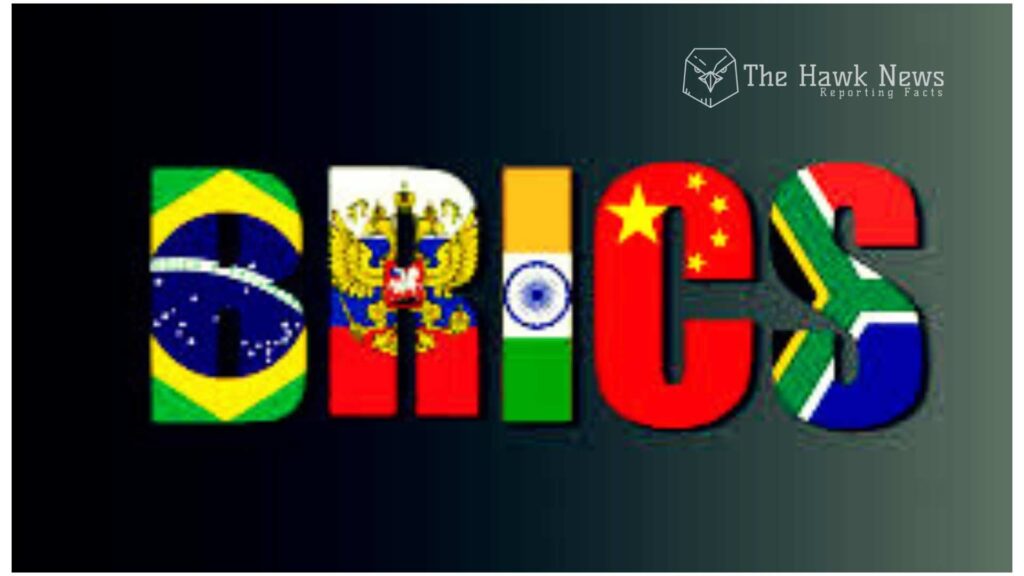
For decades, global economic and political conversations have largely been dominated by Western alliances like the G7, NATO, and financial institutions such as the IMF and World Bank. Yet, quietly and steadily, another alliance has been reshaping the world order—BRICS.
Once dismissed as a loose grouping of emerging economies, BRICS today represents nearly 40% of the world’s population, over 25% of global GDP, and an increasing share of global trade. With its recent expansion, the bloc is signaling that it intends not just to be heard but to play a central role in defining the rules of tomorrow’s multipolar world.
The Origins of BRICS
The story of BRICS begins in the early 2000s when the acronym BRIC was coined by Goldman Sachs economist Jim O’Neill to describe the rapid rise of Brazil, Russia, India, and China. These countries were not only large in terms of population but also had rapidly growing economies that were expected to drive global growth.
In 2009, the four nations formalized this idea into a political and economic partnership, holding their first summit in Russia. The aim was simple yet ambitious: create a platform for cooperation among emerging economies and reduce reliance on Western-dominated global systems. A year later, South Africa was invited to join, making it BRICS as we know it today.
Why BRICS Matters
At its core, BRICS represents a counterbalance to Western dominance. Collectively, the bloc’s influence is undeniable:
- Economic weight: Together, BRICS nations account for nearly one-quarter of the world economy.
- Population: With over 3.2 billion people, they represent a massive consumer and labor market.
- Trade power: China and India are major manufacturing hubs; Brazil is an agricultural powerhouse; Russia is rich in energy; South Africa is a gateway to African trade.
The bloc is also united by a shared vision: to challenge the unipolar dominance of the U.S. dollar and to push for a more inclusive world order where the Global South has a stronger voice.
One of BRICS’s most notable initiatives has been the creation of the New Development Bank (NDB) in 2014, designed as an alternative to the IMF and World Bank. Unlike Western institutions, the NDB emphasizes funding infrastructure and sustainable development projects without attaching heavy political conditions.
The Expansion: BRICS Plus
In August 2023, at the Johannesburg Summit, BRICS made headlines by announcing a historic expansion. Starting in 2024, Egypt, Ethiopia, Iran, and the United Arab Emirates (UAE) officially joined the bloc. This move widened BRICS’s influence across Africa, the Middle East, and the Persian Gulf—regions critical for energy, trade, and geopolitics.
- Iran and UAE bring significant oil and gas reserves, bolstering BRICS’s role in global energy markets.
- Egypt strengthens the group’s foothold in North Africa and the Arab world.
- Ethiopia represents fast-growing African economies and adds symbolic weight as the seat of the African Union.
This expansion not only boosts the bloc’s economic might but also signals its ambition to become a truly global coalition representing diverse regions and interests.
Achievements So Far
While critics argue BRICS is still more symbolic than functional, the bloc has achieved several milestones:
- New Development Bank (NDB): With billions in approved loans, the NDB funds renewable energy, transport, and infrastructure projects across member states.
- Currency Cooperation: Discussions around trading in local currencies aim to reduce reliance on the U.S. dollar—a move known as de-dollarization.
- South-South Cooperation: BRICS has positioned itself as the voice of emerging economies, pushing for reforms in institutions like the UN Security Council and IMF.
Challenges and Criticisms
Despite its achievements, BRICS faces serious challenges that limit its potential.
- Internal Rivalries: China and India, the two biggest members, share strained relations, including border disputes. This raises doubts about the bloc’s unity.
- Unequal Economies: While China is the world’s second-largest economy, South Africa contributes less than 1% to global GDP. This imbalance can affect decision-making.
- Political Diversity: The bloc includes democracies like India and Brazil alongside authoritarian regimes like Russia and China. Finding common ground on political issues is often difficult.
- Global Perception: Many see BRICS as anti-Western, though the bloc insists it wants cooperation, not confrontation.
These challenges have led some analysts to argue that BRICS is more of a talking shop than a concrete policy driver.
BRICS vs. the West
A frequent question is whether BRICS can ever rival the G7. While the G7 represents the world’s most advanced economies, BRICS symbolizes the aspiration of emerging markets.
- The G7 dominates finance and technology, but BRICS holds leverage in population, natural resources, and markets.
- Western alliances are bound by shared values and political systems, while BRICS is held together by shared economic interests and strategic goals.
In some ways, the contrast makes BRICS’s rise even more fascinating. It reflects a shift in global power where emerging economies refuse to be sidelined.
The Future of BRICS
Looking ahead, the future of BRICS is filled with both opportunities and uncertainties.
- Expansion: More countries, including Saudi Arabia, Argentina, and Indonesia, have expressed interest in joining. If admitted, the bloc could command even greater global influence.
- Financial Innovation: The push for alternative payment systems and reduced reliance on the U.S. dollar may reshape global trade.
- Geopolitical Role: As Western powers remain preoccupied with internal challenges, BRICS could increasingly act as the voice of the Global South.
However, whether BRICS can move from symbolic gestures to substantive global leadership will depend on its ability to overcome internal differences and create shared, actionable policies.
Pros and Cons of BRICS
To understand BRICS better, it helps to weigh its strengths and weaknesses.
Pros:
- Represents a huge share of global population and resources.
- Offers an alternative to Western-dominated systems.
- Encourages South-South cooperation and development.
Cons:
- Internal rivalries weaken collective strength.
- Economic and political diversity makes alignment difficult.
- Still lacks the institutional depth of the G7 or EU.
Conclusion: A Multipolar Future?
The rise of BRICS reflects a deeper shift in world politics—the move from a unipolar world dominated by the West to a multipolar one where emerging economies play a central role.
Whether BRICS becomes a true global powerhouse or remains a symbolic coalition is still uncertain. But one thing is clear: it can no longer be ignored. From energy markets to trade deals, from development financing to geopolitics, BRICS is forcing the world to rethink what global power looks like in the 21st century.
And perhaps the biggest takeaway is this: the age of the West writing the rules of the game alone is ending. The future will be written by many hands—and BRICS wants to hold the pen.