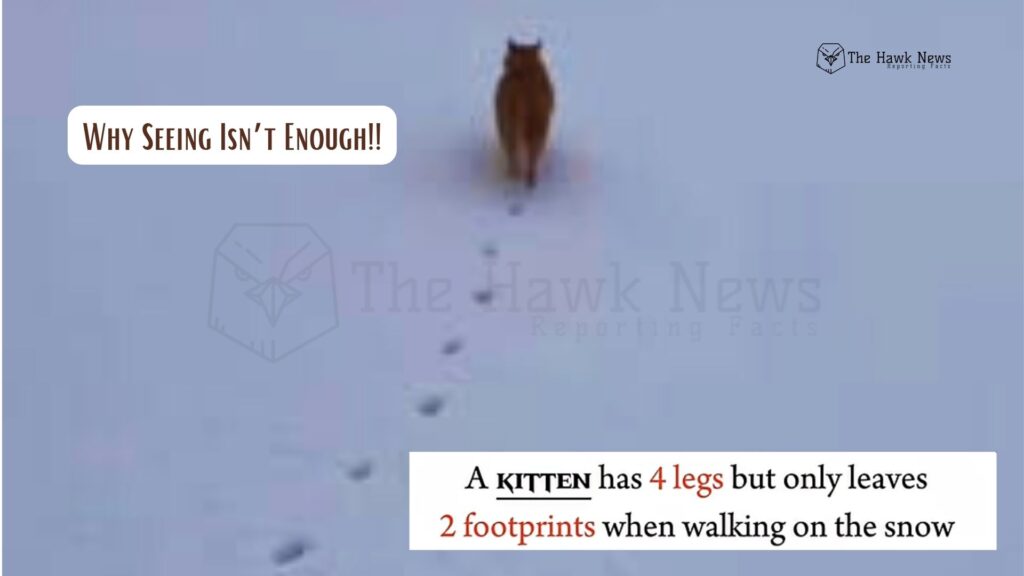
A kitten has four legs but only leaves two footprints when walking on snow. On the surface, it looks like an impossibility, yet it is simply the way movement overlaps, concealing part of the truth. What we see does not always reveal what truly is.
For centuries, we’ve heard the phrase: “Seeing is believing.” But in our age of misinformation, manipulated visuals, and curated realities, the old saying no longer holds up. Today, seeing can be deceiving—and belief requires something far deeper: discernment.
The Fragility of Sight
Sight has always been humanity’s most trusted sense. We rely on our eyes to tell us what is real, who is honest, and what is happening around us. But sight is fragile. It captures the surface, not the substance. A mirage looks like water. A magician makes an elephant vanish. A photo can show you a smile without revealing the pain behind it.
The kitten’s two footprints remind us that appearances can conceal as much as they reveal. What we see may be true in part, but it rarely tells the whole story.
The Age of Digital Deception
Nowhere is this truer than in today’s digital world. Technology has made “seeing” both easier and more dangerous.
- Deepfakes can place a person’s face and voice in situations they’ve never lived.
- Photoshop and filters can transform realities until they no longer resemble the original.
- Selective reporting and viral clips can frame events in ways that distort truth while keeping a veneer of credibility.
The result? Our eyes can no longer be trusted as final judges. What circulates on our screens can look convincing yet carry manipulation at its core.
If seeing was once believing, today it is the beginning of questioning.
The Politics of Perception
Nowhere is the battle between sight and truth more intense than in politics. Leaders parade before massive crowds, post curated images, and stage spectacles designed to impress. Cameras capture strength, unity, or popularity—but what the lens records is often the surface, not the depth.
Consider rallies that show thousands gathered, yet fail to show the hunger, the exhaustion, the disillusionment within those crowds. Or leaders who smile at ribbon-cuttings while hiding corruption scandals behind closed doors. The footprints may appear two, but the legs of the matter are four.
Discernment means asking: What is being shown? What is being hidden?
Social Media: The Theatre of Appearances
On social media, “seeing is believing” has become the primary trap. A glamorous feed suggests a perfect life. Viral “proof” videos suggest instant credibility. But behind filters, edits, and algorithm-driven visibility, what we see is a carefully crafted narrative.
A person may look successful yet struggle silently with debt. An influencer may promote a lifestyle funded not by authenticity but by sponsorships. A post may go viral not because it is true, but because it is sensational.
Discernment demands we look past the surface performance to the reality underneath.
Discernment: The Essential Civic Skill
Discernment isn’t suspicion for its own sake. It is not cynicism. It is a deeper awareness that appearances must be tested before they are trusted.
Discernment asks:
- What is the source?
- What is the context?
- What is missing?
- Who benefits from this picture, this clip, this story being seen?
In an era where fake news can spark riots, doctored videos can sway elections, and curated feeds can fuel depression, discernment is not optional—it is survival. It is the responsibility of every citizen, every voter, every consumer of information.
Historical Lessons: When Seeing Misled
History is filled with cautionary tales of misplaced trust in appearances.
- In the 1930s, staged Nazi rallies dazzled Germans with grand visuals of unity, hiding the cruelty brewing beneath.
- Colonial powers displayed images of “progress” in occupied lands while concealing exploitation and oppression.
- During the Vietnam War, photo ops often painted a rosier picture than the brutal reality soldiers and civilians endured.
In each case, the surface image was powerful—but it was not the whole truth. Without discernment, people believed what they saw, until the cost of deception became unbearable.
Personal Life: Discernment Beyond Politics
The kitten in the snow is not just a metaphor for politics or media—it touches our personal lives as well.
How often do we judge someone by their appearance, without discerning their struggles?
How often do we assume success from the car they drive, the clothes they wear, or the house they live in—without considering the hidden debts or sacrifices?
How often do we let appearances guide relationships, only to find later that what we thought we saw was only part of the truth?
Discernment in personal life means pausing before judgment, listening before assuming, and seeking depth before concluding.
Why Seeing Isn’t Enough
If sight was once a trusted guide, it is now a doorway to deeper investigation. What we see can spark curiosity, but discernment must lead to wisdom.
Because appearances are easy to craft. Truth is harder to uncover.
Because images can be manipulated. Reality demands more than a glance.
Because footprints in snow may look like two—but the truth walks on four.
Conclusion: The Age of Discernment
In the age of misinformation, discernment is not just a virtue—it is a civic necessity. We must cultivate the habit of questioning what we see, digging beneath appearances, and resisting the temptation to accept the surface as the whole.
Seeing may no longer be believing. But discerning—that is where truth begins.
The kitten walking on snow is a quiet teacher. It tells us that our eyes can trick us, but our minds and hearts, sharpened with discernment, can lead us beyond the surface.
And if there is one lesson for our age, it is this: do not stop at seeing. Go on to discerning. Only then can we hope to believe rightly.