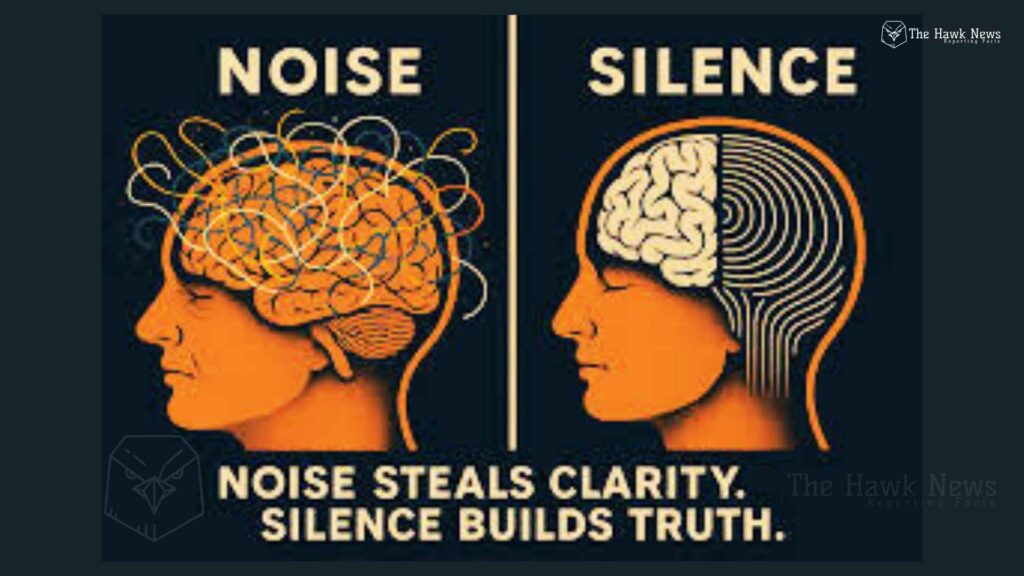
The Age of Constant Volume
We live in a world that never quiets down. From the moment we wake, noise greets us—digital notifications, traffic horns, coffee shop chatter, the hum of obligations.
Even in our solitude, our minds play replays of yesterday and previews of tomorrow. Silence has become not a natural state but a luxury—rare, uneasy, and almost forgotten.
Yet in all this sound, clarity has grown scarce.
The more voices we listen to, the less we hear our own. The more information we consume, the less wisdom we retain. We have become masters of reacting, but beginners at reflecting.
The Psychology of Noise
Modern neuroscience confirms what our spirits already know: noise overloads the brain.
The constant flood of sounds and stimuli keeps the amygdala—our threat center—on alert.
It creates a subtle but persistent anxiety, as though we must respond, update, or perform every second. This mental “static” drains focus, dulls creativity, and numbs emotional awareness.
But silence—true silence—is not the absence of sound. It’s the absence of interference.
It is the space where the brain shifts from reaction to restoration, from external attention to inner processing.
In that space, ideas connect. Emotions settle. Truth surfaces.
The Soul’s Frequency
Our ancestors intuitively understood what we now study through science: everything has a vibration.
Every feeling, every word, every thought hums with energy. When our inner frequency is drowned by external noise, we lose resonance with who we truly are.
Silence, then, is not a void—it’s a tuning fork for the soul.
It helps us align our inner frequency with truth, peace, and purpose.
That’s why in moments of stillness—standing under the rain, gazing at the night sky, or simply closing our eyes—the world suddenly makes sense again.
Why We Fear Silence
Ironically, what we most need is what we often avoid.
Silence can feel intimidating because it confronts us with ourselves.
Without noise, there is no distraction from our doubts, regrets, or unprocessed emotions. The mind, stripped of its usual chatter, begins to echo truths we’ve long postponed hearing.
But it’s precisely through that discomfort that healing begins.
Silence does not accuse—it invites. It invites us to listen, to understand, to forgive.
As author Khalil Gibran once said,
“In much of your talking, thinking is half murdered.”
In learning to be still, we resurrect thought—and with it, self-awareness.
The Practice of Quiet
Creating silence in a noisy world isn’t about retreating into isolation. It’s about reclaiming moments of stillness in daily rhythm. Here are simple yet powerful ways to begin:
- Morning Silence – Spend the first 10 minutes after waking without checking your phone. Let your thoughts arrive before the world’s do.
- Digital Sabbaths – Once a week, disconnect from screens. Let your mind wander instead of scroll.
- Mindful Listening – When someone speaks, truly listen—without formulating your next reply. That’s a silent act of respect.
- Nature Therapy – Go where man-made sounds fade and natural ones take over. Let the wind, rain, and birds recalibrate your frequency.
- Prayer or Meditation – Even five minutes of conscious breathing or reflective prayer can clear inner static and reawaken clarity.
The Power of Listening to Yourself
When the mind quiets, it doesn’t go blank—it begins to bloom.
In silence, you’ll often hear faint whispers: a forgotten dream, a creative spark, a truth you’ve ignored. These are not random thoughts; they are your soul’s native language.
Many of history’s greatest breakthroughs—scientific, artistic, and spiritual—were born not from noise but from solitude. Beethoven composed in silence he could not hear.
Newton discovered gravity under a quiet tree. The Buddha found enlightenment beneath still leaves.
Each of them practiced the same art: listening within.
A Modern Paradox
Today, we’ve built a civilization that celebrates expression but fears introspection.
We tweet, post, share, and react—but rarely pause.
We seek validation instead of understanding.
And in this pursuit of constant communication, we’ve lost communication with the one person who can truly guide us—ourselves.
Silence is the bridge back to that self.
It doesn’t ask for withdrawal; it asks for awareness.
It doesn’t demand control; it invites surrender.
The Return to Clarity
Noise steals clarity. Silence builds truth.
In the quiet, life reorders itself.
Problems appear smaller. Emotions gain language.
The fog of confusion lifts, revealing what was always there—wisdom waiting patiently in the calm beneath the clamor.
To live a peaceful life in a noisy world isn’t to escape sound—it’s to find your stillness within it.
Because clarity isn’t something you find out there.
It’s something you remember in here.
Closing Thought
Maybe, the question isn’t “How do I silence the world?”
But rather— “When the world grows loud, will I still hear my own voice?”