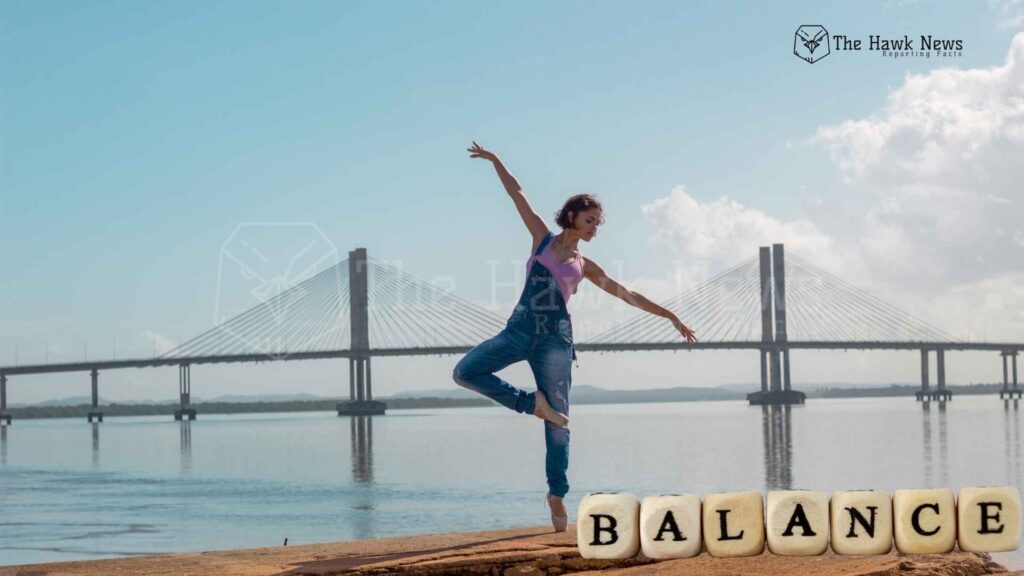
The World at the Edge
We live in an age of all or nothing. Work harder or you’re lazy. Speak louder or you’re invisible. Believe everything or believe nothing.
The middle ground — that quiet, balanced space where wisdom breathes — has somehow become a forgotten art.
Our culture glorifies excess. More productivity. More passion. More outrage. But in the pursuit of “more,” something essential has slipped through our fingers: the power of enough. Balance isn’t glamorous; it rarely trends. Yet it’s the only thing that keeps us from splitting apart.
When everything in life stretches to extremes — opinions, diets, relationships, even rest — we begin to lose our center. And in that loss, we mistake chaos for energy, and noise for life.
The Myth of “All or Nothing”
Social media thrives on absolutes. “Go big or go home.” “Cut them off.” “Work until your idols become your rivals.” But behind those slogans lies exhaustion — a generation swinging like a pendulum between burnout and apathy.
Gen Z, perhaps the most self-aware yet emotionally tired generation, has started to see through this illusion. Many are walking away from the myth that only intensity produces meaning. They are redefining what strength looks like — not in speed, but in steadiness.
Because extremes give us adrenaline, but balance gives us endurance. And in a world that never stops moving, endurance might just be the new form of rebellion.
Ancient Wisdom: Solomon’s Subtle Science of Balance
Long before burnout had a name, Solomon understood its roots. He didn’t ask God for riches or victory — he asked for wisdom. And wisdom, at its core, is balance in motion.
In Ecclesiastes, he wrote, “To everything there is a season — a time to weep and a time to laugh, a time to tear down and a time to build.” Solomon recognized that even good things, when overdone, become harmful.
The man who once ruled with unmatched insight later drowned in his own excess — proof that even the wisest can lose their rhythm when they stop seeking balance.
We often chase the crown, forgetting it was meant to remind us to bow.
The Pencil Principle: Sharpening Without Breaking
There’s a lot a pencil can teach us if we stop to notice.
To be useful, it must be sharpened — and sharpening hurts. Life carves us the same way, shaping our edges until we can create something beautiful.
But if we’re sharpened too often, without rest, we break.
Then there’s the eraser — the grace to begin again. Every mistake, every failure, is a soft correction from life that whispers, “You’re still learning.”
A pencil also leaves a mark wherever it’s used — so must we. But we must choose whether that mark heals or harms, whether our presence builds or bruises.
And finally, what truly defines a pencil is what’s inside. Its worth isn’t in the paint, but in the lead. In a world obsessed with outer shine, this lesson feels almost sacred.
Minding Your Own Way
Sometimes, balance looks like silence. We often rush to fix, to advise, to rescue — only to end up drained and scarred. We mistake meddling for compassion and call it love. But wisdom says, “Tend your own garden first.”
Even the good Samaritan helped one man, not the whole world. There’s a quiet strength in knowing when to step back, when to let life teach others the lessons they’re meant to learn.
Because when we try to absorb every storm, we forget — we are not the umbrella; we are only one drop in the rain.
Boundaries are not selfish; they are the skeleton of peace.
The Modern Middle: Finding Ground Between Extremes
Balance in today’s world isn’t about standing still — it’s about steady movement.
In health, it’s mindful eating without obsession.
In work, it’s ambition with rest.
In spirituality, it’s devotion without pride.
In connection, it’s being online without being consumed.
The world sells us speed, but meaning comes in rhythm. We’ve seen the rise of “slow living,” “digital minimalism,” and “quiet quitting” — modern movements that are really old truths dressed in new clothes.
They remind us that peace was never lost; we just forgot how to listen for it.
The Art of Still Standing
Balance doesn’t mean weakness — it means wisdom that refuses to be pulled apart. The blade that stays sharp too long snaps. The one never used rusts. The wise find the rhythm between both.
In a culture obsessed with victory, balance asks: Can you be calm and still believe you’re growing? Because true power isn’t in extremes — it’s in the quiet strength of a soul that has learned to stand in the middle, steady and unbroken.
In the end, Balance isn’t found. It’s practiced — daily, imperfectly, but faithfully. And maybe, that’s what makes it holy.