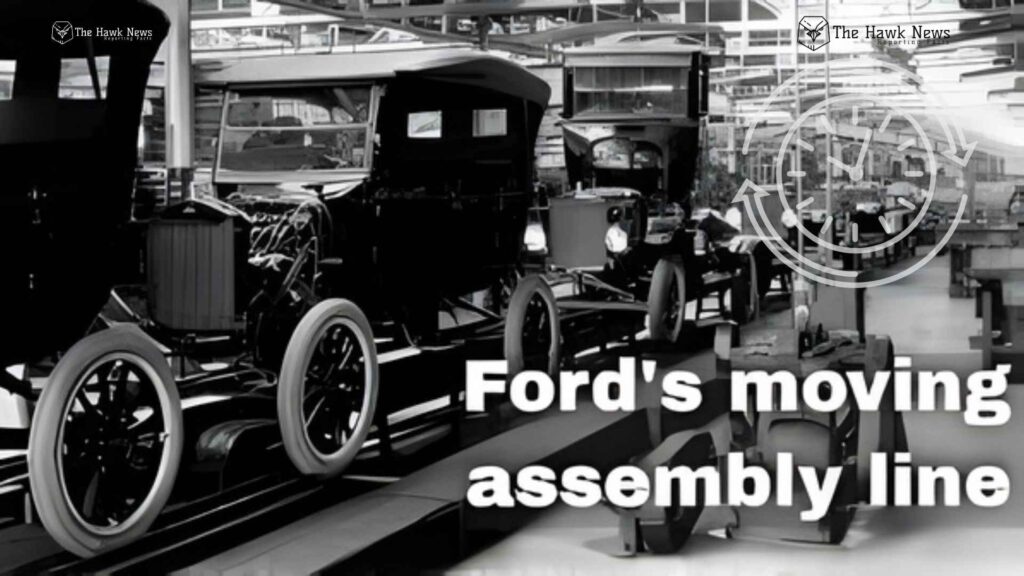
On December 1, 1913, inside a Detroit factory lit by hanging bulbs and dusted with iron filings, something quietly revolutionary began.
Ford Motor Company switched on the world’s first moving assembly line — a conveyor system that pulled car parts past workers instead of asking workers to move toward the parts.
It looked like a simple innovation.
It became a global psychological shift.
Ford didn’t just build cars faster.
He built a new definition of time.
A new definition of productivity.
A new definition of what it meant to be “a useful human being.”
And the world has been sprinting ever since.
The Moment the World Stopped Moving With the Sun
Before the assembly line, work followed a natural rhythm — the rhythm of weather, seasons, dusk, dawn, and human energy. Craftsmen built things with their hands. Tailors stitched slowly. Bakers kneaded gently. Farmers rested when the fields rested.
Time, back then, was something you lived inside.
But on that December day in Detroit, time became something you had to outrun.
The assembly line made productivity measurable down to the second. The worker was no longer a craftsman — he was a replaceable cog in a bigger wheel. What mattered wasn’t who he was, but how fast he could keep up.
Speed replaced skill.
Output replaced meaning.
Efficiency became identity.
This was the day humanity quietly entered “assembly-line mode.”
When Machines Became the Teachers, and Humans the Students
Ford didn’t just invent an assembly line.
He invented the mindset that still controls our modern world
Faster is better.
Busy is noble.
Rest is weakness.
Slowing down is failure.
Look around today:
– We brag about being “swamped.”
– We treat burnout as a badge of honour.
– We apologise for taking breaks.
– We equate self-worth with deadlines and deliverables.
– We feel guilty for resting, guilty for saying no, guilty for being human.
This is the inheritance of a 1913 conveyor belt.
When machines are the standard, humans will always fall short.
How the Assembly Line Created the “Hustle Generation”
The logic of the assembly line — produce more in less time — left the factory long ago.
Today it lives in:
Hustle culture:
Where your value is measured by how little you sleep.
24/7 connectivity:
Emails in the night, notifications as alarm clocks, the pressure to be available always.
Instant everything:
Food delivered in minutes, content consumed in seconds, opinions formed in microseconds.
The guilt of slowing down:
As if rest is a sin and speed is a moral virtue.
The cruel irony?
Cars became faster…
Machines became faster…
Technology became faster…
But humans never did.
We’re still flesh and breath and heartbeat.
Still built for rhythm, not race.
The Quiet Violence of Measuring a Soul by Productivity
Ford didn’t intend to harm anyone.
He revolutionised industry. He changed the world.
But the mindset that followed — the obsession with speed — came with a hidden spiritual cost.
When you treat a human like a machine, they eventually break like one.
The world today is full of people who are:
– Exhausted but still performing
– Successful but still empty
– Busy but still lonely
– Productive but still purposeless
– Surrounded but still unseen
Because the assembly line taught us to value output over being.
We learned how to produce… but forgot how to breathe.
Rest is Not Laziness — It Is Resistance
Here’s the truth we keep forgetting:
The body is not a factory.
The mind is not a conveyor belt.
The soul is not a machine part.
Rest is not a luxury — it is an act of rebellion
against a world that has forgotten stillness.
Slowness is not a flaw — it is proof you are human.
Meaning is not created in speed —
it’s born in silence, reflection, and presence.
We need to unlearn the lie the assembly line taught us:
That productivity = worth.
It never did.
It never will.
A New Way Forward: Being Human Again
More than a century after Ford’s innovation, perhaps it’s time to innovate again — not in machines, but in mindset.
Maybe progress now means:
– Choosing depth over speed
– Choosing peace over pressure
– Choosing a life you feel, not just perform
– Choosing to be fully human in a world that wants you mechanical
– Choosing moments that matter over metrics that don’t
The assembly line may have changed how we build cars.
But it’s within our power to change how we build lives.
Because the true revolution, my fren —
is learning how to slow down in a world addicted to speed.
This is how we reclaim our humanity.
One unhurried breath at a time.