Introduction
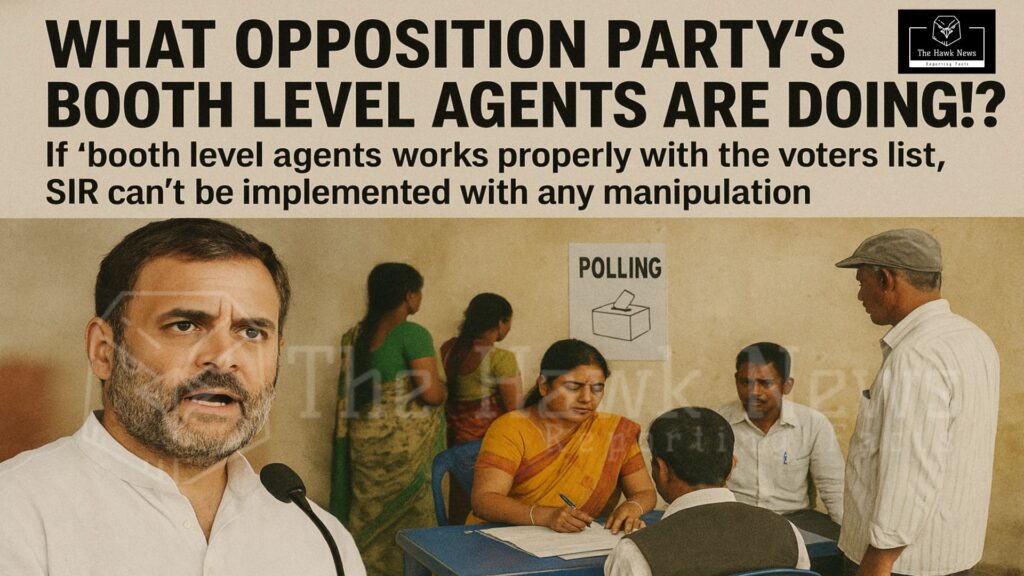
If Booth-Level Agents work effectively with the voter list, the SIR process cannot be manipulated—but are they truly in the field, or just sitting at booths? This timely question takes center stage as Rahul Gandhi’s Voter Adhikar Yatra in Bihar puts the spotlight on the SIR (Special Intensive Revision) by the Election Commission. With nationwide rollout underway and political stakes high, a closer look reveals both systemic challenges and hopeful strategies.
Understanding SIR: What Is It & Why Does It Matter?
The Special Intensive Revision (SIR) is a comprehensive overhaul of electoral rolls—pushing for accuracy, removal of ineligible voters and inclusion of eligible yet unregistered citizens. Conducted under Article 324 of the Constitution and Section 21(3) of the Representation of the People Act (1950), the SIR exercise in Bihar commenced on June 24, 2025
Key aims include: removing duplicates or ineligible entries, verifying residency, covering migrants, and registering new voters like those turning 18 by October 1, 2025
According to the Press Information Bureau (PIB), by early July, around 36% of enumeration forms had been collected, and the process was deemed “progressing smoothly”
Rahul Gandhi’s Critique of SIR & Election Commission
Rahul Gandhi unleashed strong criticism during the Voter Adhikar Yatra across Bihar, accusing the Election Commission of institutionalizing “vote theft” through SIR to benefit the ruling BJP. He framed SIR as anti-constitutional and claimed it’s a tactic to “steal the votes of the poor”
The Commission, meanwhile, responded sharply—rejecting the allegations as “baseless”; calling the phrase “vote chori” insulting to the Constitution; defending its neutrality and urging Rahul to substantiate his charges with a sworn affidavit within a week
Booth-Level Agents: Field Warriors or Booth Sitters?
As per the Supreme Court, BLAs were significantly underutilized—only two objections were filed by political parties during Bihar’s SIR process, a striking gap in participation. The Election Commission also noted that no objections were filed by any parties on the August 1 draft rolls.
Meanwhile, there’s a growing legal struggle: over 5.2 million voters were reported missing from their registered addresses, and over 1.1 lakh entries marked “not traceable”—raising concerns about bogus enrollments and potential exclusion.
Supreme Court Orders & Legal Leverage
Legal developments are shifting the ground: on August 14, 2025, the Supreme Court ordered the Election Commission to publicly release a booth-level searchable list of 65 lakh deleted electors—with reasons for each deletion—and accept objections supported by Aadhaar or EPIC.
SC further directed that political parties file status reports detailing how many claim forms were facilitated—crucial accountability steps. They also authorized online submissions for voters to restore their names.
Why Properly Trained BLAs with Voter Lists Can Counter SIR Manipulation
Here’s how effective BLA engagement can safeguard election integrity:
- Ground Awareness: BLAs deeply grounded in communities can flag deletions or suspicious patterns—especially with the SC-mandated deleted list.
- Legal Empowerment: Trained BLAs can submit claims or objections, backed by Aadhaar or other approved documents, even online.
- Documentation & Transparency: With detailed voter lists, BLAs can act as watchdogs—ensuring that eligible voters aren’t removed, and ineligible entries are challenged.
- Real-Time Accountability: If the Election Commission insists on enforcing SIR as-is, BLAs can compile evidence to bring cases to court citing field data.
- Democratic Guardrails: Active BLA participation ensures that the democratic process isn’t compromised under the pretext of administrative exercise.
On-the-Ground Challenges & Innovations
Challenges:
- Low BLA engagement: Only two objections filed by parties—a sign of gaps in coordination, training, or motivation.
- Time constraints: The narrow window for filing objections and claims makes proactive BLA involvement vital—but difficult.
- Document burden: While SC allowed Aadhaar, EPIC, and other documents, many citizens, especially migrants, may find it hard to gather proof for challenge.
Opportunities:
- Tech-assisted outreach: SMS informs 5.7 crore Bihar electors about SIR; parties can replicate outreach for awareness.
- Online claims: SC’s order to allow digital submission of objections opens new possibilities for timely action.
- Leadership momentum: Rahul Gandhi’s Yatra, public protests, and media coverage create awareness and pressure—mobilizing BLAs into action.
Key Takeaways (Table)
| Aspect | Implication / Insight |
|---|---|
| SIR intent & scope | Aims to upgrade voter rolls, but timing & execution raise concerns |
| Rahul Gandhi’s criticism | Frames SIR as institutional manipulation; demands accountability |
| Commission’s response | Denies bias, arms neutrality, demands proof via affidavit |
| BLA involvement | Currently minimal; increased activity is necessary to preserve electoral inclusion |
| Supreme Court interventions | Released deleted voters list; allows online claims; demands party-level accountability |
| Ground realities | Large-scale omissions detected; lack of BLA-driven objections risks disenfranchisement |
| BLA as democratic guardians | With voter lists, BLAs can challenge wrongful deletion and safeguard voter rights |
| Strategic focus | Enhancing BLA training, coordination, and access to documents can turn the tide |
Conclusion & Call to Action
The SIR (Special Intensive Revision) of electoral rolls—while constitutionally valid—has become a political and legal battleground. Rahul Gandhi’s aggressive push in Bihar, coupled with judicial oversight, highlights a critical flaw: the gap between process and protection. If Booth-Level Agents remain idle, the SIR system—even if well-intended—could result in widespread exclusion, especially for marginalized voters.
Yet, this risk also presents a turning point. Well-trained and engaged BLAs, armed with accurate voter lists and a proactive legal mandate, can not only counter manipulation but also strengthen democracy from within. The path is clear: policies must translate into ground-level action, with every eligible citizen’s vote preserved.
Call to Action
Readers, take charge of democracy—check your voter status, raise objections if needed, and urge your political representatives to empower BLAs in your area. Voting is not just a right—it’s everyone’s duty. Let’s stand vigilant and ensure every voice counts.