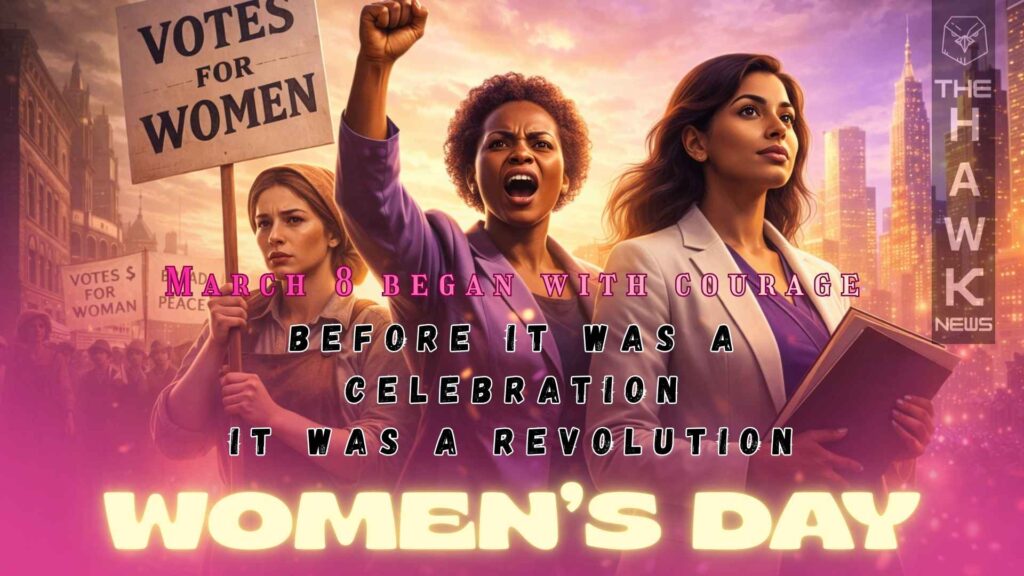
Every year on March 8, the world pauses to celebrate International Women’s Day. Social media fills with messages of appreciation, workplaces distribute flowers, and leaders deliver speeches about equality.
But beneath the celebration lies a harder truth: this day was not born from comfort or ceremony.
It was born from defiance.
International Women’s Day began as a protest—an eruption of voices from women who were tired of being invisible in the factories, the streets, and the political systems that depended on their labor but denied their rights.
Where the Fire Began
At the dawn of the 20th century, industrial cities were booming. Yet for many women, progress looked less like opportunity and more like exhaustion.
Factory workers labored long hours for wages that were often a fraction of what men earned. Their work sustained economies, but their voices carried little weight in politics or society.
In 1908, thousands of women garment workers marched through New York City, demanding safer working conditions, shorter hours, and the right to vote. The demonstrations helped inspire National Woman’s Day, organized by the Socialist Party of America.
The message was simple but radical for its time: women deserved power over their own lives.
An Idea That Crossed Borders
The struggle did not remain confined to one country. In 1910, delegates gathered in Copenhagen for the International Socialist Women’s Conference.
There, activist Clara Zetkin proposed an international day dedicated to women’s rights and suffrage.
The idea was revolutionary—not because it was symbolic, but because it united movements across borders.
Within a year, millions of women across Europe participated in rallies demanding equality in education, employment, and governance.
What had begun as scattered protests was quickly becoming a global movement.
When Protest Sparked Revolution
History took a dramatic turn in 1917.
During the final years of World War I, women in Petrograd marched in the streets demanding “Bread and Peace.” Their protest, part of the turmoil surrounding the Russian Revolution, ignited a wave of strikes that shook the empire.
Within days, political upheaval followed—and soon after, Russian women won the right to vote.
The date of their protest, March 8, became permanently etched into history.
It was proof that when women organize, the consequences can reshape nations.
From the Streets to the Global Stage
Decades later, the movement gained formal recognition when the United Nations began observing International Women’s Day in 1975 during International Women’s Year.
What began as labor protests and political agitation had evolved into a worldwide day of reflection and action.
Today, it is marked in more than 100 countries—sometimes with celebration, sometimes with protest, often with both.
The Unfinished Fight
Yet the story of International Women’s Day is not one of closure.
Despite decades of progress, gender inequality still shapes workplaces, governments, and households around the world.
Women remain underrepresented in leadership, face persistent wage gaps, and continue to confront violence and discrimination.
The spirit of March 8 reminds us that equality is not a milestone already reached—it is a promise still being pursued.
Why This Day Still Matters
International Women’s Day is not merely a tribute to women’s achievements.
It is a reminder of the courage required to achieve them.
It asks us to remember the workers who marched in freezing streets, the activists who challenged entrenched systems, and the generations who refused to accept that inequality was inevitable.
The world may celebrate March 8 with flowers and speeches, but its deeper message remains unchanged:
Progress begins when voices that were once ignored refuse to remain silent.