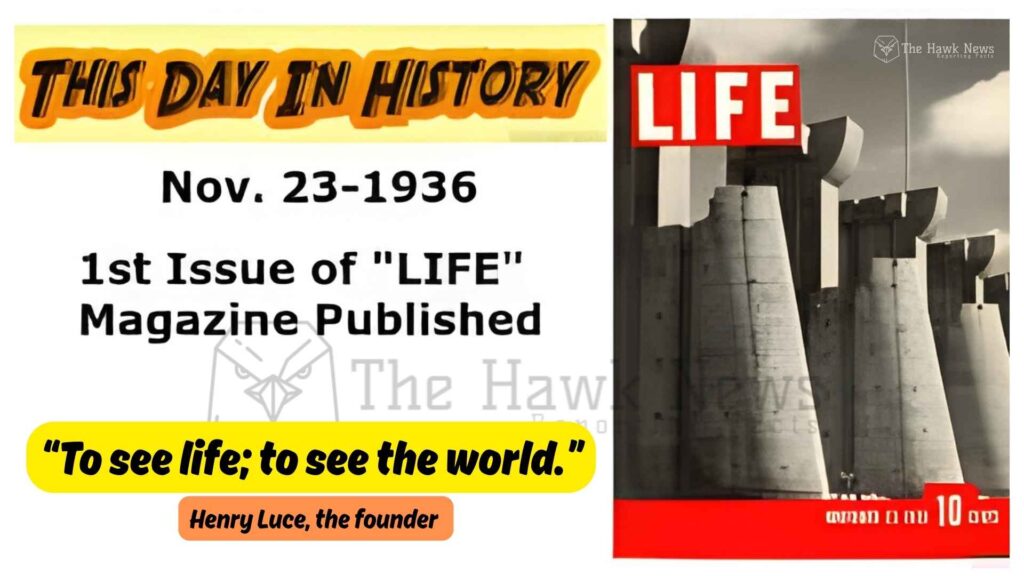
On November 23, 1936, something remarkable happened in American media — but most people today don’t realise just how revolutionary it was.
A magazine hit the stands carrying no political agenda, no heavy columns, no arguments, and no essays trying to win a debate. Instead, its mission was simple and audacious:
To show the world — not tell it.
This was the first issue of LIFE magazine.
In an era when newspapers were filled with dense text and the world was speeding toward global conflict, LIFE arrived like a sharp beam of light cutting through a grey sky. It offered something people had never seen at this scale:
Visual journalism. Stories told through the eyes of photographers. Emotions frozen in frames. History captured in moments.
It was not just a magazine.
It was a window.
A Magazine Built on a Philosophy, Not Just Photos
The genius behind LIFE was Henry Luce — the co-founder of Time Inc. He believed that photography wasn’t just decoration for words. He believed it carried its own grammar, its own emotional intelligence, and its own truth.
Luce announced:
“To see life; to see the world…
to see man’s work, his sorrows, his joys — in all the shadows and shapes in which the heart and mind pursue truth.”
This wasn’t a mission statement.
It was a manifesto.
At a time when the world was drowning in political noise, LIFE dared to be different — to be quiet. Let the pictures speak. Let people feel. Let the ordinary become extraordinary.
The First Cover: A New World in One Frame
The very first cover of LIFE featured a photograph of Fort Peck Dam in Montana — a monumental public works project. The image wasn’t glamorous. It wasn’t dramatic. It wasn’t even aesthetic for the sake of beauty.
It was symbolic.
The dam represented:
- American strength during the Great Depression
- The endurance of ordinary workers
- A nation rebuilding itself through sheer grit
With one photograph, LIFE accomplished what most newspapers tried to do with long editorials.
It showed a country standing back up.
When a Camera Became a Journalist
The power of LIFE wasn’t just in its topics, but in its photographers — men and women who followed war, joy, birth, culture, tragedy, and triumph with a humility that text alone could never capture.
Photographers like:
- Margaret Bourke-White — the first woman war correspondent
- Gordon Parks — who revealed racial injustice through photography
- Alfred Eisenstaedt — whose V-J Day kiss became one of the world’s most famous images
- Dorothea Lange — who made the Great Depression human
Their lenses became mirrors to society.
Their courage turned images into evidence.
LIFE trusted photographers the way other magazines trusted their editors.
And in return, photographers gave LIFE something priceless:
Emotion with clarity. Truth without noise.
Why LIFE Magazine Mattered — and Still Does
The 1936 launch didn’t just start a publication. It started a cultural shift.
Here’s what LIFE changed forever:
1. It democratized storytelling.
A steelworker, a child, an immigrant, a soldier, a mother — suddenly their lives mattered. Their struggles mattered. Their faces mattered.
Photography made the world intimate.
2. It documented history in real time.
From World War II to the Civil Rights Movement, LIFE didn’t wait for historians. It captured history as it unfolded.
3. It made “the world out there” feel like “the world right here.”
People could see places they might never visit, meet people they’d never encounter, and feel emotions they’d never express.
4. It redefined journalism itself.
Before LIFE, images were accessories.
After LIFE, they became essential.
Today’s Instagram age, visual news, photography-driven storytelling — all of it stands on the shoulders of what LIFE began.
What Made LIFE Beautiful Wasn’t Pictures — It Was Purpose
The success of the magazine came from its soul. It believed that humans understand the world not just through facts, but through feelings.
A mother’s tears during war.
A child laughing in the street.
A city rebuilding after a tragedy.
A mountain bathed in dawn light.
These weren’t just images.
They were universal languages.
LIFE reminded the world that to see is to feel, and to feel is to understand.
Why the First Issue Still Matters Today
In our world filled with noise — overloaded feeds, information chaos, instant opinions — the essence of LIFE is more relevant than ever:
slow down and see.
Look at life before judging it.
See people before labelling them.
Observe moments before scrolling past them.
The first issue in 1936 didn’t know it was creating a legacy. It simply wanted to honour life as it is — raw, real, and radiant.
And in doing so, it shaped how humanity tells its stories.
In the End, LIFE Wasn’t Just a Magazine — It Was a Reminder
A reminder that:
- truth can be seen
- emotion can be captured
- humanity can be preserved
- stories can be told without a single word
On November 23, 1936, the world didn’t just get a new magazine.
It got a new way to see itself.