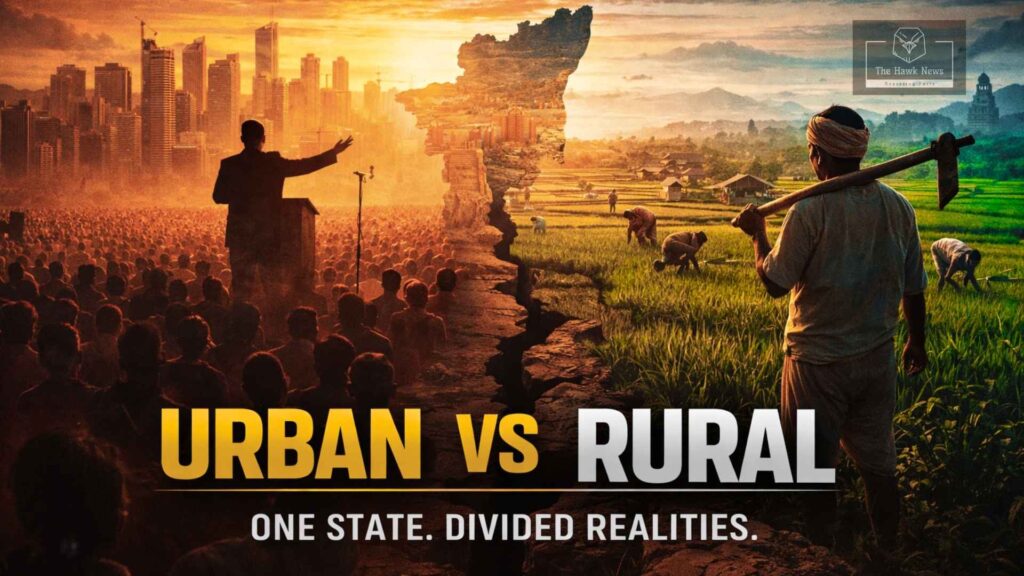
Two Tamil Nadus, Two Conversations
In Tamil Nadu’s election season, two parallel campaigns are unfolding.
One plays out in cities — focused on infrastructure, investments, and digital growth.
The other exists in villages — shaped by livelihood concerns, welfare access, and local governance gaps.
The critical question is whether political messaging is bridging this divide — or widening it.
What the Data Reveals
Recent electoral patterns show a clear urban–rural contrast in participation and engagement:
- The 2021 Tamil Nadu Assembly election recorded 73.83% turnout, with rural districts crossing 75–80%, while Chennai lagged at around 59%
- In the 2024 Lok Sabha elections, turnout hovered around 69–70%, with experts pointing to voter apathy and disconnect
- The 2026 electoral roll revision shows 5.67 crore voters, with significant churn — particularly in urban areas due to migration and deletions
Even administrative insights highlight the divide:
- Rural areas show higher voter stability and engagement
- Urban areas face frequent migration, lower participation, and documentation gaps
What Strategists Are Quietly Saying
Election strategists, speaking off-record and in analytical circles, increasingly acknowledge a growing mismatch.
One senior campaign consultant summarized it bluntly:
“Urban narratives win headlines. Rural narratives win elections.”
Another strategist working on constituency mapping noted:
“Data shows rural voters are more consistent — but messaging is still city-centric.”
A third observer pointed to a structural gap:
“Policy communication is not failing — relevance is.”
The Messaging Gap
Across party lines — whether DMK, AIADMK, or BJP — campaign narratives often lean toward:
✔ Urban-Focused Themes:
- Infrastructure development
- IT growth and investments
- Smart city initiatives
✖ Rural Ground Reality:
- Agricultural distress and input costs
- Access to welfare schemes
- Local employment and migration pressures
This creates a disconnect where campaign promises are heard — but not always felt.
Ground Signals from the Interior
Field-level observations across districts suggest a recurring pattern:
- Rural voters are less influenced by high-decibel campaigning
- They prioritize direct benefits, local leadership, and accessibility
- Welfare delivery — not announcements — shapes perception
Importantly, rural communities often show higher emotional investment in voting, driven by tangible expectations from governance.
The Political Risk
Ignoring this divide carries real electoral consequences:
✔ Pros of Current Strategy:
- Strong urban narrative builds perception of development
- Appeals to aspirational middle-class voters
✖ Risks:
- Rural dissatisfaction can translate into silent electoral backlash
- Overemphasis on urban issues risks misreading core voter base
Tamil Nadu’s electoral history repeatedly shows:
High turnout regions — often rural — decide the final outcome.
The Migration Factor
Urban voter volatility is another emerging challenge:
- Large-scale voter deletions and migration patterns complicate targeting
- Many urban voters are less likely to return to native constituencies to vote
This makes rural voters not just important — but structurally decisive.
The Bigger Reality
The divide is not just geographic — it is perceptual.
Urban campaigns often project future growth.
Rural voters often evaluate present delivery.
Until this gap is addressed, political messaging risks becoming:
Visible everywhere — but effective only in parts.
The Road Ahead
For parties across the spectrum, the challenge is clear:
- Align policy messaging with ground realities
- Shift from announcement-driven politics → delivery-driven politics
- Recognize that Tamil Nadu votes as a unified state — but thinks in local realities
The Final Word
Elections in Tamil Nadu are not lost in cities — but they are often decided in villages.
As campaigns intensify, the real test will not be who speaks louder —
but who listens better.