The signal is subtle. The message is loud.
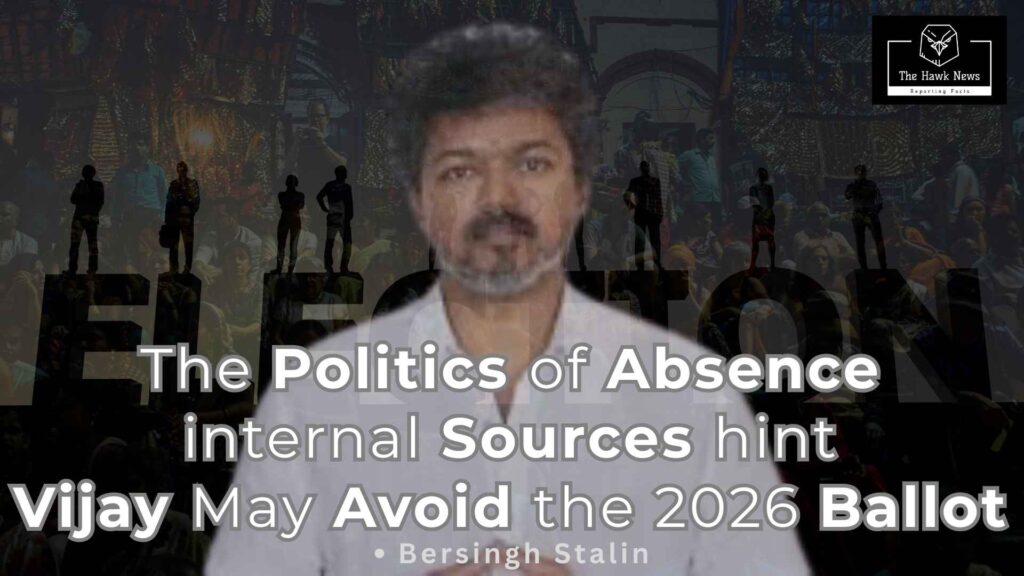
Internal sources indicate that Vijay will not contest the 2026 Tamil Nadu Assembly election as a candidate.
This does not mean his party will stay away.
Tamilaga Vettri Kazhagam will contest. Vijay will campaign. Vijay will ask people to treat it as if he is contesting all 234 seats.
But he will not put his own name on the ballot.
In Tamil Nadu politics, this is not a tactical adjustment.
This is a retreat under pressure.
The official narrative vs the operational reality
The explanation that will be sold is simple and media friendly.
One man.
234 constituencies.
Limited time.
Impossible to campaign everywhere if he contests one seat.
This argument sounds logical on television debates.
It collapses under basic political scrutiny.
History shows that chief ministerial aspirants contesting a single seat does not restrict statewide campaigns.
MGR did it.
Jayalalithaa did it.
Karunanidhi did it.
Stalin did it.
The real reason lies elsewhere.
The pressure triangle: Mental, physical, institutional
Vijay’s political slowdown did not happen organically.
It was engineered.
1. Mental pressure through investigative shadow
The Central Bureau of Investigation probe connected to the Karur incident has not just legal implications.
It has psychological intent.
Repeated summons.
Ambiguity.
Media leaks without closure.
This is not about conviction.
It is about distraction.
Every visit to Delhi is time stolen from party building.
Every appearance before investigators weakens momentum.
Politics runs on rhythm.
Break the rhythm and the campaign bleeds.
2. Physical pressure through movement control
The travel between Chennai and Delhi is not symbolic.
It is operational sabotage.
A regional party in its formative phase needs daily ground presence.
District coordinators.
Booth level structure.
Volunteer motivation.
Instead, the party head is forced into legal corridors.
This is how political movements are slowed without banning them.
3. Institutional pressure through cinema blockade
Vijay’s political strategy was clear.
Cinema as amplification.
Politics as conversion.
The film Jananayagan was designed as more than entertainment.
It was timed as a narrative vehicle.
A mass reach instrument before election notification.
That plan is now dismantled.
Censor delays.
Review postponements.
Silent administrative throttling.
Once election dates are announced, release becomes legally impossible.
This is not coincidence.
This is calendar warfare.
Why BJP feels threatened by Vijay
To understand the intensity of pressure, one must understand vote arithmetic.
Vijay is not primarily cutting into DMK’s core vote.
He is targeting floating opposition voters.
Anti-incumbency voters.
Youth voters.
First time political voters disillusioned with legacy parties.
Traditionally, these votes drift towards the NDA alliance which includes Bharatiya Janata Party and All India Anna Dravida Munnetra Kazhagam.
When Vijay enters, that drift stops.
Statistical reality
In the 2021 Assembly election, margins in nearly 40 constituencies were under 10,000 votes.
A swing of 3 to 5 percent alters outcomes.
TVK does not need to win to damage.
It only needs to split.
From BJP’s perspective, Vijay is not a competitor.
He is a spoiler.
And spoilers are neutralized early.
BJP’s Tamil Nadu dilemma
The BJP has invested a decade in Tamil Nadu without proportional electoral returns.
Low vote share.
Dependence on alliances.
Limited grassroots penetration.
Its strategy relies on:
- Consolidating opposition votes
- Weakening DMK through alliance arithmetic
- Preventing emergence of a third pole
Vijay disrupts all three.
He does not need caste arithmetic.
He brings emotional capital.
That is dangerous in a state where cinema still shapes politics.
Why Vijay stepping back as a candidate makes sense under pressure
Contest and lose, and the damage is permanent.
Tamil Nadu politics is unforgiving to symbolic defeats.
A loss is not seen as experience.
It is seen as rejection.
Vijay understands this.
If he contests and loses, he becomes another Kamal Hassan style footnote.
A star who could not convert admiration into mandate.
By not contesting, he avoids personal humiliation.
But the cost is credibility.
The credibility collapse paradox
Vijay’s entire political appeal rests on personal leadership.
People are not voting for TVK ideology.
They are voting for Vijay.
When he refuses to contest, the question becomes unavoidable.
If you will not stand, why should we?
Voters interpret absence as hesitation.
Hesitation as fear.
Fear as weakness.
This perception damage cannot be repaired by speeches.
Media management vs ground truth
Vijay will attempt to manage the narrative.
He will say he is contesting all seats symbolically.
He will ask voters to treat TVK as his proxy.
He will emphasize long term politics.
But Tamil Nadu voters are seasoned.
They understand symbolism.
They respect confrontation more.
MGR faced the system.
Jayalalithaa fought arrests.
Karunanidhi went to jail.
Retreat has never built legacy here.
BJP’s silent success
If Vijay does not contest, BJP wins without fighting.
No direct confrontation.
No public blame.
No visible suppression.
Just slowed momentum and strategic exhaustion.
This is modern political control.
Not bans.
Not arrests.
Just pressure until retreat looks voluntary.
The long term damage to TVK
A party without its leader on the ballot struggles to survive its first election.
Cadres lose motivation.
Candidates lack confidence.
Voters hesitate.
TVK risks becoming a vote cutting instrument rather than a governing alternative.
Once branded as that, recovery is rare.
Conclusion: A collapse engineered, not accidental
Vijay is not withdrawing because of logistics.
He is not stepping back because of vision.
He is cornered.
Cornered by investigative pressure.
Cornered by administrative delays.
Cornered by electoral math engineered to isolate him.
The tragedy is not that Vijay may not contest.
The tragedy is that a political movement is being neutralized before voters can decide.
Tamil Nadu has seen this pattern before.
When power fears unpredictability, it does not debate.
It delays.
It distracts.
It exhausts.
And when the leader finally steps back, the system smiles.
Because control was achieved without ever appearing oppressive.
That is the real story of 2026.