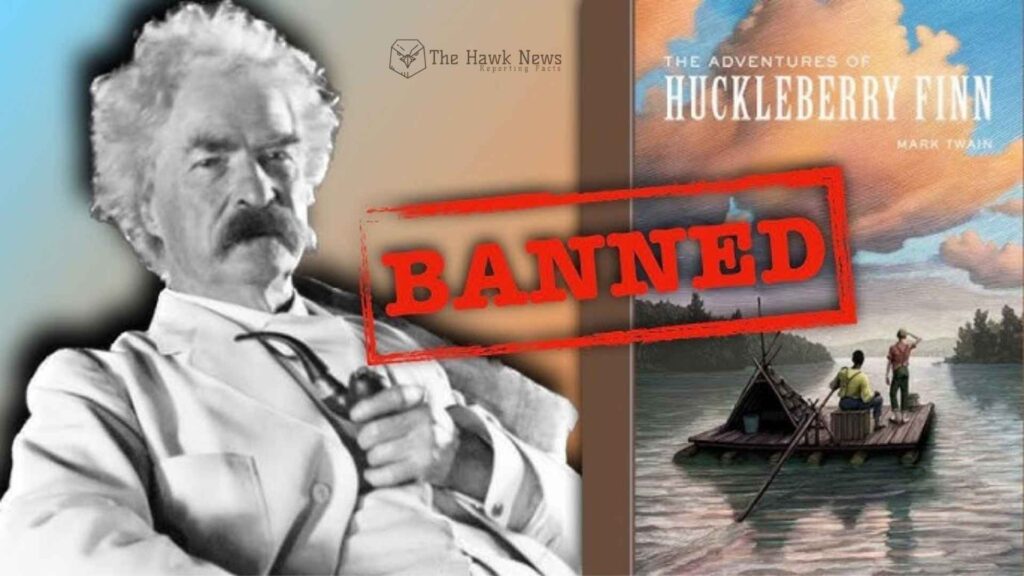
On November 25, 1884, British readers flipped open a book that would come to define American literature: Mark Twain’s Adventures of Huckleberry Finn.
But here’s the twist — they got it months before America did.
The novel that many scholars now call “the first great American novel” wasn’t even born on American soil. It debuted in London, not the Mississippi River’s heartland. And behind that oddity lies a story of copyright fears, a rogue engraver’s stunt, and one of the strangest publishing mishaps of the 19th century.
A Very British Beginning for an American Tale
By the early 1880s, Mark Twain was a global name — a humorist, a critic of human folly, and one of America’s sharpest literary voices. When he finished Huckleberry Finn, U.S. readers were eager.
But Twain knew a reality that would frustrate any modern creator: piracy was rampant, and America’s copyright laws were weak. Books printed in the U.S. could be copied abroad instantly with no protection for the author.
Britain, however, had strong, enforceable copyright laws.
So Twain did what any savvy creator in 2025 would still do:
He dropped the book first in the country that would protect it.
On November 25, 1884, Chatto & Windus published the first complete edition of Huckleberry Finn in London. British critics embraced it. American readers… waited.
The Rogue Engraver Scandal That Derailed the U.S. Release
The U.S. edition was supposed to follow immediately. The plates were engraved. The pages printed. Thousands of copies were ready.
And then the nightmare happened.
An engraver, reportedly annoyed with his workload, did the unthinkable — he secretly altered one of the book’s illustrations.
In the image where Huck appears at a tailor’s fitting room, the engraver inserted a tiny, indecent detail into the background. It was subtle, but unmistakably vulgar. Once discovered, it created a publishing meltdown.
The entire printed batch — thousands of copies — had to be recalled, destroyed, and re-engraved.
What should have been a simultaneous American release turned into a three-month delay. Twain was furious. Publishers were embarrassed. And American readers waited even longer.
The U.S. edition finally hit shelves in February 1885.
Irony: The Most ‘American’ Novel Became a British Debut
Huckleberry Finn is the novel that taught America the power of its own voice. Twain abandoned polished Victorian prose in favor of the raw, colloquial language of real people — mischievous boys, enslaved men, river con artists, and small-town eccentrics.
Its themes — racism, morality, conscience, rebellion — are deeply American.
Yet Americans were not the first to read it. That honor went to Victorian Britain.
There’s a delightful irony in that.
A Scandal That Amplified the Legend
For all its chaos, the delay did something no marketing team could have planned.
It created an international buzz.
Twain was already popular in Europe, and London reviews were positive. By the time Americans finally held the book in their hands, it was not just anticipated — it was a cultural event.
Picnics, literary clubs, and even church groups discussed the novel. Newspapers debated whether the book’s language was revolutionary or rebellious. Libraries fought over whether to ban it.
It hit shelves like a wave — and the wave has never truly receded.
Why This Matters Today
More than 140 years later, Huckleberry Finn remains controversial, studied, banned, defended, celebrated — but never ignored.
And when people talk about it, they rarely know:
- It launched outside the country it defines.
- Its American release was sabotaged by an engraver’s crude joke.
- One of the most important books in literary history almost didn’t arrive cleanly at all.
In today’s era of early leaks, pre-release controversies, and global launches, Twain’s experience feels surprisingly contemporary. Copyright strategy, launch timing, and sabotage — these could be headlines from a 2025 publishing cycle.
Except this story happened in 1884.
A Final Thought
It’s easy to view Huckleberry Finn as a classic carved in stone. But its birth was messy, human, chaotic — much like the world it tried to capture. And the fact that British readers met Huck and Jim before American ones? That’s a historical footnote worth telling.
Sometimes the most American stories don’t start in America at all.