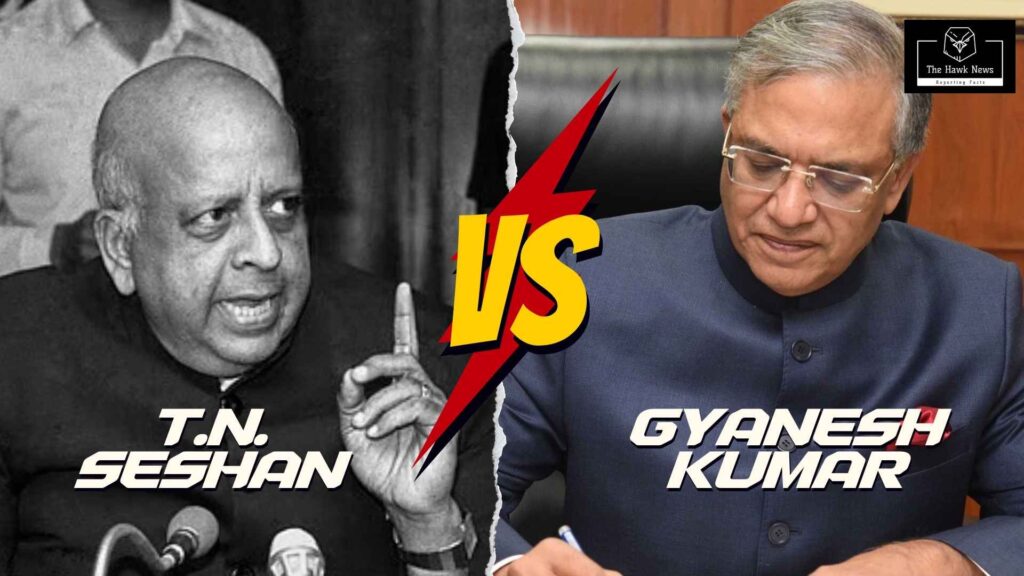
From T. N. Seshan to Gyanesh Kumar: How India Moved From Defending Elections to Controlling Them
India did not inherit electoral democracy fully formed. It was built, contested, corrected and defended through institutions that gradually learned to stand up to power. Among them, the Election Commission of India once emerged as a rare constitutional body that could look the ruling class in the eye and say no.
That authority was not accidental. It was enforced.
At the centre of that transformation stood T. N. Seshan, a bureaucrat who treated elections not as a procedural ritual but as the backbone of the republic. Three decades later, the institution he strengthened now stands altered in spirit, reshaped by law, and increasingly insulated from accountability under Gyanesh Kumar.
This is not a comparison of personalities.
It is a comparison of systems.
One built to restrain power.
The other redesigned to serve it.
When the Election Commission Refused to Be Decorative
Before 1990, the Election Commission largely existed as a ceremonial referee. Elections happened. Governments won. Violations were noted quietly, if at all. The Commission rarely disrupted political convenience.
T. N. Seshan changed that equilibrium.
He understood something critical. Elections are not free because they are held. They are free only when fear is removed, money is constrained, and the state machinery is forced into neutrality.
Seshan weaponised the Constitution itself. Article 324, long treated as vague and ornamental, was turned into an operational mandate. The Election Commission was no longer a post office forwarding dates and symbols. It became an enforcement authority.
Political parties hated him for it. Voters trusted him for the same reason.
The Model Code of Conduct Becomes a Weapon
The Model Code of Conduct existed before Seshan. What did not exist was the will to enforce it.
Under his tenure, ministers were stopped mid campaign. Government advertisements were pulled. Officials were transferred overnight. Poll schedules were announced without consulting political convenience.
For the first time, ruling parties realised something uncomfortable. Once elections were notified, power no longer belonged to them.
This was revolutionary not because it was radical, but because it was constitutional.
Voter Identity and the End of Ghost Democracy
One of Seshan’s most consequential interventions was pushing voter identity cards as a compulsory electoral instrument.
Before this, impersonation and duplicate voting were systemic features of Indian elections. Booth capturing thrived because voters were invisible.
By insisting on voter IDs, Seshan attacked electoral fraud at its root. The voter became identifiable. The vote became traceable. Manipulation became harder.
This reform did not favour any party. That itself was its greatest strength.
Money, Muscle, and the Limits of Tolerance
Cash for votes was not invented in the 1990s. What changed was tolerance.
Seshan ordered crackdowns on liquor distribution, cash handouts, and intimidation tactics. Expenditure ceilings were enforced with unprecedented seriousness.
Candidates were disqualified. Booths were repolled. Armed forces were deployed in sensitive regions not as a show, but as a deterrent.
The message was clear. Winning was allowed. Cheating was not.
An Institution That Feared No Government
Perhaps the most important legacy of Seshan was psychological.
The Election Commission began to see itself as independent. Officers drawn from outside states were appointed to avoid local pressure. Transfers were used to break political influence. Fear shifted from voters to violators.
This was not always popular. But democracy does not grow by popularity. It grows by resistance.
That culture did not survive unchanged.
The Slow Reversal Begins
Post Seshan, the Election Commission gradually returned to institutional caution. Assertiveness softened. Political negotiation replaced confrontation.
Yet, one safeguard remained intact for decades. The method of appointment.
The Chief Election Commissioner was formally appointed by the President, but the expectation of neutrality was reinforced by judicial scrutiny and constitutional convention.
That firewall collapsed in 2023.
When the Supreme Court Drew a Line
In the Anoop Baranwal judgment, the Supreme Court acknowledged what civil society had argued for years. Electoral independence requires independence in appointment.
The Court mandated a temporary selection committee consisting of the Prime Minister, the Leader of Opposition, and the Chief Justice of India.
This was not judicial overreach. It was constitutional damage control.
The message was unmistakable. Elections cannot be supervised by officials chosen exclusively by those contesting them.
Parliament Responds by Removing the Judge
Instead of strengthening the safeguard, Parliament dismantled it.
The Chief Election Commissioner and Other Election Commissioners Act, 2023 removed the Chief Justice of India from the selection process entirely. In his place came a Union Cabinet Minister nominated by the Prime Minister.
The arithmetic became obvious.
Two members from the ruling executive.
One from the opposition.
A built-in majority.
Consensus was no longer required. The ruling party could select the referee.
This was presented as legislative clarity. In reality, it was executive capture.
Democracy Without Choice in Choosing Its Guardian
Supporters of the law argue that Parliament has the authority to legislate appointments. That is constitutionally true.
What is also true is that legality does not equal legitimacy.
When the ruling party controls appointments, tenure, service conditions, and removal thresholds, independence becomes theoretical.
The Election Commission was not designed to be neutral by goodwill. It was designed to be neutral by structure.
That structure has now been altered.
Enter Gyanesh Kumar
Gyanesh Kumar became Chief Election Commissioner under this new legal framework.
His appointment is historic not because of his background, but because of the process that produced it. He is the first CEC selected after the judiciary was deliberately excluded.
Opposition consent was no longer necessary. Judicial oversight was no longer institutionalised.
This is not a personal allegation. It is a systemic observation.
Legal Immunity and the Death of Accountability
Perhaps the most alarming change lies not in selection, but in protection.
Recent legal provisions grant serving and former Election Commissioners immunity from legal proceedings for actions taken during their tenure.
In simple terms, even if decisions are arbitrary, biased, or illegal, accountability becomes nearly impossible once the term ends.
This is extraordinary.
Judges do not enjoy such immunity. Ministers do not enjoy such immunity. Yet, officials overseeing elections now do.
Power without accountability is not independence. It is insulation.
The Chilling Effect on Democracy
The implications are long term.
If commissioners know their appointment is controlled and their actions legally shielded, institutional courage evaporates. Decisions begin to align with expectation, not principle.
Public trust erodes quietly. Voters may still queue. Ballots may still be cast. Results may still be announced.
But faith diminishes.
Democracy does not collapse with tanks. It collapses when citizens stop believing outcomes reflect choice.
From Enforcement to Explanation
Under Seshan, the Election Commission acted first and explained later.
Today, explanations dominate. Press notes replace penalties. Silence replaces intervention.
This is not nostalgia. It is structural analysis.
Institutions behave as they are designed to behave.
What Changed Is Not the Law Alone
The tragedy is not merely the 2023 Act. It is the abandonment of an idea.
The idea that elections must be protected even from those who win them.
Seshan embodied that idea. He offended governments because he answered to the Constitution, not to power.
The present framework answers to procedure. And procedure has been redesigned.
Democracy Is Not Lost in One Amendment
India did not lose its democracy overnight.
It is being reorganised carefully. Legally. Procedurally. Respectfully.
Each change justified as reform. Each safeguard dismissed as obstruction.
The Election Commission now reflects that transformation.
The Question That Remains
If T. N. Seshan enforced democracy against power, today’s system manages democracy for power.
That is the difference.
The question is not whether elections will be held.
The question is whether institutions will still have the courage to stand against those who appoint them.
History has already answered this once.
The answer now depends on whether the republic still remembers why that courage mattered.