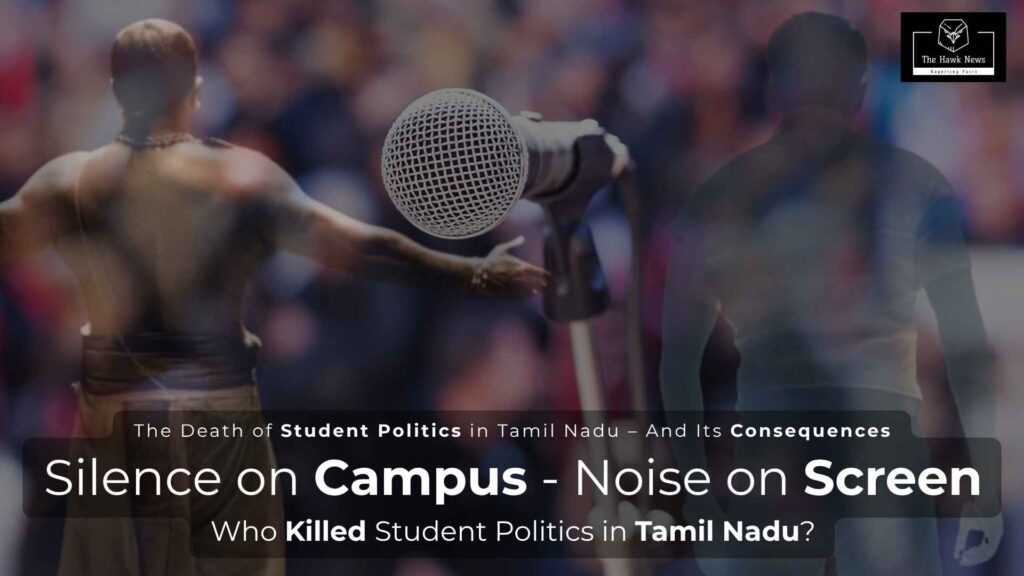
A State That Once Breathed Politics
Tamil Nadu was not built in silence. It was built in protest.
The political identity of this state did not emerge from television studios or film sets. It came from the streets, from campuses, from students who were willing to question power and confront authority. The 1965 Anti-Hindi agitations were not led by seasoned politicians. They were driven by students. Young men and women who had no electoral power, but had ideological clarity.
They did not wait to be influenced. They became the influence.
Campuses were not just places of education. They were spaces of political formation. Students debated language, caste, governance, and rights. They were not passive recipients of political messaging. They were active participants in shaping it.
That ecosystem created a generation of politically aware citizens. It also created leaders who understood the ground before they sought power.
That ecosystem is now gone.
The Systematic Erasure of Campus Democracy
Today, student politics in Tamil Nadu is not weakened. It is almost extinct.
Most colleges do not conduct student union elections. In many institutions, elections have not been held for decades. Administrative control has replaced democratic participation. Student bodies, where they exist, are often nominated, not elected.
This was not accidental. It was a deliberate shift.
The justification was simple. Prevent violence. Maintain discipline. Protect academic focus.
But what was removed in the name of order was not just conflict. It was political exposure.
When elections disappear, debate disappears. When debate disappears, ideology disappears. When ideology disappears, understanding disappears.
What remains is a generation that votes without ever learning how politics actually works.
From Political Classrooms to Political Illiteracy
Student politics is not about banners, slogans, or campus rivalry. At its core, it is a training ground.
It teaches negotiation. It teaches accountability. It teaches the difference between rhetoric and governance.
When a student contests an election, he learns how to build support. When he loses, he learns how to accept public judgment. When he wins, he learns responsibility.
Without this process, political understanding becomes theoretical at best and emotional at worst.
Tamil Nadu today produces educated graduates. But it is also producing politically untrained voters.
A voter who has never engaged in structured political activity is more vulnerable to perception than to policy. He reacts to image more than ideology.
That is not a coincidence. That is a consequence.
The Vacuum That Cinema Occupied
In the absence of campus politics, another force filled the space. Cinema.
Tamil Nadu has always had a strong connection between cinema and politics. But earlier, cinema complemented political awareness. It did not replace it.
Today, for many young citizens, cinema is the first and often the only exposure to leadership.
A growing child watches a film where an actor plays a righteous leader. He sees corruption being crushed in three hours. He sees justice delivered through dialogue. He sees power exercised without complexity.
He does not see policy. He does not see compromise. He does not see governance.
He sees performance.
Over time, that performance becomes perception. And that perception becomes belief.
When the same actor enters politics, the transition is not questioned. It is accepted. Because in the mind of the viewer, the actor was already a leader.
This is where the line between reel and real collapses.
Manufactured Emotion vs Political Understanding
Real politics is slow, complex, and often disappointing. Cinema is fast, dramatic, and emotionally satisfying.
When a population lacks political training, it naturally gravitates towards what it understands better. Emotion over analysis. Symbolism over substance.
Speeches begin to replace policy discussions. Slogans begin to replace ideological clarity. Emotional mobilisation begins to replace informed decision-making.
This is not just a cultural shift. It is a structural failure.
Because when citizens respond more to emotion than to governance, the quality of leadership they choose is directly affected.
The Cost of Blind Following
The consequences of this shift are not abstract. They are visible.
When individuals are driven by emotional attachment rather than political understanding, they become easier to mobilise and harder to reason with.
Crowd behaviour becomes unpredictable. Political support becomes personal loyalty. Criticism becomes betrayal.
In extreme cases, this leads to situations where enthusiasm overrides safety, where devotion overrides judgment.
Incidents like the Karur stampede are not isolated accidents. They are symptoms of a deeper problem. A problem where political engagement is replaced by emotional following.
When citizens are trained to question, they calculate risk. When they are trained to follow, they surrender to it.
That difference can cost lives.
Why Tamil Nadu Stands Apart for the Wrong Reasons
Across India, many states still maintain active student politics. Campuses in Delhi, Kerala, and West Bengal continue to produce leaders who have gone through electoral and ideological training at a young age.
Tamil Nadu, despite its rich political history, has moved in the opposite direction.
The state that once led mass movements is now producing voters with minimal exposure to grassroots politics.
This is not progress. It is regression.
Because democracy does not weaken when students participate. It weakens when they are excluded.
The Fear That Drove the Ban
The removal of student politics did not happen without reason. There were concerns about violence, caste clashes, and external political interference.
These concerns were real. But the solution chosen was extreme.
Instead of regulating student politics, it was removed. Instead of reforming the system, it was shut down.
This is equivalent to shutting down roads because of accidents instead of improving traffic systems.
When participation is eliminated, the problem does not disappear. It shifts.
And in Tamil Nadu, it shifted into unstructured, unregulated emotional mobilisation.
Rebuilding Political Literacy from the Ground Up
If Tamil Nadu wants informed voters, it cannot avoid student politics. It must rebuild it.
This does not mean returning to chaos. It means creating structured, regulated, transparent campus political systems.
- Mandatory student union elections
- Clear rules to prevent violence and external interference
- Political debates and policy discussions within campuses
- Exposure to multiple ideologies, not just dominant narratives
Students must learn politics before they participate in it as citizens.
Because democracy is not sustained by voting alone. It is sustained by understanding.
The Real Question
The issue is not whether cinema influences politics. It always has, and it always will.
The real question is why cinema has become the primary political educator for a generation.
The answer lies in the silence of campuses.
When institutions stop creating politically aware individuals, society fills that gap with whatever is available. In Tamil Nadu, that substitute has been cinema.
And cinema, by design, is not built to teach governance. It is built to entertain.
What Happens If Nothing Changes
If this trajectory continues, Tamil Nadu risks creating generations that are politically active but intellectually disengaged.
They will vote. They will rally. They will support.
But they may not fully understand what they are supporting.
This creates a democracy that functions on participation but lacks depth.
A democracy where choices are made, but not always informed.
The Final Reality
Tamil Nadu once produced students who shaped politics.
Today, it produces audiences who consume it.
That shift did not happen naturally. It was created by removing politics from the very place where it should begin.
The campus.
Until that is reversed, the state will continue to face a simple but dangerous reality.
When real politics disappears from education,
illusion becomes education.