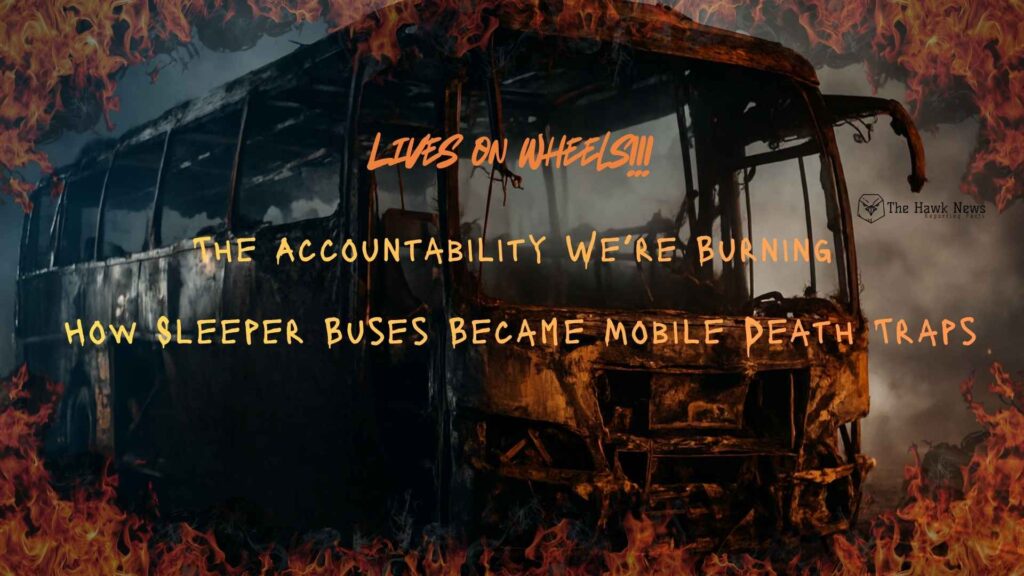
Lives on Wheels: How Sleeper Buses Became Mobile Death Traps
When the world sleeps, the road doesn’t. Overnight buses slice through darkness, claiming lives with the same quietness that many passengers hope for.
For those on board, especially on sleeper coaches, the night can be a death sentence.
1. The Midnight Inferno: A Nightmare Unfolds
On November 17, 2025, a horrifying crash shook the holy roads between Mecca and Medina: a bus carrying Indian Umrah pilgrims collided with a diesel tanker and erupted into flames.
Most of the 46 passengers were asleep, many unaware of the impending disaster until it was too late. In that moment, trust became a cage — and tragedy followed.
According to reports, 45 of them lost their lives. Survivors say escape was impossible: the fire spread too quickly, and the passengers had no way out.
This is not a freak accident — it’s a symptom of a far deeper problem.
2. Illegal Conversions, Locked Doors & Jammed Exits
It’s not just in Saudi Arabia. Similar sleeper coach fires have been reported across India, exposing a dangerously widespread pattern of structural neglect.
One such case involved a bus that was illegally converted — it was registered as a 43-seater but retrofitted with sleeper berths.
Investigators found it lacked critical fire safety features: no roof hatches, no alarms, no fire-retardant materials, and no emergency tools in the berths.
In another incident in Jaisalmer, authorities discovered that the bus’s doors could only be operated by the driver, trapping passengers inside.
These are human-made death traps, not accidents — built for capacity, not survival.
3. Drivers, Owners, Regulators: Who Bears the Burden of Blame?
This tragedy is not just a design failure. It’s also a failure of accountability.
Bus operators are reported to prioritize profit margins over safety. They cut costs by using flammable materials and dodging regulations.
Regulatory authorities share the blame. In some regions, buses with risky modifications slip through inspections.
And then there’s the driver and staff on board — responsible for checking safety, ensuring doors open, and helping with escape.
But in the chaos of a fire, many drivers are either unprepared or unable to help. In one survivor report, the driver jumped through a window to save himself.
When lives burn, it is the system — and its enablers — that must face the flames of accountability.
4. Fire Safety or Profit Margin? The Cost of Cutting Corners
On paper, regulations exist — but on the ground, enforcement is weak. Safety norms say sleeper buses should have multiple exits, fire suppression systems, and laminated glass that can be broken in an emergency.
Yet, many buses don’t meet even the basics.
In these cases, corners are cut intentionally: to maximize berth capacity, to save money on materials, and to squeeze more revenue from each journey. Regulators may issue permits, but they often fail to verify that the bus meets the safety design on paper.
This is a cruel trade-off: more berths for profit — but fewer lives saved when danger strikes.
5. Voices from the Ashes: Survivors, Families & the Unheard Pain
The survivor from the Saudi crash, Mohammed Shoaib, has recounted how he escaped — only because he was sitting beside the driver and leapt out through a window.
But not all stories end with a leap. For many families, the only thing they carry back is grief.
In Hyderabad, relatives of the deceased pilgrims are reeling from the loss of spouses, parents, children — lives extinguished in what was supposed to be a sacred journey.
Far too often, the victims are the vulnerable: pilgrims, migrant workers, mid-income travellers who rely on the cheapest overnight options.
6. What Must Change: Accountability, Design Reform & Real Enforcement
To prevent another tragedy, systemic reforms are urgent:
- Mandatory Safe Design: All sleeper buses must have multiple exits, roof hatches, emergency window-breakers, and fire-resistant interiors.
- Unannounced Safety Audits: Regulatory bodies should conduct surprise checks — not just paperwork, but physical safety verification.
- Strict Penalties: Bus operators caught running illegally converted or unsafe coaches should face heavy fines, license revocation, and criminal liability for loss of life.
- Driver Training & Responsibility: Drivers and conductors should be trained in fire response and evacuation. They should run safety briefings before every night trip.
- Passenger Awareness: Travellers must be educated: check for emergency hammers, know where exits are, and demand safer buses.
- International Accountability (for pilgrim transport): Travel agencies organizing pilgrim transport must be held to safety standards, especially when carrying vulnerable groups at odd hours.
Final Reflection: The Road Should Not Be a Coffin
Every time a sleeper bus burns and people die, the world owes them more than headlines.
We owe them a reckoning.
They were not just passengers. They were people asleep with trust in their drivers. They were pilgrims returning home, workers heading back to their families, travellers hoping for rest.
Instead of rest, they found fire. Instead of a journey, they found a trap.
If this continues — if money and negligence keep winning over human life — then every overnight journey carries a question: when will it be our turn?
We need to hold the operators, the regulators, and ourselves accountable. Because a ride should be a promise of safety — not a gamble with fate.