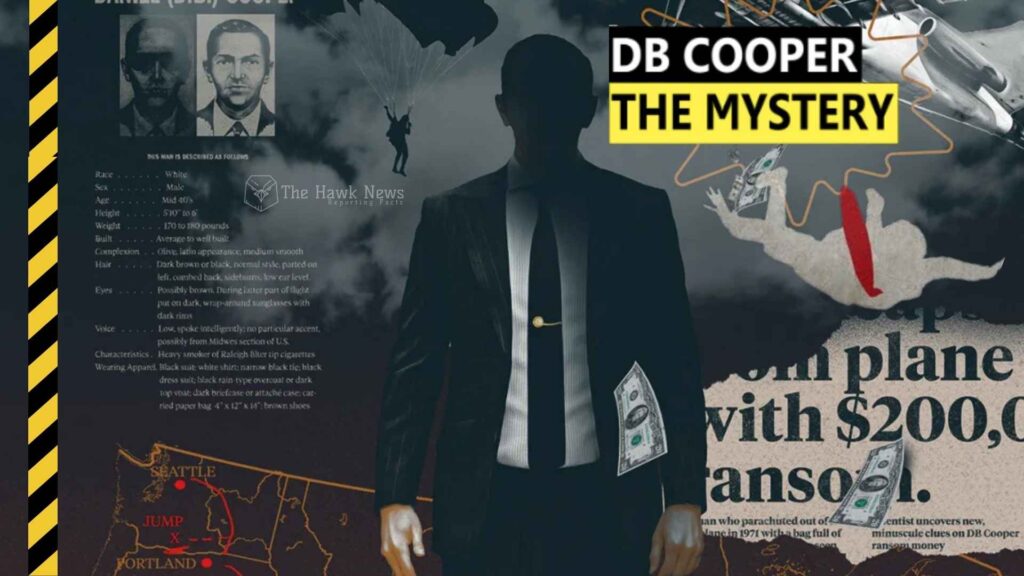
On November 24, 1971, a man boarded a Boeing 727 under the name “Dan Cooper,” ordered a bourbon and soda, handed a note to a flight attendant, and calmly began one of the most audacious crimes in American history. By nightfall, he had leaped from the rear staircase of the aircraft — parachute strapped on, ransom money secured — and vanished into the darkness of the Pacific Northwest.
For more than 50 years, the world has obsessed over one question:
How can a man step out of a plane and never touch history again?
The real mystery, however, isn’t how D.B. Cooper vanished.
It’s why we keep wanting him to.
The Vantage Point Everyone Misses:
D.B. Cooper Is America’s Last Willing Unknown**
In a world of surveillance, digital footprints, and relentless self-promotion, anonymity has become nearly impossible. Everyone is tracked. Everyone is documented. Everyone is visible.
But D.B. Cooper stands alone as the last figure who refused to be known — and succeeded.
He is the only criminal in modern history who:
- left no digital trail,
- created no legacy of violence,
- rejected personal fame,
- and walked away without leaving a single provable identity.
He became the anti-celebrity in an age racing toward visibility.
Cooper didn’t disappear because he was clever.
He disappeared because he never wanted to be found.
And that is something our generation, addicted to visibility, struggles to understand.
The Heist That Wasn’t About Money
D.B. Cooper demanded $200,000 — a significant amount at the time, but not enough to justify such risk. If it were only about wealth, the story might have faded like countless other hijackings of the era.
But Cooper’s behavior defied greed:
- He was polite.
- He never pointed the bomb at anyone.
- He paid for his drink.
- He let passengers go unharmed.
- He thanked the crew.
- He refused unnecessary violence.
This wasn’t the psychology of a desperate criminal.
It was the psychology of a man making a point.
The money was incidental.
The act was symbolic.
The Leap That Defined Him
When D.B. Cooper stepped out of that jet, he jumped into more than a stormy sky.
He jumped into:
- the American imagination,
- the cracks of the justice system,
- the mythology of rebellion,
- and our cultural hunger for someone who can outsmart authority without cruelty.
Most criminals seek power.
Cooper sought disappearance.
In an era where every mistake, every secret, every failure is instantly archived forever, Cooper’s vanishing feels like a rebellion against the permanence of modern life.
He became a phantom by choice — the last person to ever pull that off.
The Reason No One Really Wants the Case Solved
Every few years, a new suspect emerges.
A deathbed confession.
A forensic clue.
A theory with just enough smoke to get attention.
Yet none of them ever satisfy the public.
Why?
Because the mystery is more meaningful than the man.
Revealing D.B. Cooper would collapse the story into something ordinary — a name, a background, a motive. The unknown is what elevates him from criminal to legend.
He represents:
- the thrill of uncertainty,
- the possibility of reinvention,
- the fantasy of escaping systems,
- and the rare idea that a human being can decide who they become.
In an age where everything is traced, tracked, and timestamped, Cooper is the last proof that a clean escape is still possible — even if only in myth.
A Crime That Became a Cultural Mirror
Cooper’s story exposes something about us:
- Our distrust of institutions
The FBI spent decades chasing him. He became a symbol of the individual outrunning the system. - Our fascination with antiheroes
He hurt no one. He outsmarted many. He broke rules we secretly admire being broken. - Our fear of transparency
We live in a time where anonymity feels impossible. Cooper represents the freedom we subconsciously crave.
His escape isn’t just a crime — it’s a reflection of modern anxieties about identity, control, and the shrinking space for personal mystery.
The Final Vanishing Act
Whether D.B. Cooper survived the jump or died in the woods has never been conclusively proven.
But in a strange way, it doesn’t matter.
The real legacy of D.B. Cooper is not the heist, the money, or even the mystery.
It’s this:
He is the only modern legend who never needed to be seen to be remembered.
Cooper didn’t vanish from history.
He became history’s negative space — the outline of everything we project onto the unknown.
And maybe that’s why he still matters.
Not because he escaped with the money.
But because he escaped definition.