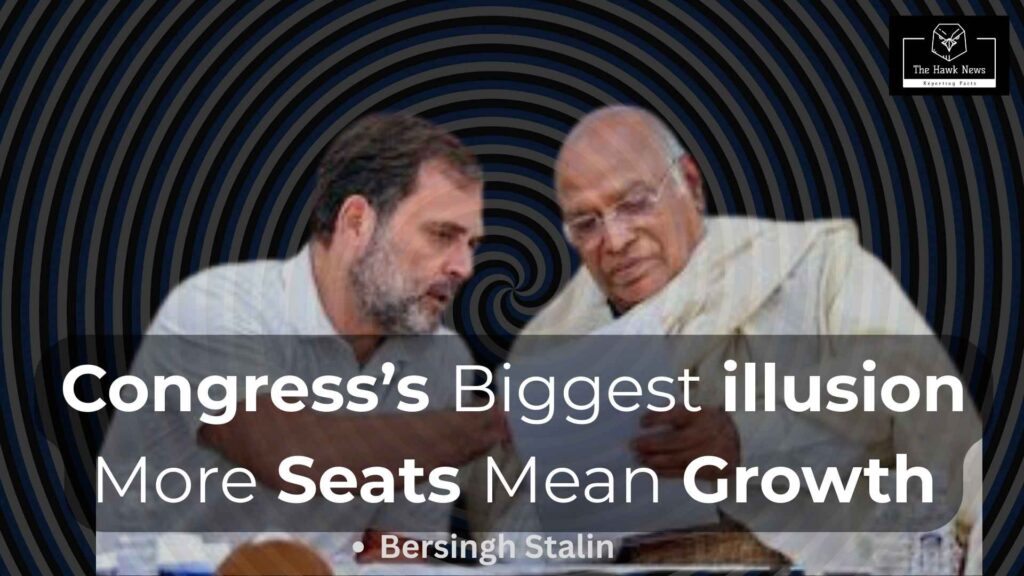
Congress Is Not Losing Elections. It Is Losing the Ground.
Congress believes growth means getting more seats.
Rahul Gandhi believes growth means contesting more constituencies.
This assumption is not just flawed. It is dangerous.
Seats do not grow a party.
Ground work does.
For decades, Congress has confused outcomes with effort. They treat elections like arithmetic problems solved inside meeting rooms. Indian elections are not solved on paper. They are decided on streets, in villages, in wards, and in the minds of voters who observe confidence, clarity, and commitment long before voting day.
Congress thinks people automatically vote for them. They do not.
That era ended long ago.
This article dissects why Congress keeps failing electorally, why delayed alliances hurt more than help, why seat obsession exposes weakness, and how historical data repeatedly proves one thing: parties grow by working on the ground, not by negotiating chairs.
The Core Illusion Inside Congress
Congress leadership believes that contesting more seats equals political expansion. This belief is deeply embedded in their thinking.
They assume vote percentage follows seat presence.
In reality, vote percentage follows trust.
Congress today does not command independent voter trust across most regions. Whatever percentage they receive is often an accumulation of alliance partner votes, not proof of their own organizational strength.
Yet leadership behaves as if those votes belong to Congress alone.
This misunderstanding leads to one recurring mistake: unrealistic seat demands during alliance talks.
The 2024 Reality Congress Refuses to Accept
In the 2024 Lok Sabha elections, the opposition INDIA alliance secured a significant number of seats. Congress emerged with 99 seats.
But here is the uncomfortable truth Congress avoids discussing openly.
A large portion of those votes did not come from Congress ground work.
They came from alliance partners with stronger regional presence.
Congress benefited from coalition arithmetic, not organizational revival.
If Congress had contested alone in most states, its performance would have been drastically weaker. The leadership knows this, yet behaves publicly as if the party is back to strength.
This disconnect between reality and self perception is the root of repeated strategic failures.
Alliances Delayed Are Trust Destroyed
Indian voters observe alliance behavior closely.
Early alliances signal confidence.
Late alliances signal confusion.
Congress consistently announces alliances late, negotiates seats until the last minute, and projects internal uncertainty to voters and cadres alike.
This is not strategy. This is paralysis.
Cadres do not know who they are fighting with.
Voters do not know what coalition they are voting for.
Opponents exploit the confusion mercilessly.
Every delayed alliance weakens the campaign before it begins.
Tamil Nadu Is the Clearest Example
Tamil Nadu is an alliance driven state. Results there prove one simple truth repeatedly.
When alliances are early and cohesive, victory follows.
When alliances are delayed and conflicted, defeat is guaranteed.
In 1996, Congress aligned awkwardly and late. The result was catastrophic. Zero seats out of thirty nine.
In 2004, Congress aligned early with regional partners, projected unity, and worked together. The result was a clean sweep of all thirty nine seats.
Same state. Same voters. Same party.
Different approach. Completely different outcomes.
The lesson is not subtle. It is screaming.
Yet Congress still repeats the same mistake cycle.
BJP’s Growth Is Not Accidental
Congress supporters often dismiss BJP’s gains in southern states as temporary or artificial.
That is denial.
BJP increased its vote percentage in Tamil Nadu in 2024 not because of sudden ideological conversion, but because of sustained presence.
They worked at the booth level.
They invested in cadre building.
They stayed visible between elections.
Vote share growth follows organizational investment. Always.
Congress instead shows up months before elections, negotiates seats, releases manifestos, and expects loyalty.
That is not how modern voters behave.
The Psychology Congress Fails to Understand
Voters do not vote for logos.
They vote for confidence.
They watch how parties behave under pressure.
They observe internal unity.
They sense hesitation instantly.
When Congress delays alliances, quarrels publicly over seat numbers, and sends mixed signals, voters interpret it as weakness.
Weakness repels votes.
People want to back a side that looks prepared to govern, not a group still arguing about who contests where.
Seat Obsession Reveals Ground Weakness
Here is the brutal truth Congress avoids confronting.
If a party has strong ground presence, it does not beg for seats.
Seats come to it naturally.
Congress demands seats because it lacks leverage on the ground.
Alliance partners bring voters. Congress brings legacy.
But legacy does not mobilize crowds anymore.
So Congress compensates by demanding more seats to appear relevant.
This strategy backfires every single time.
Historical Decline Is Not Coincidental
Congress peaked in 1984 with over four hundred Lok Sabha seats.
Since then, its decline has been steady and structural.
The fall was not sudden.
It was not because of one leader.
It was not because of one election.
It happened because Congress slowly withdrew from ground level politics and replaced it with high command culture.
Decisions moved upward. Cadres disconnected. Local leadership weakened.
BJP did the opposite. It decentralized, empowered local units, and built booth level machinery.
Results followed accordingly.
Indoor Politics Versus Field Politics
Congress practices indoor politics.
BJP practices field politics.
Congress leadership meetings generate statements.
BJP ground meetings generate turnout.
Congress invests energy in internal negotiations.
BJP invests energy in voter contact.
This difference defines electoral outcomes.
You cannot replace field work with press conferences.
You cannot replace booth management with alliances alone.
Delayed Alliances Kill Momentum
Momentum is psychological.
When alliances are announced early, cadres feel energized.
When alliances drag on, morale collapses.
Workers ask questions.
Volunteers hesitate.
Voters disengage.
By the time Congress finalizes alliances, half the campaign window is gone.
Opponents already control the narrative.
Congress Misreads Vote Percentages
Congress sees inflated vote percentages and assumes growth.
They forget that those percentages include alliance partner votes that are many times stronger than their own.
If Congress contests alone, those percentages collapse.
Yet leadership treats alliance derived votes as proof of revival.
This is self deception.
Trust Is Built Before Election Season
No voter decides on polling day alone.
Trust builds over years of presence, consistency, and delivery.
Congress appears during elections.
BJP remains present between them.
That single difference explains most outcomes.
The Cost of Internal Quarrels
Voters punish disunity.
When alliance partners argue publicly, voters question stability.
If you cannot manage alliances before elections, how will you manage governance after winning.
This doubt costs votes silently.
Congress underestimates how closely voters watch these signals.
What Congress Must Accept
If Congress wants revival, it must accept uncomfortable truths.
Ground work builds parties.
Seat negotiations do not.
Early alliances build confidence.
Late bargains destroy credibility.
Votes follow trust.
Trust follows presence.
No amount of legacy rhetoric can replace this reality.
Final Truth
Congress is not losing because of ideology.
Congress is losing because of strategy.
They confuse outcomes with effort.
They mistake alliances for strength.
They treat seats as currency instead of trust.
Until Congress rebuilds itself from the ground up, no number of seats on paper will save it.
Elections are not won in war rooms.
They are won in streets.
And Congress has been absent there for far too long.