In the dense settlements of Banajodi village in India’s eastern state of Odisha, a remarkable rescue unfolded—one that showed how knowledge, teamwork, and quick thinking can turn a dangerous situation into a story of hope.
At the center of the drama was a trapped elephant.
The animal had accidentally fallen into a 30-foot-deep functioning well located amid human habitation in Banajodi, within the Sadar forest range of Keonjhar District. The well’s steep walls made escape impossible for such a massive creature.
But what followed next was an extraordinary example of science meeting compassion.
The rescue team would eventually rely on a principle discovered more than two thousand years ago by the ancient Greek mathematician Archimedes.
And it worked.
A Dangerous Fall
The incident occurred in an area where forests and villages share fragile boundaries. Elephants often move through these corridors in search of food or water, occasionally wandering close to human settlements.
In Banajodi, the elephant likely approached the well during its movement through the region. Hidden by surroundings and lacking protective barriers, the well became a deadly trap.
Once the animal fell in, there was no easy escape.
Thirty feet below ground level, the elephant struggled against the narrow, vertical walls. Its enormous weight and the confined space made climbing impossible. The risk of exhaustion, dehydration, or injury grew with every passing hour.
Villagers soon discovered the situation and alerted authorities.
What began as panic quickly turned into a coordinated rescue effort.
A United Rescue Effort
Responding swiftly, officials from the Odisha Forest Department arrived at the site. Soon they were joined by teams from the Fire Services and the local Police, forming a coordinated rescue operation.
The challenge was immense.
An adult elephant can weigh between three and five tons, and extracting such a massive animal from a deep, narrow well without causing injury requires careful planning. Pulling the elephant out directly using ropes or heavy machinery could easily harm the animal—or cause the well’s structure to collapse.
The rescuers needed a strategy that would reduce the elephant’s weight and allow it to move safely toward the surface.
This is where science quietly stepped in.
A Principle From Ancient Greece
The rescuers turned to a concept known as Archimedes’ Principle, discovered by Archimedes in the third century BCE.
The principle explains buoyancy—the upward force exerted by fluids such as water.
Simply stated:
When an object is submerged in water, it experiences an upward force equal to the weight of the water it displaces.
In everyday terms, objects become lighter in water because the fluid helps support their weight.
It is the same reason ships weighing thousands of tons can float in the ocean.
For the rescuers in Banajodi, the idea offered a lifeline.
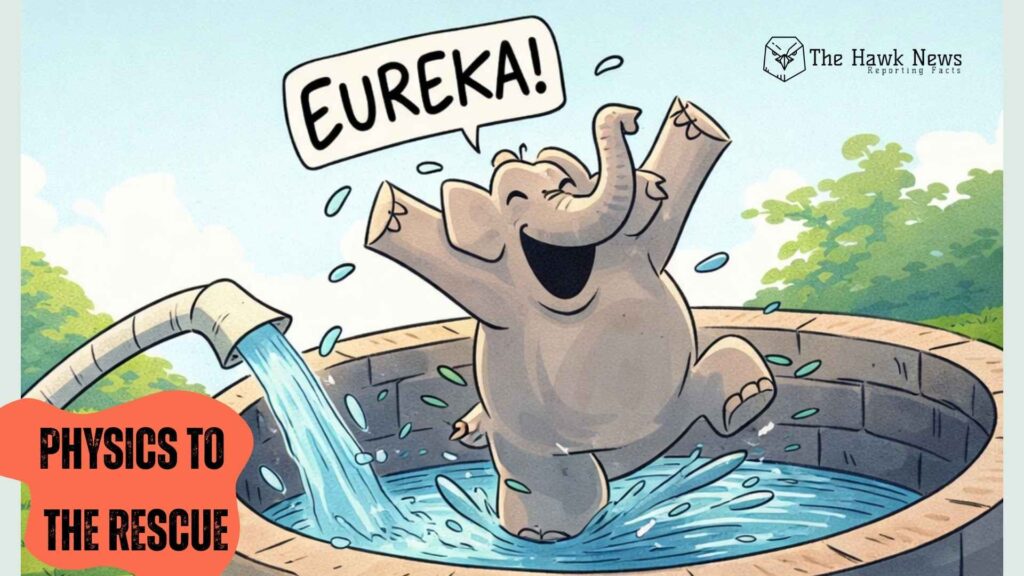
If the well could be filled with water, the elephant would gradually begin to float. The buoyant force would reduce the pressure on its legs and allow it to rise closer to the surface.
Turning the Well Into a Lifeline
Rescue teams began pumping large amounts of water into the well.
Slowly, the water level started rising around the trapped elephant.
At first, the animal remained at the bottom, exhausted and struggling. But as the well filled, something remarkable began to happen.
The elephant’s massive body displaced the water, generating buoyant force. Bit by bit, the water began supporting part of its enormous weight.
Instead of being trapped against the floor of the well, the elephant started to lift upward.
What had been a prison of stone and earth slowly became a floating platform.
Science at Work
The physics behind the rescue was simple but powerful.
Because an elephant’s body occupies a large volume, it displaces a significant amount of water when submerged. According to Archimedes’ Principle, that displaced water pushes upward on the animal’s body.
As the water level rose:
- the elephant’s effective weight decreased
- the suction of mud and pressure on its legs reduced
- movement became easier
Gradually, the giant animal floated higher and higher.
The deeper the water, the closer it came to safety.
A Moment of Relief
The rescue operation took time, patience, and precise coordination between the Forest Department, Fire Services, and Police teams on site.
Villagers watched anxiously as the well filled with water and the elephant slowly rose toward the surface.
Finally, when the water level reached the edge, the exhausted animal was able to regain its footing and climb out with guidance from rescuers.
After hours trapped in darkness, the elephant stepped back onto solid ground.
The crowd erupted in relief.
The rescue had worked.
Knowledge Is Power
The Banajodi rescue stands as a powerful reminder that knowledge can change outcomes in extraordinary ways.
Scientific principles often appear abstract when taught in classrooms. Equations and theories can seem distant from daily life.
But moments like this reveal their true value.
The philosopher Francis Bacon once wrote:
“Knowledge is power.”
In Banajodi, that idea became reality.
A principle discovered over two millennia ago provided the insight needed to solve a modern problem. Like a dash of salt transforming a meal, the right piece of knowledge—applied at the right moment—made all the difference.
Science and Compassion Together
The rescue was not simply a triumph of physics.
It was also a testament to teamwork and compassion.
The coordinated effort of the Odisha Forest Department, Fire Services, and Police personnel ensured that the operation unfolded safely and effectively. Their collaboration demonstrated how different agencies can unite when wildlife is in danger.
Together, they turned a potentially tragic accident into a story of survival.
A Lesson Beyond the Well
Stories like the Banajodi elephant rescue travel far because they carry a universal message.
They remind us that knowledge is not confined to textbooks or laboratories. Science lives in the world around us—in rivers, oceans, machines, and even deep village wells.
And sometimes, the insights of ancient thinkers like Archimedes can still guide modern solutions.
On that day in Banajodi, the principle of buoyancy did more than explain a scientific concept.
It saved a life.
And it proved once again that when knowledge meets compassion, remarkable things can happen.