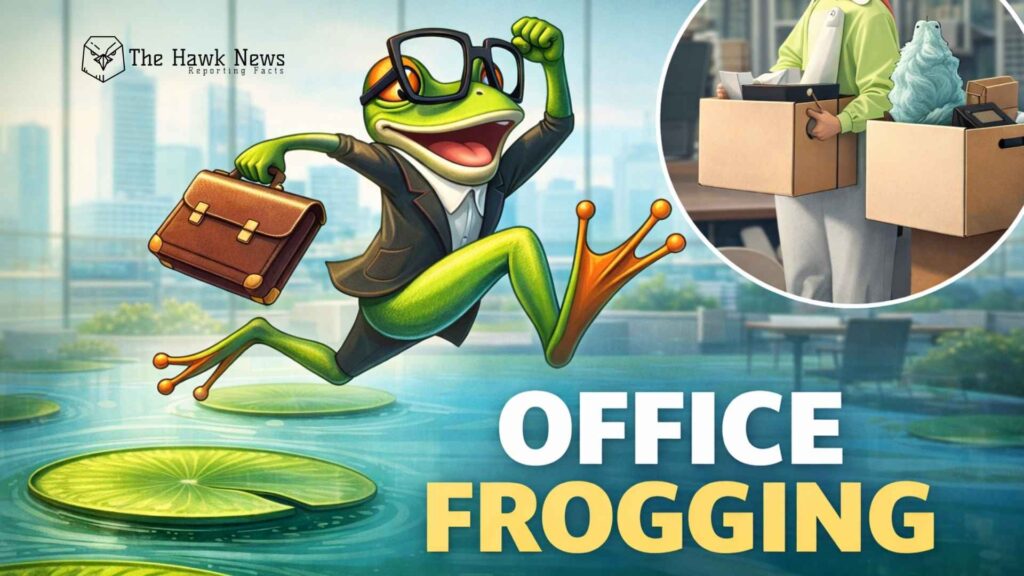
A Leap, Not a Hop
If the 1990s celebrated loyalty and the 2000s glorified hustle, 2026 belongs to the leapers.
“Office frogging,” a phrase that’s quickly entered HR boardrooms and Gen Z group chats alike, defines the new rhythm of modern careers.
Unlike chaotic job-hopping, office frogging is strategic — an intentional leap from one company to another every 18–30 months, motivated by growth, pay, and mental health rather than restlessness or rebellion.
It’s not disloyalty. It’s design.
“If I’m not growing, I’m going,” one 25-year-old marketing analyst in Bengaluru summarized succinctly.
In the new world of work, stability is no longer the trophy. Adaptability is.
The Psychology Behind the Leap
The traditional career arc — stay, climb, retire — is losing its meaning.
For younger professionals, especially Gen Z, the corporate ladder feels less like a ladder and more like a cage.
Today’s workers are growing up in a volatile landscape:
- Layoffs without warning.
- Automation threatening entire industries.
- Rising costs of living without matching pay.
- And a corporate culture that often preaches “mental health” but practices burnout.
So they adapt. They move. They leap.
This isn’t recklessness; it’s realism.
In a world that promises flexibility but often delivers exhaustion, frogging offers autonomy.
A 2025 Gallup report noted that Gen Z employees value learning and growth twice as much as job security. To them, the safest career is not the longest, but the most evolving one.
“I’m not chasing comfort,” says an IT engineer who’s switched roles three times since 2021. “I’m chasing competence.”
The Pros: The Power of the Leap
1. Faster Skill Acquisition
Office froggers move through diverse projects, teams, and technologies — accumulating more cross-functional knowledge in five years than traditional employees might in ten.
It’s career acceleration through exposure.
They’re not waiting for permission to grow — they’re engineering their own growth cycles.
2. Higher Negotiation Power
Every leap resets value.
Those who shift roles strategically often see 20–40% salary jumps with each move, compared to the single-digit annual raises typical of long tenures.
In uncertain economies, agility often pays better than loyalty.
3. Psychological Renewal
For many, moving on prevents stagnation and preserves creativity.
Fresh challenges reignite motivation, and new environments reduce the monotony that long-term corporate life can breed.
“When you leap, you feel alive again,” says a design consultant who describes her career as “chapters, not chains.”
4. Boundary Awareness
Unlike earlier generations that tolerated toxic work cultures, froggers are quick to exit environments that compromise mental peace or values.
They see quitting not as weakness, but wisdom.
The Cons: The Price of Constant Motion
But every leap leaves ripples.
Office frogging, while empowering, isn’t without cost — both personal and institutional.
1. Shallow Roots
Frequent changes can dilute long-term mentorship, depth in skill, and sustained impact.
Many employers note that froggers often excel in adaptation but struggle with mastery.
The deeper layers of leadership, empathy, and institutional understanding — those take time to grow.
2. Trust Deficit
Employers often hesitate to invest in training those who might leave in 18 months.
This can lead to a vicious cycle — short stays reinforce short trust, perpetuating transactional work relationships.
3. Emotional Displacement
While the freedom to move is liberating, constant transition can also create restlessness.
When every role is temporary, belonging becomes elusive.
“You start to feel like a guest everywhere you go,” admits a 29-year-old HR manager who has moved across four firms in six years.
4. Identity Fragmentation
Career identity used to be tied to company legacy — “20 years at Tata,” “retired from Infosys.”
Now, identity feels more like a digital portfolio — fluid but fragmented.
The pride of “where you belong” is replaced by “what you’ve done.”
Why the Leap Makes Sense (Still)
Despite these pitfalls, it’s hard to fault this generation for the way they move.
They’ve witnessed loyalty unrewarded, pensions replaced by performance bonuses, and job security replaced by algorithmic performance metrics.
Their skepticism isn’t cynicism — it’s survival instinct.
In fact, many froggers aren’t anti-organization; they’re pro-evolution.
They still value mentorship, purpose, and collaboration — they just refuse to tie those ideals to one employer indefinitely.
This isn’t the death of loyalty.
It’s the rebirth of agency.
What It Means for Employers
For companies, office frogging is both a threat and an opportunity.
Those clinging to outdated notions of lifelong loyalty may see attrition as betrayal.
But those who adapt — by creating learning-rich, psychologically safe workplaces — can turn this tide into talent renewal.
Forward-thinking employers are already responding:
- Micro-learning ecosystems that allow rapid skill progression.
- Internal gig projects that mimic the excitement of role changes.
- Flexible career pathways that give employees freedom within organizations.
“If we can’t keep people forever,” says an HR director at a tech firm, “we can at least make their time with us meaningful enough to remember.”
That’s the new retention philosophy: impact over duration.
A Generation Between Leaps and Lessons
Office frogging, at its core, is a cultural mirror.
It reflects a generation seeking progress, peace, and purpose — in that order.
They’re not lazy, nor fickle; they’re pragmatic idealists navigating a post-pandemic corporate terrain where permanence feels like a myth.
They understand something the old system never admitted:
Loyalty without growth is just stagnation in disguise.
Still, the challenge lies in balance — in knowing when a leap is strategic and when it’s simply escapism.
True evolution, after all, is not about moving away — but moving forward.
“A frog that keeps leaping,” writes Shiphrah, “must still learn to pause — to rest on a lily long enough to see what it has become.”
Conclusion — The Future of Work, One Leap at a Time
As we step deeper into 2026, office frogging might not be a phase — it might be the framework of the modern career.
It’s the logical response to an era of instability, yet also a quiet rebellion for self-determination.
And perhaps that’s the truth hidden under the buzzword:
Every leap is both an escape and an arrival — from what was expected, to what feels authentic.
The future of work, it seems, belongs to the ones who dare to leap — not out of fear, but faith that the next lily might hold a wider view of the pond.