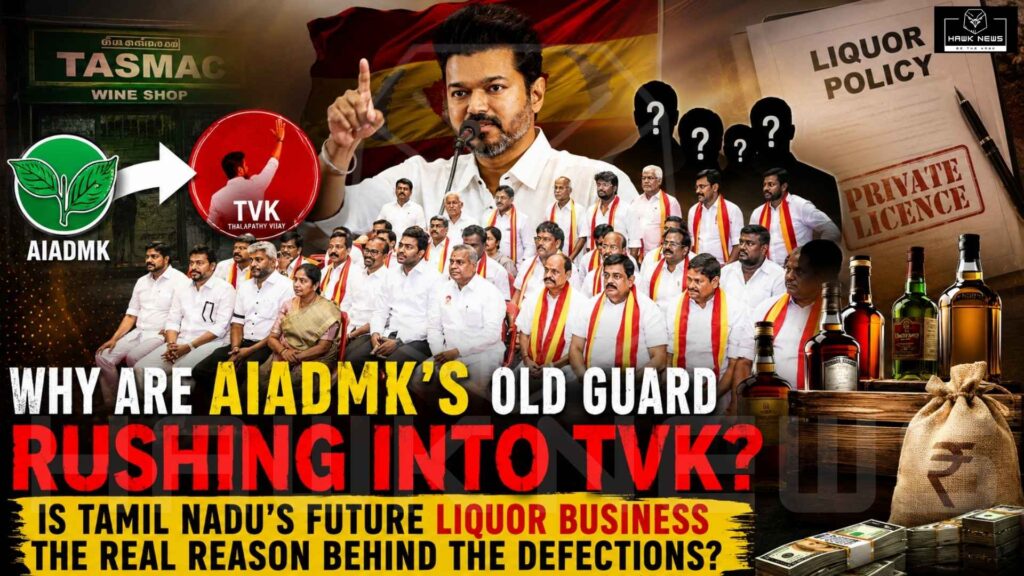
Tamil Nadu politics has been witnessing an interesting trend over the past several months. Former AIADMK MLAs, district-level functionaries, influential local leaders and long-time party loyalists have been steadily moving towards TVK. Publicly, most of these leaders have offered familiar explanations. Some speak about disappointment with AIADMK’s current direction, while others describe TVK as an emerging political force capable of reshaping the state’s future.
However, according to discussions taking place within certain political circles, another question continues to surface behind closed doors. Is there a deeper strategic calculation behind these defections that goes beyond ideology and electoral politics?
While no public evidence currently supports any specific explanation, political observers have begun speculating about whether some experienced politicians may be positioning themselves for opportunities they believe could emerge under a future political order.
Not All Political Defections Are Created Equal
Political defections are common in Tamil Nadu. Leaders frequently change parties when they sense shifting political winds or diminishing opportunities within their existing organizations. Yet the current movement towards TVK has attracted attention because many of the individuals making the switch are not first-time politicians searching for relevance.
Several of them have already occupied positions of influence. They understand government administration, power structures, business networks and the economic realities that often accompany political change. Such individuals are generally regarded as experienced operators who carefully assess future possibilities before making major political decisions.
For that reason, some political analysts believe it is worth examining whether the current defections are driven solely by ideology or whether broader strategic considerations may also be involved.
The Theory Being Quietly Discussed
Among certain political observers and insiders, an unverified theory has gradually gained attention. The theory suggests that some former AIADMK figures may be looking beyond immediate electoral politics and considering what economic opportunities could emerge if TVK eventually becomes a dominant governing force in Tamil Nadu.
One area frequently mentioned in these discussions is Tamil Nadu’s liquor sector.
It is important to emphasize that there is currently no publicly available evidence that the government intends to privatize TASMAC or return liquor retailing to private operators. The theory remains speculative and has not been substantiated through official announcements or documented policy proposals.
Nevertheless, according to discussions occurring within sections of the political community, some observers believe that long-term expectations regarding future economic opportunities could be influencing certain political calculations.
Whether those expectations are realistic or not remains an open question.
Understanding Tamil Nadu’s Liquor History
To understand why such speculation exists at all, it is necessary to revisit the history of liquor policy in Tamil Nadu.
Many younger voters have known only one system throughout most of their lives: government-controlled liquor sales through TASMAC. As a result, there is often an assumption that this arrangement has always existed.
The reality is considerably more complex.
Tamil Nadu’s liquor policy has undergone multiple transformations over several decades. The state experimented with prohibition, relaxed prohibition, reintroduced restrictions and repeatedly adjusted its approach depending on the political and economic priorities of successive governments.
Before the current TASMAC-dominated structure emerged, private participation played a far larger role in liquor retailing. During those years, liquor licenses were considered valuable commercial assets and often carried significant financial importance.
When Private Operators Controlled Retail Sales
Before the state assumed complete control over retail liquor sales, private operators were active participants in the sector. Liquor vending licenses, retail permissions and related business opportunities represented highly sought-after assets in many parts of Tamil Nadu.
Veteran political observers often recall that obtaining and maintaining such licenses required not only business capability but also strong administrative and political relationships. Local influence frequently became an important factor within the broader ecosystem surrounding liquor retailing.
Many senior politicians and businessmen who lived through that period continue to view the old licensing model as one of the most lucrative commercial environments that existed in Tamil Nadu.
Whether that perception is entirely accurate or partly shaped by nostalgia, it remains a significant part of the state’s political memory.
How TASMAC Changed the Landscape
The structure changed dramatically when the government expanded TASMAC’s role and eventually moved retail liquor sales under state control.
With the state becoming the dominant retail seller, the old private-license model largely disappeared. Instead of thousands of independent operators competing for retail opportunities, the government itself became the central player in the sector.
This transition fundamentally altered how money, influence and control flowed through the liquor business.
For more than two decades, Tamil Nadu’s liquor retail system has remained largely defined by this state-controlled model. As a result, an entire generation of voters has grown up without witnessing the private retail structure that existed earlier.
Why The Old System Still Matters Today
The relevance of this history lies in the fact that political actors often think years ahead.
Experienced politicians rarely focus only on current realities. They frequently evaluate where power may exist in the future and position themselves accordingly. This is one reason political observers continue discussing historical policy shifts even when no immediate reforms appear likely.
According to some analysts, memories of the old private-license era continue to influence how certain political and business figures think about future possibilities. The belief is not necessarily that change is imminent, but that political transitions can create entirely new opportunities over time.
This context helps explain why speculation surrounding future liquor policy occasionally resurfaces whenever major political realignments occur.
What Is Actually Known Today?
At present, the publicly available facts are relatively straightforward.
The government has publicly denied reports suggesting plans to privatize TASMAC. Recent policy actions have focused largely on regulating the existing system, including the closure of certain liquor outlets and discussions surrounding alcohol availability.
No official policy document currently indicates a move toward large-scale private retail liquor sales.
For that reason, any claim that privatization is imminent would be unsupported by available evidence.
This distinction is important because responsible political analysis must separate established facts from speculation and political theories.
Then Why Does The Speculation Continue?
Political speculation often survives because it is fueled by expectations rather than official announcements.
When large numbers of experienced politicians begin moving toward a particular party, observers naturally search for explanations beyond the public statements being offered. Some believe these leaders are simply aligning themselves with a rising political force. Others argue that long-term strategic considerations may be influencing their decisions.
The reality may ultimately be far less dramatic than either side suggests. Political survival, electoral calculations, local rivalries and personal ambitions can all play significant roles in shaping defections.
Yet the persistence of the discussion itself reveals something important about Tamil Nadu politics. Many people continue to view the liquor sector as one of the state’s most influential economic and political arenas.
The Unanswered Question
At this stage, no evidence proves that former AIADMK leaders are joining TVK because of expectations surrounding future liquor policy. Such claims remain speculative and should be treated accordingly.
However, the history of Tamil Nadu demonstrates that liquor policy has never been merely an administrative issue. For decades, it has intersected with revenue generation, political influence, business interests and government power.
As more familiar AIADMK faces continue appearing within TVK’s ranks, political observers are likely to keep asking questions about the motivations behind those decisions.
Whether the answer lies in ideology, political opportunity, electoral survival or expectations about future economic possibilities remains unknown.
But until those questions are convincingly answered, the debate surrounding the real reasons behind these defections is unlikely to disappear from Tamil Nadu’s political conversation.